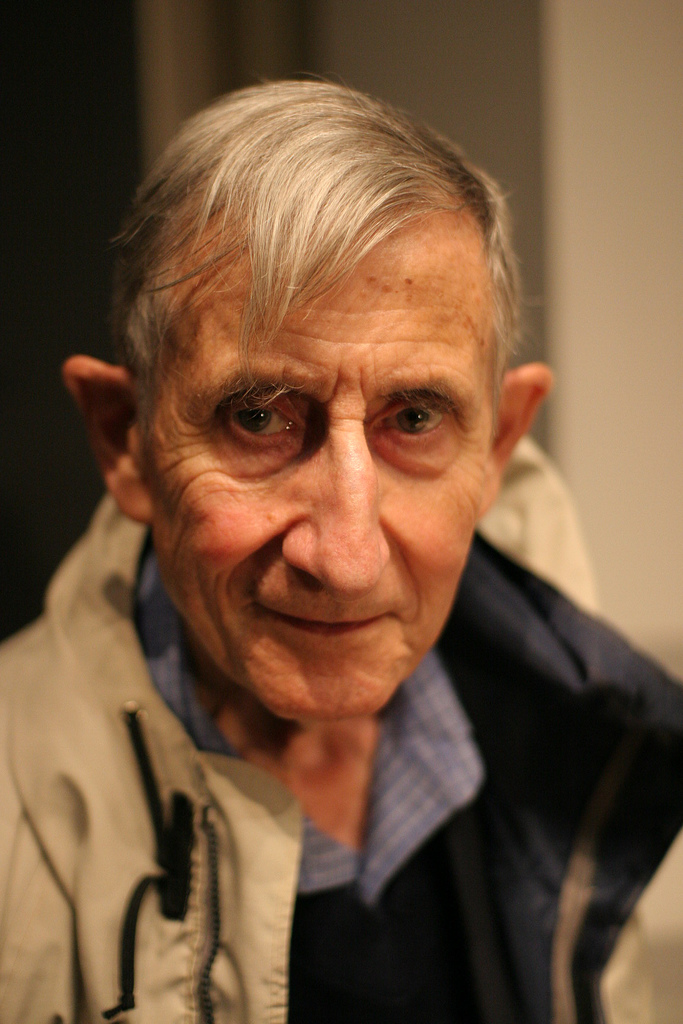

Photo: Jacob Appelbaum (Flickr: ioerror), Long Now Foundation seminar, 5 October 2005, CC BY-SA 2.0 · Wikimedia Commons, 'Freeman Dyson.jpg' -- photograph by Jacob Appelbaum (Flickr user ioerror) at a Long Now Foundation seminar, San Francisco, 5 October 2005; original Commons file 683 x 1024 pixels, saved unchanged (no scaling); the Commons page records an automated Flickr licence review ('FlickreviewR' pass, 1 April 2008) for CC BY-SA 2.0; the Flickr page itself could not be opened (HTTP 403) so the review record on Commons is the verification; no conflicting notice was found in the IAS or AIP pages read (the AIP Emilio Segre Visual Archives group photograph of 1979 was seen but not used). · CC BY-SA 2.0
물리학자 · 20세기
프리먼 다이슨
1923–2020
주요 업적 분야
아직 성격 매칭에 포함되지 않았습니다 — 기록된 근거가 성격 모델 전체를 다루기에는 충분하지 않습니다. 이 페이지의 다른 모든 내용은 자유롭게 확인하실 수 있습니다.
핵심 특성
주요 업적
1949년 그는 양자전기역학을 다룬 두 경쟁 이론, 곧 도모나가·슈윙거의 이론과 파인만의 이론이 수학적으로 동등함을 보였고, 이로써 물리학자들이 파인만 도형을 계산에 쓸 수 있게 되었다.
그는 양자전기역학 밖에서도 TRIGA 연구용 원자로 설계에 참여했고, 무작위 행렬과 물질의 안정성을 연구했으며, 1960년에는 별을 둘러싼 구조물이 내는 적외선으로 고도 문명을 찾자고 제안했다. 이 구조물은 훗날 다이슨 구로 불렸다.
1970년대부터 그는 일반 독자를 위한 책과 에세이를 썼고, 《우주를 어지럽히다》(1979)와 1984년 전미도서비평가협회상 논픽션 부문을 받은 《무기와 희망》이 대표작이다.
삶의 장면들
1948년 혼자 버스를 타고 프린스턴으로 가던 길에, 파인만과 슈윙거의 방법을 몇 달 동안 파고든 끝에 두 이론이 동등함을 알아냈고, 훗날 이를 번뜩이는 깨달음이라고 불렀다.
이는 어려운 두 형식 체계를 함께 붙들고 그 관계를 증명해 내는 능력과 부합한다. 분석적 엄밀성
동료 윌리엄 프레스가 반복 죄수의 딜레마에 관한 문제를 내놓자 다이슨은 이튿날 답을 보냈고, 두 사람은 2012년에 많이 인용되는 논문을 함께 발표했다.
이는 관심을 끄는 문제에 대해 짧고 과제 중심으로 협업하는 양상과 부합한다. 협업 성향
전환점
1975년 그는 늙으면 책을 써야 한다는 G. H. 하디의 조언에 따라 책을 쓰기로 결심했고, 정리 증명은 점차 줄고 저서는 늘어 갔다.
이는 가장 창조적이라고 느끼는 일을 향해 스스로 경력의 방향을 정하려는 성향과 부합한다. 자율성 욕구
비슷한 인물
전체적인 프로필이 이 사람과 닮은 사람들이에요.


에이다 러브레이스

레오나르도 다빈치

세쿼야

카를 융

힐데가르트 폰 빙엔
출처
- Freeman Dyson (Q153717) -- verified live via the Wikidata API (2026-10-11): English label 'Freeman Dyson', description 'theoretical physicist and mathematician (1923-2020)', born 15 December 1923, died 28 February 2020, Korean label present. Orientation only; not used as support for any row.
- Institute for Advanced Study, 'Freeman J. Dyson (1923-2020), Scientist and Writer, Who Dreamt Among the Stars, Dies at 96' (IAS obituary of 28 February 2020 with tributes by Dijkgraaf, Witten, Simonyi and Simons; read as reproduced by the MacTutor History of Mathematics archive, because the IAS's own page returned an access error) -- CANONICAL SIGNIFICANCE SOURCE: the 1949 paper showing that the Tomonaga-Schwinger and Feynman formulations of quantum electrodynamics are equivalent, the work with Bethe and Feynman at Cornell, his permanent IAS faculty appointment from 1953, and his later work in many fields and as a writer. An institutional house obituary, so admiring in tone; read in full.
- Robbert Dijkgraaf (Director of the Institute for Advanced Study), 'Freeman J. Dyson 1923-2020: Legendary physicist, writer, and fearless intellectual explorer', Proceedings of the National Academy of Sciences, 16 June 2020 -- tribute by the head of his home institution. Notes his jumping between fields by his own account of a short attention span, being an 'eternal graduate student' with no doctorate, his friendships with people who disagreed with him, and his 1970s climate-model work and later skepticism described briefly. Read in full; an admiring institutional tribute.
- MacTutor History of Mathematics (University of St Andrews), 'Freeman John Dyson' biography -- scholarly secondary biography including the Taylor and Bethe letters of reference, the 1948-49 QED papers, his mathematics published alongside physics, Gibbs lecture 'Missed Opportunities' and 'Unfashionable Pursuits', and reviewers' summaries of his selected papers. Read in full; its paragraphs on his marriage, children and family were not used.
- Patrick Das Gupta (University of Delhi), 'F. J. Dyson: The Man who would make Patterns and Disturb the Universe', Resonance 25(10), 2020 (arXiv:2010.07767) -- independent physicist's scientific obituary. Explains the 1949 paper unifying the Tomonaga-Schwinger operator formalism with Feynman's space-time approach, G. I. Taylor's reference calling him 'the best mathematician in England', the 1948 Lamb-shift calculation and the later speculative ideas. Read through the QED section and introduction; later technical sections were skimmed, not checked.
- Phillip F. Schewe, obituary 'Freeman Dyson', Nature 579, 342 (19 March 2020) -- obituary by his biographer. Lists QED, the intrinsically safe nuclear reactor, field theory in condensed-matter physics, random matrices, the stability of matter and the infrared search for extraterrestrial civilisations, notes his 'intellectual restlessness', that he 'avoided collaboration, saying that he needed the freedom to vary his interests', and his contrarian climate views. Read in full; his biographer's book Maverick Genius was not opened.
- Andrea Stone, 'Freeman Dyson, legendary theoretical physicist, dies at 96', National Geographic, 28 February 2020 -- independent news obituary quoting science-communication scholar Declan Fahy and physicist Virginia Trimble. Reports that he 'did not propose radical new ideas' but cleaned up the details of the quantum revolution's theories, that he never completed a doctorate and called the Ph.D. system 'an abomination', the TRIGA reactor, and that his climate stance came to define him publicly. Read in full; its family details were not used.
- Quanta Magazine, 'A Rebel Without a Ph.D.', 26 March 2014 -- magazine profile and interview conducted days after his 90th birthday. Independent framing by the magazine and by colleague William Press (the 2012 Press-Dyson iterated prisoner's dilemma paper, a problem Dyson answered the next day), plus Dyson's own answers (SELF material: 'I'm not a person for big questions. I look for puzzles'; that he translated Feynman's ideas into mathematics). Read in full; the self statements are used only for how he describes his own approach, never as sole support.
- Graham Farmelo (physicist-biographer), 'Freeman Dyson', remembrance, 2 March 2020 (grahamfarmelo.com) -- first-person account by a biographer who lunched with Dyson over fifteen years. Describes a quiet, direct man who offered a counter-orthodox opinion in every conversation, who agreed 'there is some truth' in the Princeton remark that he would rather be interesting than right, who would not back down under criticism of his climate-model views, his published essays and the Oppenheimer quarrel (he reports Dyson saying he told Oppenheimer he thought him a narrow-minded snob). A single biographer's recollection of Dyson's own statements, so one perspective; the very private statements about hating or admiring individuals were not used as trait evidence.
- Lawrence Krauss, 'Freeman Dyson', Inference: International Review of Science 5(2), May 2020 (written as 'In Praise of a Great Contrarian') -- tribute from a physicist colleague who disagreed with him on climate and cosmic futurology. Reports lunches at the Institute for Advanced Study, that he 'never really wanted to be a member of any club who would have him', his decision at fifty to write books, Weinberg's remark that when consensus forms 'like ice hardening on a lake, Dyson will do his best to chip at the ice', and Krauss's view that his climate claims were mistaken. Read in full; a friendly critic.
- Hamish Johnston, review of David Kaiser (ed.), 'Well, Doc, You're In: Freeman Dyson's Journey through the Universe', Physics World, 16 May 2023 -- independent review of a ten-author multi-chapter biography. Describes the Cornell and IAS years, General Atomics and the TRIGA reactor, Project Orion, the origin-of-life 'metabolism-first' view, the Dyson sphere, and the trajectory of his climate position over 50 years. Read in full; the book itself was not opened.