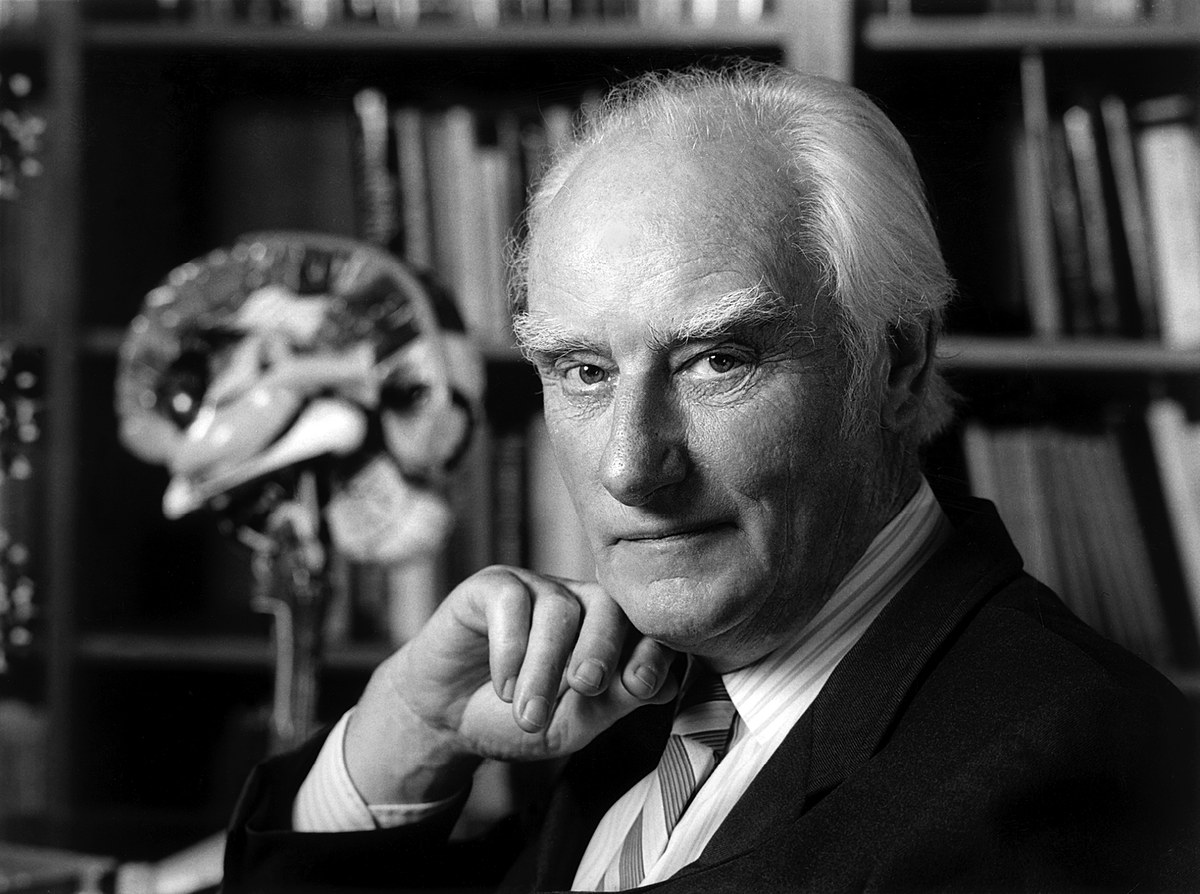
Photo: Marc Lieberman, via Siegel RM and Callaway EM, PLoS Biology 2004, CC BY 2.5 · Wikimedia Commons, 'Francis Crick.png' -- photograph credited to Marc Lieberman showing Crick in his office with a brain model behind him; first published in Siegel and Callaway, PLoS Biology 2(12):e419 (2004), an open-access article under the Creative Commons Attribution licence; original Commons file 3000 x 2236 pixels (greyscale PNG), converted to JPEG and downscaled once to 1200 x 894 (never upscaled). · CC BY 2.5
생물학자 · 20세기
프랜시스 크릭
1916–2004
주요 업적 분야
아직 성격 매칭에 포함되지 않았습니다 — 기록된 근거가 성격 모델 전체를 다루기에는 충분하지 않습니다. 이 페이지의 다른 모든 내용은 자유롭게 확인하실 수 있습니다.
핵심 특성
주요 업적
1953년 그는 제임스 왓슨과 함께 DNA의 이중나선 구조를 제안했고, 짝을 이루는 염기쌍은 유전자가 어떻게 복제되는지를 설명해 주었다.
1955~58년 그는 어댑터 가설, 서열 가설, 분자생물학의 중심 원리를 내놓아 유전 정보가 단백질로 이어지는 흐름을 정리했다.
1961년 시드니 브레너 등과 함께 DNA 염기 세 개가 아미노산 하나를 지정함을 보였고, 1977년부터는 솔크 연구소에서 뇌와 의식을 연구했다.
삶의 장면들
1986년 샌디에이고의 한 만찬에서 그는 올리버 색스를 옆자리에 앉히고 '이야기를 들려주시오!'라고 했고, 환자 이야기가 나올 때마다 가설과 검증 방법을 쏟아냈다.
다른 사람의 관찰을 새로운 가설의 재료로 삼는 과학자의 태도와 일치한다. 호기심
전달 RNA가 발견되었을 때 그는 그것이 자신이 예측한 어댑터라고 믿지 않았다. 예상보다 크기가 컸기 때문이며, 아미노산마다 서로 다른 어댑터 스무 종이 있을 것이라고 주장했다.
새로운 증거가 자신의 예측과 느슨하게만 맞아도 예측의 구체적 형태를 고수하는 태도와 일치하지만, 이후 실험은 그가 내다본 어댑터와 효소를 확인해 주었다. 입장 수정 성향
전환점
1947년 그는 물리학 기반의 해군성 전시 연구를 떠나 생물학 공부를 시작했다. 노벨재단의 표현으로는 당시 생물학을 전혀, 유기화학과 결정학도 거의 알지 못하던 때였다.
새로운 분야에서 처음부터 다시 배우기를 마다하지 않는 연구자라는 점과 일치한다. 숙련 지향
비슷한 인물
전체적인 프로필이 이 사람과 닮은 사람들이에요.
출처
- Francis Crick (Q123280) -- verified live via the Wikidata API (2026-10-10): English label 'Francis Crick', description 'British molecular biologist, biophysicist, neuroscientist; co-discoverer of the structure of DNA (1916-2004)', born 8 June 1916, died 28 July 2004, Korean label present. Orientation only; not used as support for any row.
- Nobel Foundation, 'Francis Crick - Biographical', Nobel Prize in Physiology or Medicine 1962 (nobelprize.org; text written at the time of the award) -- institutional career record: physics degree, wartime Admiralty mine work, the 1947 move to biology with, in the text's words, no biology and practically no organic chemistry or crystallography, the helix diffraction theory, the 1953 DNA structure, and the later adaptor hypothesis and genetic-code work with Brenner. Work record only; family paragraph not used. Read in full.
- U.S. National Library of Medicine, Profiles in Science: Francis Crick Papers -- three scholarly essays: 'The Discovery of the Double Helix, 1951-1953', 'Defining the Genetic Coding Problem, 1954-1957' and 'From Molecular Biology to Neurobiology, 1976-2004'. INDEPENDENT institutional archive narrative drawing on the papers; includes the adaptor hypothesis circulated in the RNA Tie Club, the central dogma, the move to the Salk Institute, his stated skepticism of behaviorist approaches, his own admission that he had not produced a novel convincing theory in neurobiology, and the controversy over the use of Rosalind Franklin's data. Read in full; the 'Deciphering the Genetic Code' and 'Embryology' essays were not opened.
- Koji Tamura, 'The Genetic Code: Francis Crick's Legacy and Beyond', editorial, Life (Basel) 6(3):36, 25 August 2016 (open access via PubMed Central) -- scholarly centenary editorial by a tRNA researcher. Describes his collaborations with Watson, Brenner, Orgel and Koch, his adaptor hypothesis and central dogma, his initial refusal to accept that tRNA was the adaptor because of its size, the 1961 triplet-code paper, and his 'frozen accident' view with room left for stereochemical interactions. Admiring in tone but specific and dated; Tamura's cited quotations of others (the 'conductor' and 'nuclear reactor' phrases) were used only where the original source was also read. Read in full.
- Oliver Sacks, 'Remembering Francis Crick', The New York Review of Books, 24 March 2005 -- PEER witness and correspondent: a neurologist's first-hand account of Crick's 1962 talk on the triplet code, a 1986 dinner at which Crick demanded stories and generated hypotheses from each, and a 1987-88 exchange of long, prompt, detailed letters on a colour-blind patient, in which Crick consulted other vision scientists and pushed for scans and psychophysics. Admiring; used for dated, concrete scenes only. Read in full to the point of the letters; the final sections were skimmed.
- Matthew Cobb and Nathaniel Comfort, 'What Rosalind Franklin truly contributed to the discovery of DNA's structure', Nature, 25 April 2023 -- INDEPENDENT modern historians (each writing a biography, Cobb of Crick) re-examining the 1953 discovery from Franklin's archive and Crick's own notes and interviews. Reports that Watson and Crick solved the structure by six weeks of trial-and-error model building and then used the King's College data, without permission, to confirm it; that Crick said he was glad he had not seen Franklin's data earlier; and that Franklin worked without a peer to exchange ideas with. Used as a counter-balance to the popular account, and for his working method. Read in full to the section on what Franklin did; the closing paragraphs were skimmed.
- Helen Pilcher, 'Francis Crick', Nature News, 29 July 2004 (reprinted by BioEd Online, Baylor College of Medicine) -- obituary report noting his switch from physics to biology after the war, the 1962 Nobel Prize shared with Watson and Wilkins, his work on the genetic code, and his turn to consciousness at the Salk Institute, where he championed the idea that aspects of consciousness correlate with specific brain changes. A tribute quote from Watson is in the piece and was not used. Read in full.
- Siegel RM and Callaway EM, 'Francis Crick's Legacy for Neuroscience: Between the alpha and the Omega', PLoS Biology 2(12):e419, 2004 (open access, CC BY) -- the publication in which the portrait photograph (credited to Marc Lieberman) appeared; used only to check the portrait's licence and credit. Not used for scoring.