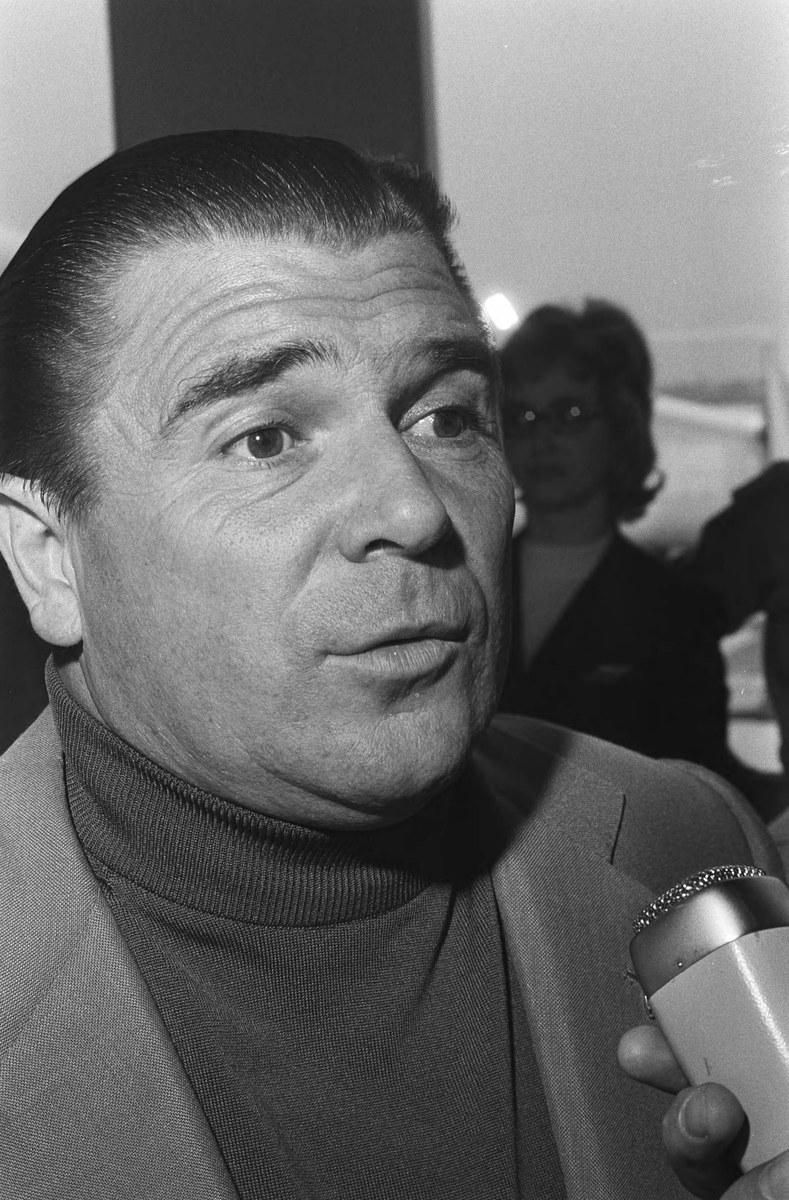
Photo: Anefo (unknown photographer), 4 May 1971, Nationaal Archief, CC0, resized from the original · Black-and-white press photograph of Ferenc Puskas on his arrival at Amsterdam-Schiphol airport as coach of the Greek club Panathinaikos, 4 May 1971, by an unknown photographer for Anefo; Nationaal Archief (Dutch National Archives), Fotocollectie Anefo, file number 924-5181, series 'Aankomst van Ferenc Puskas, trainer van de Griekse voetbalclub' (permanent link hdl.handle.net/10648/abbde3be-d0b4-102d-bcf8-003048976d84). Rights review: the live archive record (opened 2026-11-05) gives the photographer as 'Fotograaf Onbekend / Anefo', the date 1971-05-04, the person keyword 'Puskas, Ferenc', the organisation 'Panathinaikos' and the rights holder as 'Nationaal Archief, CC0'; the archive's own original file is a normal portrait frame (not a failed shot) with the same 2399 x 3650 pixel dimensions as the Commons copy, and the Commons file page also states CC0. The sitter is identified by the archive title and person keyword; the frame carries no lettering. Original 2399 x 3650 pixels, downscaled to 789 x 1200 (no cropping, never upscaled). · CC0 1.0 (public domain dedication by the Nationaal Archief)
운동선수 · 20세기
푸슈카시 페렌츠
1927–2006
주요 업적 분야
아직 성격 매칭에 포함되지 않았습니다 — 기록된 근거가 성격 모델 전체를 다루기에는 충분하지 않습니다. 이 페이지의 다른 모든 내용은 자유롭게 확인하실 수 있습니다.
핵심 특성
주요 업적
1950년대 헝가리 '황금 세대' 대표팀의 주장이자 공격수로, A매치 84경기 83골(자료마다 수치가 조금 다르다)을 넣었고 1952년 올림픽 축구 금메달, 1953년 웸블리 6-3 승리에서 2골, 1954년 월드컵 결승 진출과 대회 최우수선수 선정을 이뤘다.
2년간의 출전 정지 끝에 31세에 레알 마드리드에 입단해 알프레도 디 스테파노와 함께 유러피언컵 3회(1959, 1960, 1966)와 리그 5회 우승을 이뤘고, 1960년 아인트라흐트 프랑크푸르트와의 결승(7-3 승)에서 4골을 넣었다.
은퇴 후 여러 나라의 클럽과 대표팀을 지도했으며, 가장 큰 성과는 파나티나이코스를 1971년 유러피언컵 결승(아약스에 0-2 패)과 그리스 리그 2회 우승으로 이끈 것이다. FIFA는 훗날 연간 최우수 골 상에 그의 이름을 붙였다.
삶의 장면들
레알 마드리드 첫 시즌 마지막 경기에서 디 스테파노와 득점왕 동률이던 그는 골키퍼를 제친 뒤 직접 넣는 대신 빈 골문 앞으로 패스해 디 스테파노가 득점하게 했다고 한 축구사 기사는 전한다.
이는 파트너의 스타 위상을 받아들이고 자기 득점보다 팀의 호흡을 앞세운 공격수의 면모와 일치한다. 협업 성향
31세에 컨디션이 떨어진 채 레알 마드리드에 왔을 때 팬들은 그를 나이 들고 살찐 선수로 여겼으나, 그는 정원에 플라스틱 고리를 매달아 놓고 공을 통과시키는 슛 연습을 몇 시간씩 했다고 전해진다.
이는 체력에 대한 의심에 목적 있는 반복 연습으로 답한 선수의 면모와 일치한다. 숙련 지향
전환점
2년간의 출전 정지를 마친 그는 1958년 31세에 레알 마드리드와 계약해 디 스테파노 곁의 공격수로 스페인에서 선수 생활을 새로 일으켰고, 이후 스페인 대표로 뛰었으며 은퇴 후에는 해외에서 지도자로 일했다.
이는 앞선 경력이 끊긴 뒤 새로운 나라와 클럽, 역할에 적응해 간 사람의 면모와 일치한다. 적응력
비슷한 인물
전체적인 프로필이 이 사람과 닮은 사람들이에요.
출처
- Ferenc Puskás (Q482931), verified live via the Wikidata API (2026-11-05): English label 'Ferenc Puskás', description 'Hungarian association football player (1927-2006)', Korean label 푸슈카시 페렌츠, born 1 April 1927, died 17 November 2006, citizenship Hungary and Spain. Orientation only; not used as support for any row.
- Olympedia (Olympic historians' athlete database), biography of Ferenc Puskas, read in full. CANONICAL SIGNIFICANCE SOURCE: front man of the 'Mighty Magyars' of the 1950s, 1952 Olympic football champion and 1954 World Cup finalist (he scored the first goal in the 3-2 loss to West Germany), later three European Cups with Real Madrid (1959, 1960, 1966), Spanish citizenship and a 1962 World Cup appearance for Spain, then coaching in nine countries with his biggest success at Panathinaikos (1971 European Cup final, two league titles) and further league titles with AEK Athens, Sol de America and South Melbourne Hellas; the Hungarian national stadium was renamed for him in 2002. Reference database written by Olympic historians; it counts 85 internationals and 84 goals where press obituaries count 84 and 83.
- The Scotsman, obituary 'Ferenc Puskas' (November 2006), read in full: left-footed forward with a low centre of gravity whose 'attention to practice' produced exceptional ball control; overweight during his prime but built a method that played to his strengths; made the Kispest first team at 16; the 1953 6-3 win at Wembley and the drag-back on Billy Wright; the 1954 World Cup final, in which he returned from injury 'clearly short of fitness', scored and had an equaliser ruled offside; the two-year ban, exile in Milan and Real Madrid career (1959 European Cup, four goals in the 1960 final against Eintracht Frankfurt); retired from playing about 40; coached around the world, most successfully Panathinaikos to the 1971 European Cup final. Newspaper obituary, admiring; some figures differ from other sources (it gives 84 goals in 85 internationals and a 2 April birth date).
- The Irish Times, 'The best player of his generation' (obituary, November 2006), read in full: Honved and Real Madrid goalscoring figures; international record of 83 goals in 84 games that stood until 2003; Olympic gold in 1952; first cap at 17 with a goal on debut against Austria; the Di Stefano partnership and the 7-3 win over Eintracht Frankfurt in 1960; coached Panathinaikos to the 1971 European Cup final; compared in physique and style with Maradona and in scoring with Pele; a former neighbour recalls him as down to earth. Wire-style obituary, admiring.
- Real Madrid C.F. official website, 'Ferenc Puskas Biro' (history and honours page), read in full: he arrived at 31 after Honved; Spanish fans thought the 'old and overweight man' out of his depth and 'soon discovered they were mistaken'; his goalscoring was essential to three European Cups and five league titles; the club describes his gentlemanliness, charm and friendliness; FIFA named its best-goal award after him. Club page, celebratory.
- FIFA.com, 'The beginning of the Magyars' magic' (feature on the start of Hungary's 31-match unbeaten run), read in full: Puskas is the team's 'captain and star striker' with 83 goals in 84 internationals; his own remark that the team were 'the prototype for Total Football' and 'when we attacked, everyone attacked'; Hidegkuti's, Sebes's and an England player's tributes; the 1952 Olympic title, the 1953 Wembley win, the 1954 World Cup route and the final defeat. Governing-body feature; the teammate and opponent quotes are tributes, the Puskas quotes are self-report.
- Hungary Today, 'Ferenc Puskas, One of the Greatest Footballers of All Time, Died 15 Years Ago' (17 November 2021), read in full: 83 goals in 84 internationals, 1952 Olympic champion, two goals in the 'Match of the Century' at Wembley, named best player of the 1954 World Cup, three European Cups with Real Madrid, four caps for Spain, and later management of Panathinaikos, Colo-Colo, Saudi Arabia, AEK Athens and, finally, Hungary; the Hungarian national stadium bears his name. Hungarian news site, retrospective and admiring.
- These Football Times, 'How Alfredo Di Stefano and Ferenc Puskas became football's most prolific partnership' (27 August 2018), read in full: his weight on arrival at Madrid at 31 (his reported remark 'I can't play. I'm too fat'), the plastic rings he hung in his garden to practise shooting for hours, his deference to Di Stefano as the star (including passing across an open goal for Di Stefano in the last game of the first season), the four goals in the 1960 final and his later three-goal final in 1962; also reports that he told France Football that the 1954 German team had been doped, later retracted. Independent football-history writer, a feature rather than a primary account; the anecdotes are unsourced in the article, so they are corroborated only in general terms by the club page and obituaries.
- UEFA.com, 'Panathinaikos class of '71 get their due' (feature, read via a web reader), read in full: Puskas arrived at Panathinaikos in 1970 and had an immediate impact; striker Antonis Antoniadis says 'He instilled hope in us' and credits him with improving the players mentally; he spoke little before matches and expected players to prepare properly; before the final he said 'Go out there, play your football and enjoy the game!'; Panathinaikos beat Jeunesse Esch, Slovan Bratislava, Everton and Red Star Belgrade (on away goals after a 4-1 loss) and lost the 1971 Wembley final 2-0 to Ajax. Governing-body feature built on one player's recollections.
- RSSSF (Rec.Sport.Soccer Statistics Foundation) archive page 'Puskas' (compiled from 1990-1994 rec.sport.soccer discussion posts), read in full: career outline including coaching posts in the United States, Canada, Greece, Saudi Arabia, Chile, Australia and an interim role with Hungary in 1993; and, in one post, quotations from Brian Glanville's 'The History of the World Cup' that Puskas was kicked in the group match against West Germany, that whether he would play the final was the 'great question' and that his playing was 'a manifest mistake, a testimony to the captain's own powers of persuasion rather than the good sense' of the coaches. Volunteer-compiled Usenet material: the Glanville passages are second-hand (the book was not opened) and several details in the compilation are loosely worded; used only as a critical voice, not for facts.
- Panathinaikos FC official website, '55 years since Wembley's epic era' (club history page), read in full: the club's own account of the 1970-71 European Cup run under 'Ferenc Puskas' great Panathinaikos', the first and so far only Greek team in a European Cup final, losing 2-0 to Ajax. Club page, celebratory; used for the coaching achievement only.