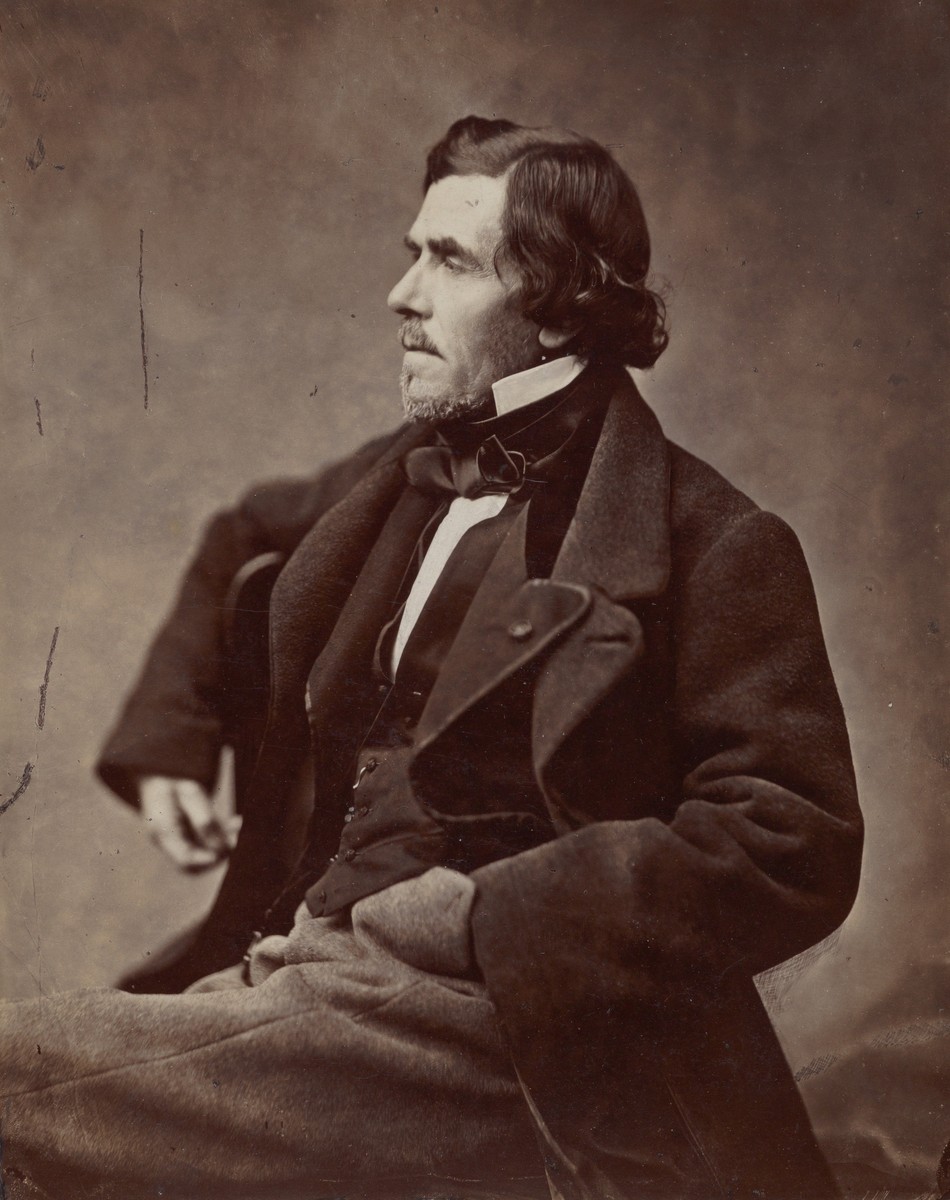

Pierre Petit, Portrait of Delacroix, about 1862, albumen print, The Metropolitan Museum of Art, New York (2024.591.45), public domain · Albumen print 'Portrait of Delacroix' by Pierre Petit (1832-1909), about 1862, Metropolitan Museum of Art, New York, object 2024.591.45 (Gift from the Karen B. Cohen Collection of Eugene Delacroix, 2024); the museum's Open Access record marks it public domain. The sitter is named by the museum. The museum scan (3054 x 4000 pixels) shows the photograph on its card mount; this project cropped to the photograph (1764 x 2228 pixels) and reduced it to 950 x 1200 pixels, never enlarging it · Public Domain (Metropolitan Museum Open Access; photograph by Pierre Petit, who died in 1909)
화가 · 19세기
외젠 들라크루아
1798–1863
주요 업적 분야
아직 성격 매칭에 포함되지 않았습니다 — 기록된 근거가 성격 모델 전체를 다루기에는 충분하지 않습니다. 이 페이지의 다른 모든 내용은 자유롭게 확인하실 수 있습니다.
핵심 특성
주요 업적
1822년 살롱에 출품한 '지옥의 단테와 베르길리우스'로 데뷔한 뒤 '키오스섬의 학살', '사르다나팔루스의 죽음', '민중을 이끄는 자유의 여신' 등을 통해 강렬한 색채와 움직임으로 아카데미 전통에 맞서며 프랑스 낭만주의 회화를 대표하는 화가가 되었다.
팔레 부르봉, 뤽상부르 도서관, 루브르 아폴롱 갤러리 천장화, 생쉴피스 성당의 천사 예배당(1849~1861) 등 파리 공공건물의 대규모 장식화를 그렸다.
1832년 모로코 여행에서 얻은 스케치와 기록은 수십 년 동안 그의 작업의 바탕이 되었고, 그의 색채와 일기는 후대 화가들에게 참고가 되었다. 한 전시 리뷰는 세잔이 모두가 들라크루아의 언어로 그린다고 말했다고 전한다.
삶의 장면들
1857년 1월, 여러 번 낙선한 끝에 일곱 번째 도전에서 미술 아카데미 회원으로 선출되었다.
이는 거듭된 거절 속에서도 목표를 이어간 끈기 있는 면모와 부합한다. 끈기
1832년 모로코 사절단에 동행한 뒤 스케치북과 기록을 가득 채웠고, 이후 '알제의 여인들' 같은 이전 구도를 다시 다루며 오랫동안 이를 활용했다.
이는 본 것을 저장해 두고 다시 꺼내 쓰는 호기심 많은 관찰자의 면모와 부합한다. 호기심
전환점
1822년 살롱에 출품한 '지옥의 단테와 베르길리우스'가 곧바로 비평계의 주목을 받으면서 스물네 살의 그는 낭만주의 운동의 주요 인물로 떠올랐다.
이는 아카데미의 관행에서 벗어난 독창적 접근이 곧바로 주목받았음을 보여주는 것과 부합한다. 창의적 독창성
비슷한 인물
전체적인 프로필이 이 사람과 닮은 사람들이에요.
출처
- Eugène Delacroix (Q33477), verified live via the Wikidata API (2026-11-04): English label 'Eugène Delacroix', description 'French painter (1798-1863)', born 1798-04-26, died 1863-08-13, Korean label present. Orientation only; not used as support for any row.
- The Metropolitan Museum of Art, New York, object 2024.591.45 'Portrait of Delacroix', albumen print by Pierre Petit, about 1862 (Gift from the Karen B. Cohen Collection of Eugène Delacroix, 2024), record read through the museum's Open Access API (public domain flag true, no reproduction restriction). Used only for the portrait; not used as support for any row.
- Musée national Eugène-Delacroix, Paris, 'Eugène Delacroix - Biography', read in full: dated account of his training under Guérin from 1815, the 1822 Salon debut with Dante and Virgil in Hell, the 1824 Massacre at Scio, the 1827 Death of Sardanapalus, the 1831 Liberty Leading the People, the 1832 Moroccan mission (more than 72 later Moroccan paintings), the mural commissions at the Palais Bourbon, the Luxembourg library, the Louvre Galerie d'Apollon and the Saint-Sulpice chapel (1849-1861), the 1855 special exhibition, and election to the Académie des Beaux-Arts in January 1857 on his seventh attempt. CANONICAL SIGNIFICANCE SOURCE (together with the National Gallery artist page). Museum devoted to him, so favourable.
- The National Gallery, London, artist page 'Eugène Delacroix', read in full: calls him the leading exponent of Romanticism in French painting; trained under Guérin, first exhibited at the Salon in 1822, visited England in 1825, travelled to Spain, Morocco and Algiers in 1832, received a long series of official decorative commissions from 1833, last exhibited at the Salon in 1859. CANONICAL SIGNIFICANCE SOURCE.
- Museo Nacional Thyssen-Bornemisza, Madrid, biography page 'Eugène Delacroix', read in full: grew up in a cultured family, copied Raphael, Titian, Veronese and Rubens at the Louvre, encountered English collections, Byron, Scott, Shakespeare and Goethe's Faust in 1825, made sketches and notes in Morocco and Spain that fed later compositions, turned to decorative schemes in his mature phase, and was kept away from Paris by chronic laryngitis.
- Charles Baudelaire, 'L'Oeuvre et la vie d'Eugène Delacroix' (1863, in French), read in full on Wikisource (1885 edition text): a contemporary and admirer's account of his daily regime (a careful palette, hesitation before starting, then working until physically exhausted), evening drawing and copying, his reading of Shakespeare, Dante, Byron and Ariosto, his output (about 236 easel works and 77 major Salon subjects, citing Silvestre), his mural commissions, and the hostility of critics and slow sales. Written days after his death by a friend; admiring, and the main early source for his work habits.
- 'A Romantic of Endless Industry', The Christian Science Monitor, 22 July 1991, read in full: exhibition feature describing him as a man of endless industry who copied in the Louvre as a student, kept a journal from the age of 24, drew horses and big cats from Paris menageries and stables as well as from his Moroccan sketchbooks, noted small visual details such as a stirrup's shadow on a horse's flank, and held state mural commissions from the Palais Bourbon onward; says critics were unkind and that he entered the Academy only after seven rejected applications (it gives 1859 for the election, whereas the museum's biography gives January 1857, so the museum's date is used).
- Review of 'Delacroix and the Rise of Modern Art' (National Gallery, London, 2016) and its catalogue, 19th-Century Art Worldwide, spring 2016, read in full: a scholarly review stating that contemporaries almost universally named him leader of French Romanticism, that colour was his defining strength, that he worked in glazes and interwoven strokes, copied old masters, reworked earlier compositions (Women of Algiers 1847-49 from 1834), and was versatile across large pictures, murals, lithographs and watercolours, and that later artists from Manet to Cezanne drew on him through copying, collecting and his posthumously published journals.
- 'Eugene Delacroix and the Rise of Modern Art' exhibition review, Studio International, London, read in full: a critical review that describes him as equally criticised and revered in his own time, quotes his statement that he had been a Romantic since 15 because of his dislike of academic recipes, notes that he resisted leadership of any school, and doubts that his direct influence on Gauguin, Cezanne, Kandinsky or Matisse is as large as the exhibition claimed. COUNTER-VOICE on influence claims.