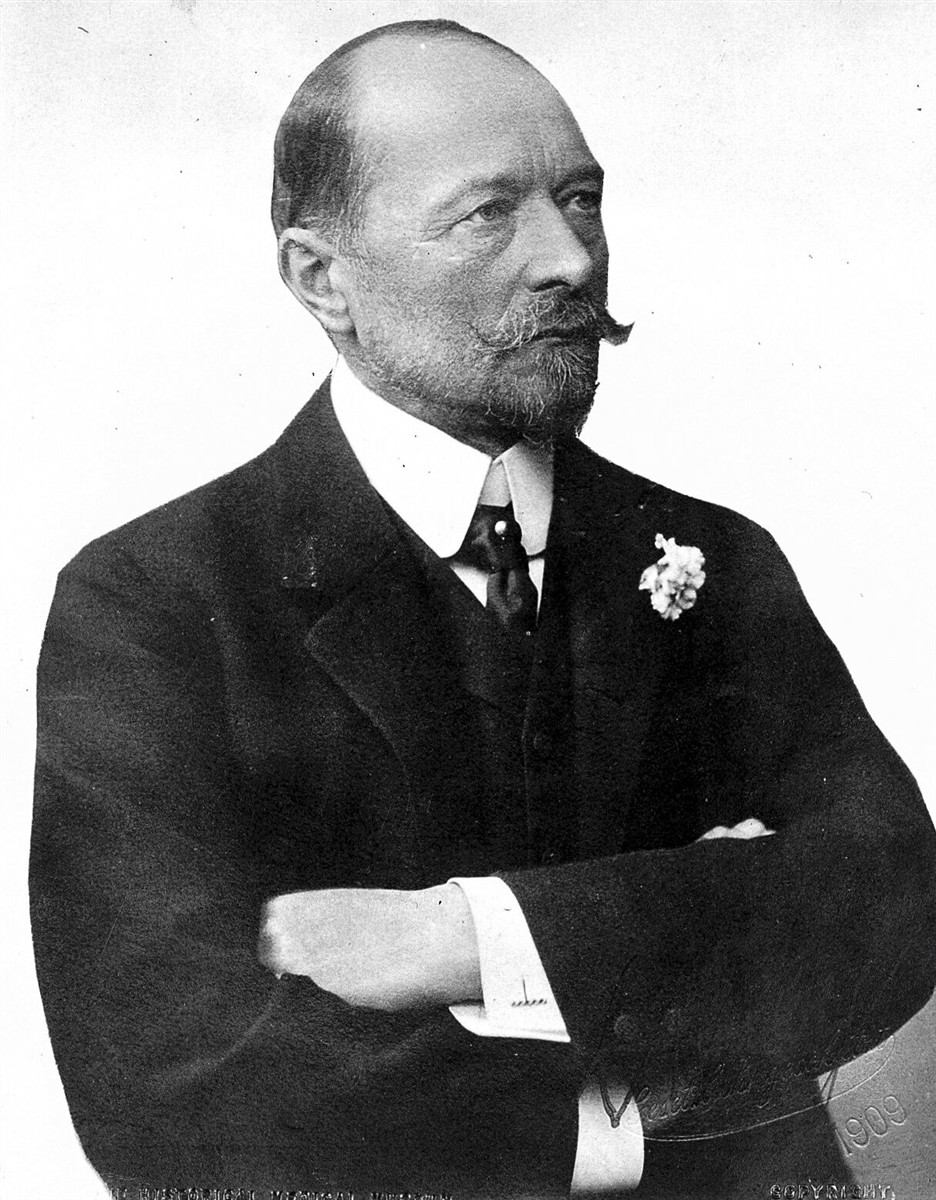
Photographer unknown, Emil von Behring, photograph dated 1909; Wellcome Collection, London (reference 12328i); Public Domain Mark. · Studio photograph of Emil von Behring dated 1909 on the print, photographer not identified; held by the Wellcome Collection (reference 12328i, photo L0019097), whose catalogue marks it with a Public Domain Mark; Wikimedia Commons file 'Emil von Behring. Photograph. Wellcome L0019097.jpg' (original 1215 x 1557, which Commons labels CC BY 4.0 from the older Wellcome statement). Downscaled only, to 936 x 1200, with the printed edge captions left uncropped. · Public domain (Wellcome Collection Public Domain Mark)
의사 · 19세기
에밀 폰 베링
1854–1917
주요 업적 분야
아직 성격 매칭에 포함되지 않았습니다 — 기록된 근거가 성격 모델 전체를 다루기에는 충분하지 않습니다. 이 페이지의 다른 모든 내용은 자유롭게 확인하실 수 있습니다.
핵심 특성
주요 업적
1890년 그는 시바사부로 기타사토와 함께, 디프테리아나 파상풍 배양액을 단계적으로 투여한 동물이 독소를 중화하는 물질을 만들고 이 물질이 다른 동물을 보호하거나 치료할 수 있음을 보여 혈청 요법의 토대를 놓았다.
1890년대 초 그는 획스트사, 그리고 파울 에를리히의 혈청 표준화 작업과 함께 디프테리아 항혈청을 사람 치료에 도입했고, 1901년 혈청 요법으로 최초의 노벨 생리의학상을 받았다.
1913년 그는 디프테리아 예방 면역을 위한 독소-항독소 혼합제를 발표했는데, 그는 이를 자신의 필생 연구의 정점으로 여겼고 이후의 백신들이 이를 개량했다.
삶의 장면들
1892년 1월 첫 사람 대상 디프테리아 시험이 혈청의 질 부족으로 제한적인 성과에 그치자, 혈청 생산은 더 큰 동물과 에를리히의 표준화 방식으로 옮겨 갔고 이후 임상 사용이 이어졌다.
이는 실험실의 발견을 쓸 수 있는 치료법으로 만들어 내려는 끈기와 부합한다. 끈기
결핵 제제를 둘러싼 코흐와의 분쟁에서 그는 끈질기게 싸웠고, 나중에 자신은 자신의 지적 재산을 가능한 모든 냉혹함으로 지켰을 뿐이라고 말했다.
이는 자신의 우선권과 권리를 지키는 데 호전적으로 임하는 태도와 부합한다. 경쟁 성향
전환점
1892년 그는 로베르트 코흐의 권고에 따라 획스트사와 대규모 혈청 요법용 항독소 생산 계약을 맺어 연구를 실험실에서 산업적 생산으로 옮겼다.
이는 과학적 성과를 대규모 제품으로 전환하는 안목과 부합한다. 기회 감지
비슷한 인물
전체적인 프로필이 이 사람과 닮은 사람들이에요.
출처
- Emil von Behring (Q76425) -- verified live via the Wikidata API (2026-10-26): English label 'Emil von Behring', description 'German physiologist who received the first Nobel Prize in Physiology or Medicine 1901 for his discovery of a diphtheria antitoxin', Korean label '에밀 아돌프 폰 베링' (kowiki title the same), born 1854-03-15, died 1917-03-31, P18 image 'Emil Behring 1896 Neapel.jpg'. Orientation only; not used as support for any row.
- NobelPrize.org, 'Emil von Behring - Biographical' (from Nobel Lectures, Physiology or Medicine 1901-1921, Elsevier, 1967), read in full. CANONICAL SIGNIFICANCE SOURCE: army-medical training, the 1881-83 iodoform work suggesting antitoxic action, work under Koch from 1888-89, the 1890 publication with Kitasato that graduated doses of diphtheria or tetanus culture made animals produce toxin-neutralising substances transferable to other animals, the 1898 toxin-antitoxin finding with Wernicke and the 1913 toxin-antitoxin mixture he saw as the crowning success of his work, the turn to tuberculosis, the commercial firm that built him laboratories at Marburg and the Behringwerke, and the first Nobel Prize in Physiology or Medicine in 1901. Award-body biography: authoritative on chronology, admiring in tone, silent on the priority disputes. Family and health passages were read but not scored.
- Stefan H. E. Kaufmann, 'Remembering Emil von Behring: from Tetanus Treatment to Antibody Cooperation with Phagocytes' (mBio editorial, 2017), read in full: the 1890 Behring-Kitasato paper and Behring's single-author diphtheria paper a week later, the first human trial of serum therapy in January 1892 and its limited success until Ehrlich's standardisation and larger animals, the 1892 contract with Hoechst, the priority and compensation disputes with Ehrlich, the patent clashes with Koch, Behring's own quoted remark that he had defended his intellectual property with all ruthlessness at his disposal, the manoeuvring over the Marburg chair, the abandoned tuberculosis programme (1908), the 1913 toxin-antitoxin vaccine, the Behringwerke, and the observation that he was abrasive toward Ehrlich and Koch but relatively friendly with Metchnikoff. Specialist historian-immunologist; balanced and the most critical source read. Passages on frustration and depression, personal life and the Monte Carlo anecdote were excluded.
- Stefan H. E. Kaufmann, 'Immunology's Coming of Age' (Frontiers in Immunology, 3 April 2019), read in the sections on Behring, Ehrlich and Metchnikoff: the first Nobel Prize in Medicine awarded in 1901 to Behring for serum therapy, Behring and Ehrlich as young independent researchers at Koch's institute identifying antibodies, the Behring-Kitasato tetanus paper and the separate diphtheria paper, Behring's joining forces with industry, his roughly twenty years to reach active vaccination, and the statement that Ehrlich's work made large-scale production of antisera of reproducible quality possible. Independent specialist review; complements the 2017 editorial.
- Martha Marquardt, 'Paul Ehrlich' (London: William Heinemann Medical Books, 1949), Internet Archive OCR text, the chapter on research with Koch and von Behring (Ehrlich's collaboration with Behring, the standardisation of diphtheria serum, Ehrlich's long 1 November 1906 letter to Friedrich Althoff, the contract dispute, tuberculosis and test-toxin disagreements) read in full; other chapters not read. ADVERSARIAL BUT PARTISAN: written by Ehrlich's secretary and quoting Ehrlich's own bitter account of Behring; useful as the opposing side of the priority dispute, not as neutral fact. Claims in it are cited only as Ehrlich's account.
- Nobuyuki Okui, 'Shibasaburo Kitasato (1853-1931): Pioneer of Japanese Medicine and Global Immunology Innovator' (Cureus, 2024), read in full for the joint attribution: the 1890 Behring-Kitasato paper 'On the development of diphtheria immunity and tetanus immunity in animals' as the foundation of serum therapy, the statement that the first Nobel Prize in Physiology or Medicine went to von Behring in 1901 while Kitasato's crucial role was widely acknowledged. Admiring profile of Kitasato by a Japanese medical historian; the independent voice on the Kitasato side.
- Laure Grandiere Perez and Sylvain Brisse, 'Diphtheria antitoxin treatment: from pioneer to neglected' (clinical history and review, 2025), read in the sections on the discovery of diphtheria antitoxin and the early clinical trials: von Behring's 1890 immunisation experiments, the 1891 treatment of a seriously ill girl, the 1892 contract with Hoechst, Ehrlich's 1893 standardisation, and the 1894 Berlin series of 220 children with 76% survival but no control group. Modern clinical-historical review; supplies the methodological caveat on the early trials.
- Wellcome Collection work 'Emil von Behring. Photograph.' (reference 12328i, library reference ICV No 26468, photo L0019097; catalogue API lists a Public Domain Mark licence on the image) and the Wikimedia Commons file page 'Emil von Behring. Photograph. Wellcome L0019097.jpg', checked for the portrait only.