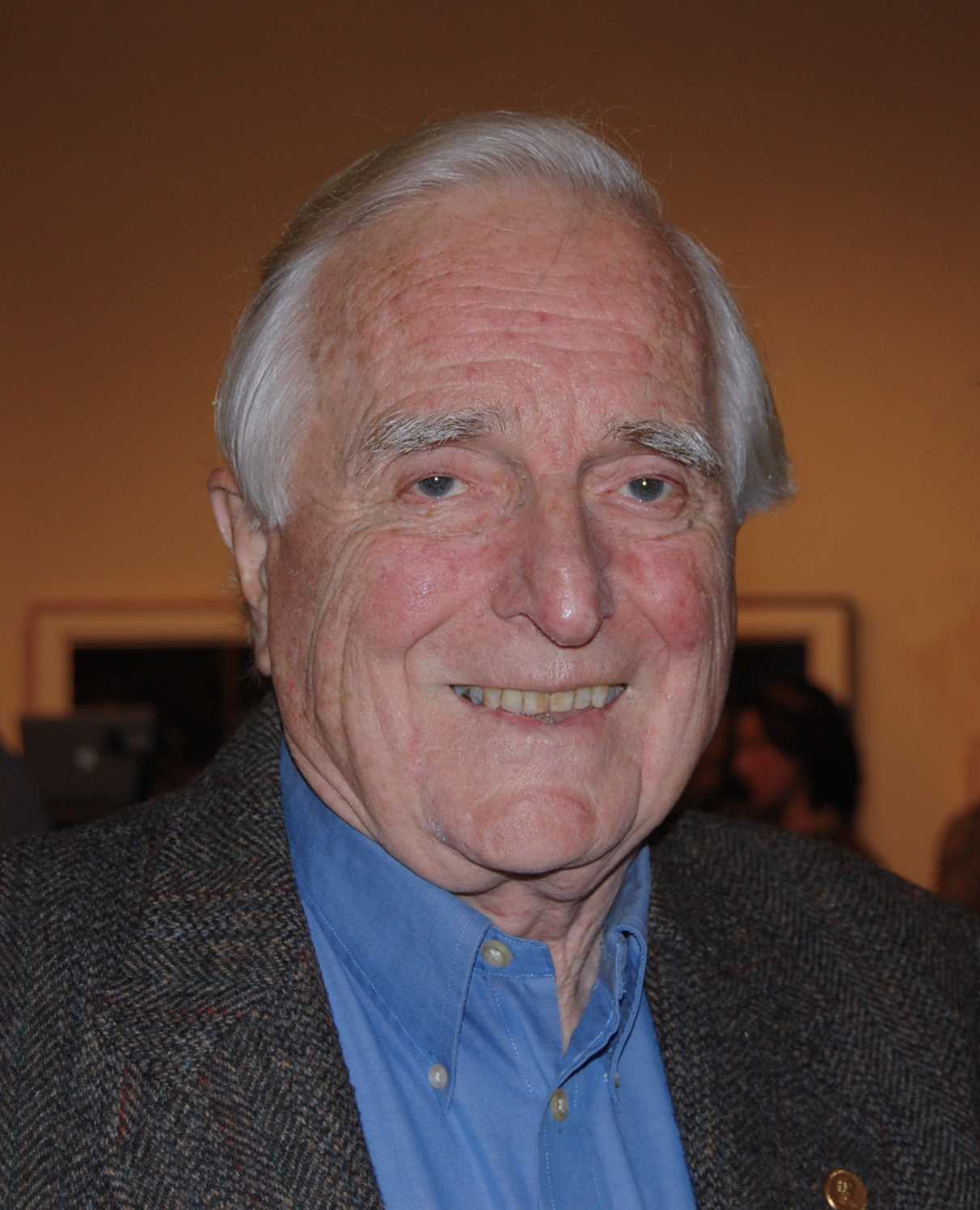

Photo by Alex Handy, taken 8 December 2008, CC BY-SA 2.0, via Wikimedia Commons; verified on the original Flickr page (license shown as Attribution-ShareAlike 2.0 Generic) on 2026-10-05 and reviewed by the Commons Flickr-review bot on 2010-03-13 · Wikimedia Commons, File:Douglas Engelbart in 2008.jpg (1212x1496), uploaded from Flickr (user vonguard / Alex Handy, photo 3092878391); stored unmodified (no resampling, no crop) · CC BY-SA 2.0
핵심 특성
주요 업적
엥겔바트는 1963년부터 스탠퍼드 연구소(SRI)의 증강연구센터(Augmentation Research Center)를 이끌었으며, 이 연구소는 ARPA, NASA, 공군의 지원을 받았다. 그의 팀은 화면 위에서 서로 연결된 구조화 문서를 키보드, 코드 키세트, 마우스로 다루는 oN-Line System(NLS)을 만들었다. 마우스는 1964년 엥겔바트의 연구소에서 빌 잉글리시(Bill English)가 설계했고 1970년에 특허를 받았다. 이 연구소는 초기 ARPANET의 네트워크 정보센터(Network Information Center)도 운영했다.
1968년 12월 9일 엥겔바트와 그의 팀은 샌프란시스코에서 약 1,000명의 컴퓨터 전문가 앞에서 NLS를 시연했다. 시연은 멘로파크 SRI의 호스트 컴퓨터와 마이크로웨이브로 연결되어 진행되었고, 공동 온라인 편집, 하이퍼텍스트, 화상회의, 워드 프로세싱, 마우스를 보여 주었다. 이 시연은 '모든 시연의 어머니(Mother of All Demos)'로 불리게 되었으며, IEEE는 이를 기리는 마일스톤 명판을 헌정했다.
엥겔바트는 1962년 10월 공군과학연구국(AFOSR)에 제출한 SRI 보고서 「인간 지성의 증강: 개념적 틀(Augmenting Human Intellect: A Conceptual Framework)」을 발표했다. 이 글은 컴퓨터가 인간의 지성을 확장할 수 있다고 주장했으며, 그 방법으로 사람들이 정보를 구조화하고 네트워크로 공유하는 것을 들었고, 이는 ARPA의 지원으로 이어졌다. 그는 이후 1997년 ACM 튜링상과 2000년 12월 미국 국가기술훈장을 받았다.
삶의 장면들
1957년 엥겔바트는 컨설팅 수입을 올리며 자신의 발명을 상품화하려던 네 명의 소규모 회사 디지털 테크닉스(Digital Techniques)의 동업자였다. 그의 설명에 따르면, 그는 1년 가까이 의구심이 커지다가 동업자들에게 손을 떼겠다고 말했는데, 컴퓨터로 인간의 일을 증강한다는 꿈을 포기할 수 없다는 이유였고, 동업자들은 그가 없으면 계속하고 싶지 않다고 했다. 그는 이후 SRI에 일자리를 요청하고 몇 달 동안 답을 기다렸다.
자신이 함께 세운 회사를 떠나 불확실한 연구 목표를 택하고, 이후 SRI에서 몇 달을 기다린 행동은 수입보다 사명에 대한 강한 헌신과 일치한다. 이 이야기는 그 자신의 회고에 근거하며, 마크 웨버(Marc Weber)가 기록한 이후 수십 년의 활동도 같은 방향을 가리킨다. 영향 창출 동기
엥겔바트는 1968년 3월경 가을 컴퓨터 학술대회 프로그램 위원회에 샌프란시스코 현장에서 NLS를 실시간으로 시연할 시간을 달라고 요청했다고 말한다. 주최측은 주저하며 두 차례 현장 점검 인원을 보냈다. 팀은 SRI와 영상·데이터 회선을 연결했고, 실시간 시스템이 다운될 경우에 대비해 녹화 필름을 대기시켜 두었다. 그의 설명에 따르면, 시연이 실패했을 때 후원 기관이 곤란해지지 않도록 연구 후원금이 얼마나 들어갔는지 알리지 않았고, 비용은 약 1만~1만 5천 달러였다고 한다.
후원 기관에 비용을 모두 알리지 않은 채 전례 없는 실시간 시연을 추진한 것은 개인적인 직업적 위험을 감수하려는 태도와 일치한다. 후원 기관에 관한 내용은 그 자신의 회고에서만 확인된다. 위험 감수
전환점
1969년 이후 ARPA는 지원을 줄였고, 엥겔바트를 후원해 온 밥 테일러(Bob Taylor)는 제록스 PARC로 옮겼으며, PARC는 이후 빌 잉글리시와 제프 룰리프슨(Jeff Rulifson) 등 그의 가까운 동료들을 영입했다. 1977년 SRI는 연구소를 타임셰어(Tymshare)에 매각했고, NLS는 이곳에서 Augment가 되었다. 엥겔바트는 1970년대 중반에 연구 방향은 자신이 맡고 운영은 다른 사람이 맡게 해 달라고 SRI에 요청했으나, SRI는 오히려 그를 교체했고 1977년 7월 그의 고용을 끝냈다고 말한다.
그는 일상적 운영 없이 연구 방향을 유지할 수 있는 역할을 찾았다고 말하는데, 이는 자신의 연구 의제를 스스로 통제하려는 강한 욕구와 맞는다. 마크 웨버 등은 그를 현장 관리자보다는 비전을 제시하는 사람으로 묘사하지만, 해고 사유에 관한 그 자신의 설명은 여기서 교차 확인되지 않았다. 자율성 욕구
비슷한 인물
전체적인 프로필이 이 사람과 닮은 사람들이에요.
출처
- Douglas Engelbart (Q92614) -- verified live via wbgetentities (2026-10-05): en label 'Douglas Engelbart', description 'American engineer and inventor (1925-2013)', born 30 Jan 1925, died 2 Jul 2013, citizenship United States, instance of human, ko label '더글러스 엥겔바트', images P18 'Douglas Engelbart in 2008.jpg' and 'SRI Douglas Engelbart 1968 (cropped).jpg'. Orientation only; not used as support for any row.
- Douglas Engelbart, English Wikipedia -- orientation only: used for the uncontested high-level facts that he won the ACM Turing Award (1997) and the US National Medal of Technology (December 2000), and for the title and report number of the October 1962 Air Force Office of Scientific Research summary report. Not used for any scored row.
- Douglas Engelbart, Stanford and the Silicon Valley Oral History interviews (interviewers Judith Adams and Henry Lowood; edited by Thierry Bardini; 19 Dec 1986, 14 Jan 1987, 4 Mar 1987, 1 Apr 1987), Stanford University Libraries web transcripts -- SELF-ACCOUNT (his own long, frank retelling; used only where an independent source corroborates, or for facts about what he himself did and said he did). Read in full: interview 2 sections on Digital Techniques, the decision to join SRI and the first funding; interview 1 sections on the Navy, the Bush reading, Ames and Berkeley; interview 3 sections on the 1964 funding, SRI management, the patent/licensing question, the mouse and the 1968 demonstration; interview 4 sections on the Journal, the Network Information Center dissension, the 1977 sale to Tymshare. The remaining pages were skimmed and searched, not read line by line.
- Transcript of a video history interview with Douglas Engelbart by Jon Eklund, Computerworld Smithsonian Award series, National Museum of American History, Cosmos Club, Washington, 4 May 1994 -- SELF-ACCOUNT. Read the sections on resistance at SRI to the 1962 report, the research community's view that he was on the wrong track, and NLS and the Alto; the rest of the transcript was skimmed.
- Ted Daniels, review of Thierry Bardini, 'Bootstrapping: Douglas Engelbart, Coevolution, and the Origins of Personal Computing' (Stanford University Press, 2001), First Monday reviews section -- INDEPENDENT, CRITICAL secondary account that summarises Bardini's history of the SRI lab: Engelbart's single-minded pursuit, a dominating style that became prophet-like, weekly encounter-group sessions imposed on staff, the est episode, the difficulty of learning his system, and his lack of interest in product development. Reviewer's retelling of a book that was NOT itself read (lending-only at the Internet Archive); read in full.
- James G. Mitchell (Xerox PARC computer scientist; Engelbart's contemporary and sometime collaborator), oral history interview by David C. Brock, 19 February 2019, Computer History Museum, reference X8963.2019 -- INDEPENDENT PARC-side perspective: the shared programming-language project between PARC and Engelbart's lab, why people in the lab were upset at his directive style, the legal agreement that ended the collaboration, his later dislike of the web, his 'windows' claim, and Mitchell's admiration of the 1968 demonstration. Read the passages on Engelbart (about 14 mentions) in full; other parts of the 37-page transcript were not read.
- Marc Weber (historian, Computer History Museum), 'Net@50: Did Engelbart's "Mother of All Demos" Launch the Connected World?', Computer History Museum blog, 9 December 2018 -- INDEPENDENT institutional historian's overview: Engelbart's goal and the contrast with artificial-intelligence researchers, his hands-off management of operational detail, the Network Information Center, the decline of the lab after 1969, the 1977 sale to Tymshare, Bootstrap Institute (1988), and the later honours. Read in full.
- Valerie Landau, 'How Douglas Engelbart Invented the Future', Smithsonian Magazine, January 2018 -- COLLABORATOR's account (Landau worked closely with Engelbart from 1986 to 2013, co-authored 'The Engelbart Hypothesis'); admiring but candid: his 1951 resolve, the 1968 audience reaction, the hiring of social-science graduates for 'networked improvement communities' and the funders' reaction, his 'You just don't get it' habit, his refusal to simplify the mouse and the system, and his own irritability toward colleagues. Read in full.
- Engineering and Technology History Wiki (IEEE), Milestone 'Public Demonstration of Online Systems and Personal Computing, 1968' (dedicated 19 March 2017) -- institutional milestone citation and supporting statement (non-self, laudatory in tone): what was shown on 9 December 1968, the obstacles (funding for radical ideas, attitude of the mainstream computing community), and the list of references. Read in full.
- Guide to the SRI ARC/NIC records (X3578.2006), finding aid by Elizabeth Feinler (a member of Engelbart's lab and later director of the Network Information Center), Computer History Museum, 2011 -- COLLEAGUE-written administrative history of the Augmentation Research Center and Network Information Center (dates, funding agencies, the NIC spin-off in 1973). Read the abstract and administrative history.
- Computer History Museum, 'CHM Acquires Original SRI Mouse' -- institutional page crediting Bill English with designing the first mouse in 1964 at Engelbart's laboratory (patented 1970) and describing the 1968 demonstration. Read in full.