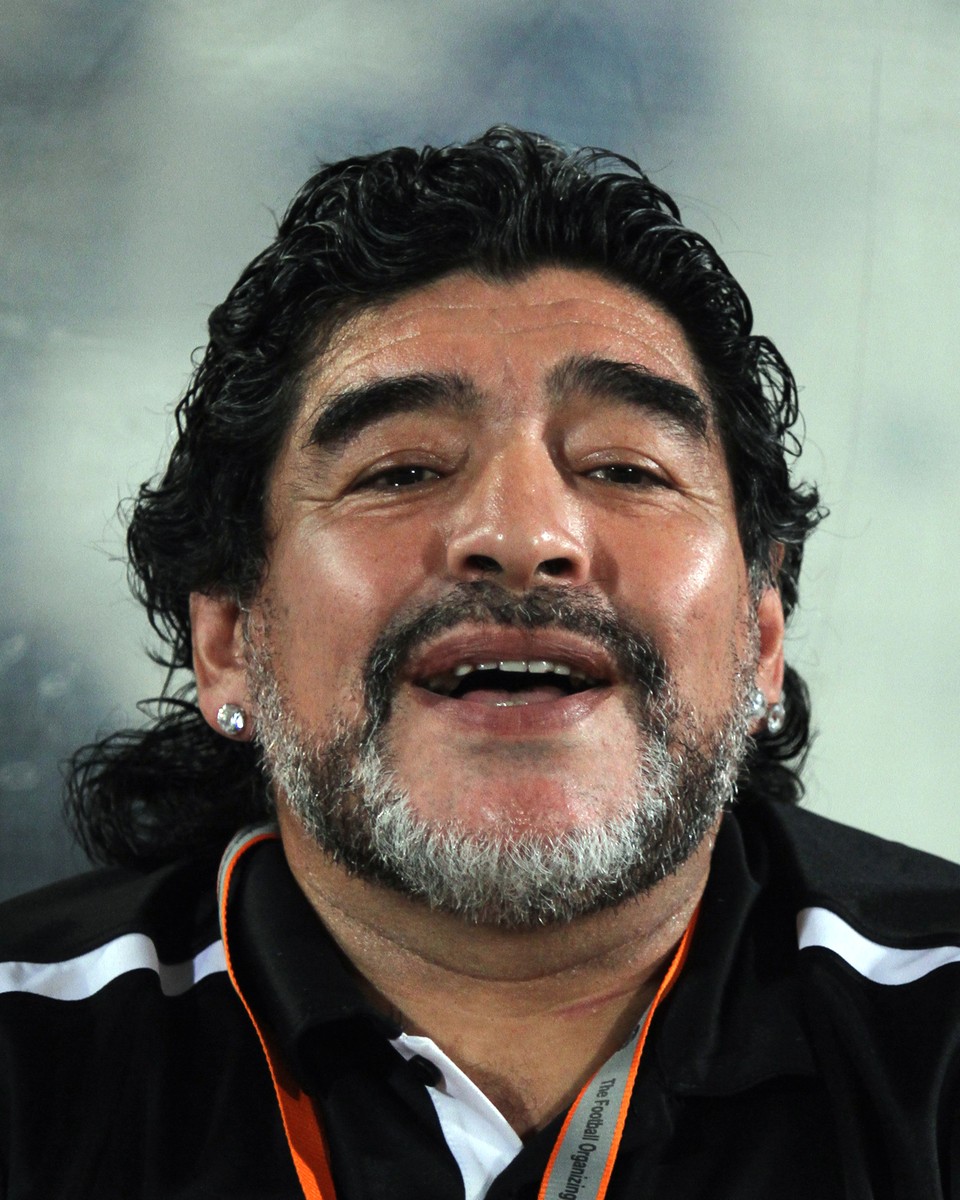

Photo: Vinod Divakaran (Doha Stadium Plus Qatar), 30 May 2012, CC BY 2.0, cropped and downscaled from the original · Wikimedia Commons, 'Diego Maradona 2012 2.jpg' -- Flickr upload of Flickr photograph 7448907672 (title 'Diego Maradona', Flickr account Doha Stadium Plus Qatar) whose description credits 'Picture by Vinod Divakaran' and whose original EXIF Artist field reads 'Vinod Divakaran' (Canon EOS 7D), taken 30 May 2012 at Al Wasl's GCC Champions League semi-final against Al Khor, when Maradona was Al Wasl's coach; uploaded to Commons by the Flickr upload bot on 3 October 2013 with the licence confirmed by Commons user Ureinwohner as CC BY 2.0; the live Flickr page (opened 2026-10-16) shows licence id 4 (CC BY 2.0, 'Some rights reserved') and no 'All rights reserved' notice, and the file's embedded metadata carries no conflicting copyright statement; original 1800 x 2221 pixels, cropped to a 1312 x 1640 head-and-shoulders area and downscaled once to 960 x 1200 (never upscaled). · CC BY 2.0
운동선수 · 현대
디에고 마라도나
1960–2020
주요 업적 분야
아직 성격 매칭에 포함되지 않았습니다 — 기록된 근거가 성격 모델 전체를 다루기에는 충분하지 않습니다. 이 페이지의 다른 모든 내용은 자유롭게 확인하실 수 있습니다.
핵심 특성
주요 업적
1986년 월드컵에서 아르헨티나 주장으로 우승을 이끌며 5골을 넣고 5개의 도움을 기록했다. 잉글랜드와의 8강전(2-1)에서는 '신의 손' 핸드볼 골과 훗날 FIFA가 '세기의 골'로 선정한 단독 드리블 골을 모두 넣었고, 골든볼을 받았으며, 서독을 3-2로 꺾은 결승에서는 세 골 모두에 관여했다. FIFA, FIFA 박물관, ESPN의 기록이다.
1984년 당시 세계 최고 이적료 기록으로 나폴리에 입단해, 리그 우승 경험이 없던 클럽을 1987년 구단 사상 첫 세리에 A 우승(남부 클럽으로는 처음)으로 이끌었다. 1987-88시즌에는 리그 득점왕에 올랐고, 1989년에는 구단 첫 유럽 대회 우승인 UEFA컵을, 1990년에는 두 번째 리그 우승을 차지했다. FIFA와 FIFA 박물관의 기록이다.
1976년 16세 생일을 열흘 앞두고 아르헨티나 1부 리그 역사상 최연소 선수로 프로 무대에 데뷔했다. 1979년 세계 청소년 선수권에서 골든볼을 받았고, 주장으로서 1990년 월드컵 결승(서독에 0-1 패)에 올랐으며 국가대표 91경기에서 34골을 넣었다. 2000년에는 펠레와 함께 '세기의 선수'로 공동 인정받았는데, 마라도나의 선정은 대중 투표로 결정되었다. FIFA 박물관과 가디언의 기록이다.
삶의 장면들
1986년 결승 막판, 서독이 0-2에서 2-2로 따라붙자 호르헤 부루차가는 마라도나에게 '가서 이기자'고 말했다고 회상한다. 약 3분 뒤 마라도나가 서독 수비진 사이로 찔러 준 패스가 부루차가를 골문 앞으로 보냈고 결승골이 되었다. 부루차가는 자신이 공을 달라고 소리쳤지만 등을 거의 돌리고 있던 마라도나는 그 소리를 듣지 못했는데도 패스를 내주었다며, '디에고는 뒤통수에 눈이 달린 것처럼 뛰곤 했다'고 말한다.
결정적인 순간에 개인 기량과 동료를 향한 정확하고 시의적절한 패스를 함께 보여 준 선수의 모습과 일치하지만, 이 이야기는 득점자의 회상에 의존한다. 협업 성향
1987-88시즌 나폴리가 우승 경쟁에서 앞서 있다가 무너진 뒤, 선수단은 오타비오 비안키 감독에게 문제가 있다는 성명을 냈고 선수 4명은 감독 교체를 요구하는 서한에 서명했다. 마라도나는 기자들에게 '팀 전체가 비안키에 반대하는 탄원서를 냈다'고 말했고, 비안키는 마라도나가 구단 회장도, 부회장도, 감독도 아니라고 맞받았다. 한 기록에 따르면 마라도나는 서명하지는 않았지만 이 네 명의 편에 섰다. 구단주는 비안키를 유임하고 반대했던 선수들을 팔았다.
공개적으로 감독에 맞서 동료들의 편에 서는 선수의 모습과 일치하지만, 서명한 선수의 수와 마라도나 본인의 역할은 자료마다 다르고, 결과는 구단 안에서 그의 영향력에 한계가 있었음을 보여 준다. 갈등 감내
전환점
1984년 코파 델 레이 결승에서 FC 바르셀로나가 아틀레틱 빌바오에 패한 뒤 집단 난투극이 벌어졌고, 마라도나는 그해 여름 나폴리로 팔려 갔다. 가디언의 회고 기사는 이를 3개월 출전 정지를 치르며 남아 있는 것보다 나은 선택으로 설명한다. FIFA에 따르면 나폴리는 그의 첫 시즌을 중위권, 둘째 시즌을 3위로 마쳤고, 1987년 그는 구단 사상 첫 세리에 A 우승을 주장으로서 이끌었다.
한 클럽이 자신을 중심으로 꾸려졌을 때 가장 꾸준한 성과를 낸 선수의 모습과 일치하지만, 그 변화에서 그 자신의 선택이 얼마나 컸는지는 자료로 알 수 없다. 주도 성향
비슷한 인물
전체적인 프로필이 이 사람과 닮은 사람들이에요.


어니스트 헤밍웨이

엘리자베스 케이디 스탠턴

시어도어 루스벨트

아웅산 수치

오토 폰 비스마르크
출처
- Diego Maradona (Q17515) -- verified live via the Wikidata API (2026-10-16): English label 'Diego Maradona', description 'Argentine football player and manager (1960-2020)', born 30 October 1960, died 25 November 2020, citizenship Argentina, Korean label present. Orientation only; not used as support for any row.
- FIFA.com, 'Relive Maradona's Mexico '86 magic', 30 October 2023 -- the world federation's short tribute: one of the greatest players in the history of the game, who scored five times as he inspired Argentina's 1986 World Cup title, including the double against England in the quarter-final ('Hand of God' and 'Goal of the Century'), with a link to the adidas Golden Ball award. CANONICAL SIGNIFICANCE SOURCE (second; the FIFA Museum timeline is the first). Short and celebratory; used for the significance statement and the achievement cards, never for a behavioural row. Read in full through the built-in browser (the page is script-rendered).
- FIFA.com, 'Watch: Cosmic Diego's extraterrestrial exhibition', published 12 July 2026 -- FIFA's match page for Argentina 2-1 England, Estadio Azteca, 22 June 1986: Carlos Bilardo's plan to get the ball to the number 10, Maradona drawing six fouls before half-time, the two goals four minutes apart, his own account of the first goal ('a little with the head of Maradona and a little with the hand of God') and of shouting at team-mates to come and hug him so the referee would not disallow it, quotations from John Barnes, Jorge Valdano and Gary Lineker, and the trivia of the shirt he picked the day before ('We'll beat England in that'). Institutional and celebratory; the passages on the political background and on his 1978 omission and 1982 sending-off were read but only the sporting facts are used. Read in full through the built-in browser (the page is script-rendered).
- FIFA.com, 'Maradona's immortal 11-second dash' (page dated 22 June 2016, text saying '25 years ago today') -- FIFA's account of the second goal against England: the 11-second run from his own half, the radio commentary of Victor Hugo Morales, a similar run at Wembley in a 1980 friendly, and the reactions of England coach Bobby Robson and striker Gary Lineker and of Jorge Valdano, who says Maradona apologised in the dressing room for not passing to him and still had time to see him during the run. Institutional and celebratory, with Maradona's own autobiography quoted; the page date and the '25 years' wording do not agree, so no date is taken from it. Read in full.
- FIFA.com, 'Burruchaga's Azteca ecstasy' (8 June 2017) -- FIFA's account of the 1986 final from the scorer's side: Jorge Burruchaga turning to Maradona after Germany's two goals to say 'Right, let's go and win this thing', Maradona's defence-splitting pass three minutes later, and Burruchaga's 2007 recollection that Maradona never heard his shout and 'used to play like he had eyes in the back of his head'. A team-mate's retrospective as relayed by the federation; admiring. Read in full.
- FIFA.com (French edition), '10 mai 1987 : Maradona et Naples au paradis', 10 May 2021 -- FIFA's history of Napoli's first Serie A title: the club's world-record signing of Maradona in 1984, a mid-table first season and a third place in the second, his declaration before 1986-87 that it would be Napoli's year, the 1-1 draw with Fiorentina on 10 May 1987 that clinched the title, Ciro Ferrara's and Ottavio Bianchi's recollections of the tense second half, and Maradona's remark that the title was worth more to him than a World Cup. Read in French; institutional and celebratory.
- Julie Welch, 'Diego Maradona obituary', The Guardian, 25 November 2020 -- the newspaper's full obituary and career overview: debut for Argentinos Juniors in 1976, the 1979 World Youth Championship, Boca Juniors and the 1982 league title, Barcelona and the 1984 Copa del Rey final brawl, Napoli's 1987 and 1990 league titles and 1989 UEFA Cup, five of Argentina's 14 goals and the captaincy in 1986, the Golden Ball and FIFA's 2002 Goal of the Century award, 91 caps and 34 goals. Independent and critical; the passages on drug use, health, family, the Camorra, the 1994 expulsion and his later coaching were read and are NOT used. Read in full.
- Simon Kuper, 'Maradona's shadow looms over Messi', ESPN, 13 July 2014 (read as syndicated on ABC13) -- column comparing Argentina's 1986 and 2014 teams: Bilardo letting his star stay up late with his entourage ('there's Maradona and there's the rest of the team', as told to biographer Jimmy Burns), Valdano's account of teasing Maradona in the dressing room after the England goal and Hector Enrique's joke about his pass, and Kuper's reading that Maradona towered over his team-mates yet felt as one with them and led the 1986 team. Independent columnist with named team-mates; the passage on painkilling injections was read and is not used. Read in full.
- These Football Times, 'Jorge Burruchaga and the tears of World Cup joy', 13 March 2018 -- long-form feature on the 1986 campaign from Burruchaga's side: a squad of 'big personalities, jealousies, cliques', Bilardo's plan for the final if Maradona were man-marked, Burruchaga as the player who linked best with him, Maradona's 98 touches in the semi-final, Burruchaga's El Gráfico remark that 'we all helped Diego become what he did', and the final's winning pass. Independent football writing partly built on Burruchaga's own recollections, so retrospective and admiring; some match narrative has no cited source. Read in full.
- Rashedul Islam, 'The man who scored the World Cup winning goal for Argentina', Prothom Alo, 29 June 2022 -- interview with Jorge Burruchaga (answers given in Spanish and translated into English by a third party): that Maradona was the team's leader whom every player followed, that his behaviour towards the others did not change after the title, that he and Burruchaga practised the through pass in training and that Maradona used to try to score such goals in practice, and Burruchaga's view that Maradona could not have won the World Cup without the team's support. A team-mate's retrospective in a translated interview; admiring. Read in full.
- Jorge Valdano, 'Maradona the footballer had no flaws; Maradona the man was a victim', The Guardian, 26 November 2020 (first published in El Pais, translated by Sid Lowe) -- Valdano's farewell column the day after the death: the juggling-in-the-lift story told by Bilardo in Berlin, Maradona dominating the stage 'like a rock star' yet being 'generous with his teammates, committed to them' and 'as competitive as a starving man', and the 1986 England match as a goal of beauty and one in which 'he cheated'. A 1986 team-mate's tribute written after the death, so retrospective and admiring; its passages on his life, addiction and later years are NOT used. Read in full.
- Barney Ronay, 'World Cup questions: Were England robbed by Argentina at Mexico 86?', The Guardian, 26 April 2020 -- a column that re-watches the whole quarter-final from the FIFA archive film: Maradona beating Sansom twice and being fouled by Fenwick, the 'Hand of God' sequence (Hodge's mis-hit back towards Shilton, Maradona running forward and punching the ball in), the 11-second second goal past the England players, the late tie-breaking gamesmanship, his remarks about finding the right tempo in Italy, and the writer's verdict that England were cheated but not robbed. Independent and first-hand viewing, with a critical edge. Read in full.
- Donald McRae, 'Peter Shilton: Maradona's the greatest player in history but I don't respect him', The Guardian, 15 January 2020 -- interview in which England's goalkeeper in 1986 says Maradona 'cheated' with the first goal, did not apologise or show remorse, that he will not shake his hand, and that the second goal was legal and sumptuous; Shilton also calls him the greatest player in history. An opposing player's adversarial view, thirty-four years later; the interview's passages on Shilton's own life were not used. Read in full.
- Will Unwin, 'Kung-fu kicks and riot police: the day Maradona got Barca brawling', The Guardian, 17 April 2021 -- account of the 1984 Copa del Rey final: Maradona returning to play against Athletic Bilbao after the previous season's ankle injury, Barcelona's 1-0 defeat, and the mass brawl at the final whistle in which he attacked Athletic players, kneeing an unused substitute in the face, followed by a three-month ban and his sale to Napoli that summer. Independent retrospective of a documented on-pitch incident; its passages on the earlier injury are not used. Read in full.
- Emmet Gates (The Gentleman Ultra), 'Napoli v Milan: the Serie A title decider that still rankles to this day', The Guardian, 3 March 2022 -- history of the 1 May 1988 Napoli-Milan match that decided the 1987-88 title race: Maradona's pre-match words about the San Paolo, his free-kick that Sacchi says Maradona told him was aimed at Gullit's hair, a rabona pass to Careca, and the later dispute in which four Napoli players wrote to demand coach Ottavio Bianchi's removal, with the writer's remark that Maradona sided with them though he did not sign. The passages on injections, the Camorra and betting rumours were read and are NOT used. Read in full.
- Henry Bell (The Gentleman Ultra), 'Fiorentina v Napoli: when Roberto Baggio faced Diego Maradona', The Guardian, 2 October 2021 -- match analysis of Napoli 3-2 Fiorentina, 17 September 1989, in which Napoli came back from 2-0 down after Maradona came on at half-time: his penalty miss, the cross, corner routine and passing that set up goals for Careca and Corradini, and the writer's view that he gave instructions and helped others reach their potential. Independent football analysis; Baggio-related passages not used. Read in full.
- Clemente Lisi, 'The Diego Maradona magic that helped Napoli lift the 1989 UEFA Cup', These Football Times, 29 April 2019 -- season history of Napoli's 1988-89 UEFA Cup: the players' petition against coach Bianchi and Maradona's public remark about it, Fernando De Napoli's recollection that Maradona gave the team confidence before big matches, the pre-match dribbling show in Munich and the lemon juggling in the dressing room, the semi-final against Bayern, the final against Stuttgart in which Maradona's hand-assisted penalty and passes for Careca are described, and Bianchi's measured manner. Independent football feature; no sourcing for some match details, and the paragraph on the penalty is internally muddled, so it is used only for the petition and the teammate quotation. Read in full.
- Wikimedia Commons file 'Diego Maradona 2012 2.jpg' and its Flickr source page (Flickr account Doha Stadium Plus Qatar, photo 7448907672, picture by Vinod Divakaran, taken 30 May 2012; licence shown as Creative Commons Attribution 2.0) -- opened to check the portrait's licence. Not used for any scoring.
- FIFA Museum, 'Maradona' (The Legend of Football), digital.fifamuseum.com -- the museum's illustrated timeline: professional debut ten days short of his 16th birthday on 20 October 1976 as the youngest player in the history of the Argentine Primera Division, the 1979 FIFA World Youth Championship won with the Golden Ball, the 1982 red card against Brazil, the 1983 ovation at the Bernabeu, the world-record transfers to Barcelona (1982) and Napoli (1984), the 1986 World Cup Golden Ball (the first player to win it at youth and senior level), captaining Napoli to its first Serie A title in 1987 and the top-scorer award in 1987-88, the 1989 UEFA Cup (a penalty and three assists against Stuttgart), the 1990 assist for Claudio Caniggia against Brazil, and the joint 'Player of the Century' recognition of 2000 decided by public poll. CANONICAL SIGNIFICANCE SOURCE (the world federation's museum). Institutional and celebratory; its collection notes on the 1986 quarter-final ticket were read for the match description. Read in full.
- FIFA Museum blog, 'Diego Armando Maradona: The King of Soccer' (published after his death in late 2020, undated on the page) -- the museum's career essay: debut at 15, the 1978 omission by Menotti ('I cried my eyes out'), the 1979 World Youth Championship Golden Ball, trouble with Barcelona's officials and the mass brawl at the 1984 Copa del Rey final that led to his sale to Napoli, Napoli's first league title and Coppa Italia in 1987, the 1989 UEFA Cup and the 1989-90 title, and the 1986 final in which he was involved in all three Argentine goals and as captain lifted the trophy. Institutional; the death announcement and the closing tribute are not used. Read in full.
- FIFA Annual Report 2020, 'Obituaries' section -- FIFA's paragraph on Diego Armando Maradona (1960-2020): captained Argentina to two World Cup finals and won in 1986 with the Golden Ball and the goal later named FIFA's Goal of the Century (2002), debut at 15, world-record fees from Barcelona and Napoli, Napoli as the first southern club to win Serie A (1987), the 1989 UEFA Cup and a second title in 1990, and the retired number 10 shirt. Institutional; its passages on the doping ban and later life are NOT used. Read in full.
- Scott Murray, 'The best and worst moments of Diego Maradona's turbulent career', The Guardian, 26 November 2020 -- list article: the 1979 World Youth Championship (Menotti's remark in 1978 that Maradona was too young that time but would be captain in 1982; player of the tournament with six goals including a free-kick in the final), Mexico 86, Napoli's titles, Italia 90 (a hand used to foil a header against the USSR and the pass for Caniggia's winner against Brazil) and the 1982 sending-off and 1984 brawl. Independent but anecdotal; its passages on the failed drug test, the air-rifle episode and other off-pitch matters are NOT used. Read in full.
- Marcela Mora y Araujo, 'Diego Maradona: the achingly human superstar who embodied Argentina', The Guardian, 25 November 2020 -- essay by an Argentine writer; the passage used says he was often regarded as a prima donna for turning up late to training yet was extremely hard working in his own terms, and that Cesar Menotti always said Maradona stayed at training longer than anyone and practised what he felt he was weak at over and over until he mastered it. Retrospective and admiring, with Menotti's view relayed second-hand; the essay's passages on his private life, addictions and health are NOT used. Read in full.
- Guardian staff, 'How a wind-up convinced Maradona he could win World Cup on his own', The Guardian, 7 April 2023 -- extract from 'Inside Diego' by his personal fitness trainer Fernando Signorini on the 1986 pre-tournament camp: the trainer's staged provocation, Maradona's lively press conference the next day and a newspaper headline quoting him that he would be the star of the World Cup. An insider's memoir, so partial and self-interested; used only for the public-statement fact and never alone, and its passages on weight, injuries and conditioning are NOT used. Read in full.
- Marcus Alves, 'The Maradona I knew', Yahoo Sport, 26 November 2020 -- tribute compilation of recollections by Napoli team-mate Careca and others; the one passage used is Careca's remark that Maradona was a team player who would demand that the kit men got the same prize money as the players after wins. A day-after-death tribute, so retrospective and admiring; its passages on private life and addiction are NOT used. Read in full.
- Jonathan Wilson, 'Child genius Diego Maradona became the fulfilment of a prophecy', The Guardian, 25 November 2020 -- obituary essay; the one passage used says his 1986 handball was the first of three in high-profile games, followed by a penalty won after handling in the 1989 UEFA Cup final and a hand clearance against the USSR in 1990, and that rules remained something to be got around on the pitch. Independent and critical; its passages on childhood, drugs, tax, politics and character labels were read and are NOT used. Read in full.