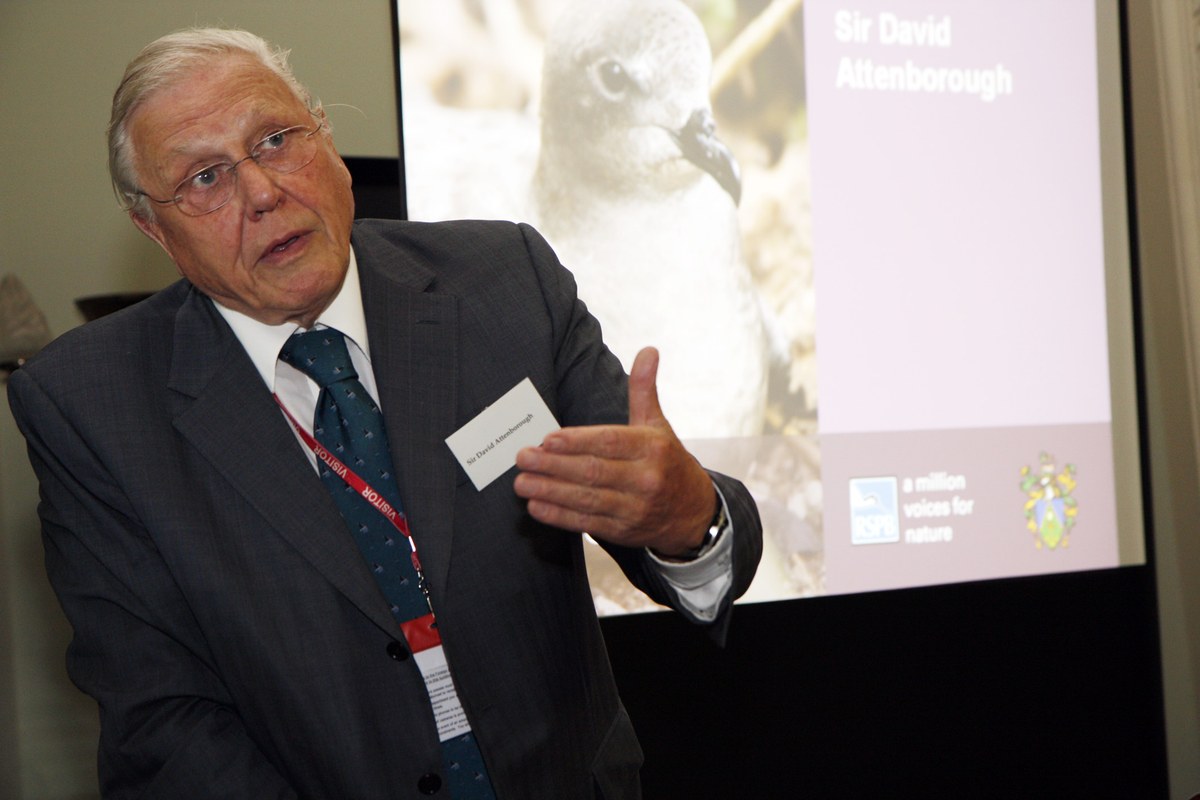

Photo: Foreign and Commonwealth Office, 2010, CC BY 2.0 · Wikimedia Commons 'Sir David Attenborough (4770349105).jpg', from the Foreign and Commonwealth Office Flickr stream (photo 4770349105): FCO photograph of Sir David Attenborough speaking at an FCO event for Henderson Island World Heritage Site, 6 July 2010 (name card and slide visible in the frame). The live Flickr page shows photo-level licence Attribution (CC BY 2.0); the Commons file carries the FCDO licence tag with a VRT permission ticket (2013061310007371) for the FCDO Flickr stream under the Open Government Licence; the two permissive licences do not conflict. Original 2136 x 1424, downscaled only to 1200 x 800 (no upscaling). Supersedes the earlier file david-attenborough-dawson-2025.jpg (Flickr licence conflict) - lead to remove the old file. · CC BY 2.0
박물학자 · 현대
데이비드 애튼버러
b. 1926
주요 업적 분야
아직 성격 매칭에 포함되지 않았습니다 — 기록된 근거가 성격 모델 전체를 다루기에는 충분하지 않습니다. 이 페이지의 다른 모든 내용은 자유롭게 확인하실 수 있습니다.
핵심 특성
주요 업적
1979년 BBC에서 생명의 역사를 다룬 13부작 「Life on Earth」를 직접 쓰고 진행했으며, 브리태니커가 대표작으로 꼽는 「The Living Planet」부터 「Life in Cold Blood」까지 이어지는 Life 시리즈를 만들었다.
1965년부터 BBC2 채널 총괄을 맡아 케네스 클라크의 「Civilisation」, 제이컵 브로노프스키의 「The Ascent of Man」, 「Monty Python's Flying Circus」의 방송을 도왔고 컬러 방송을 살리려 스누커 중계를 도입했으며, 1968~1972년에는 BBC 편성 총괄을 지냈다.
1952년 BBC 프로듀서로 출발해 1954년 「Zoo Quest」를 만들었고, 이후 BBC 자연사 제작부와 함께 「The Blue Planet」과 「Planet Earth」를 쓰고 내레이션했으며 2014년 피보디상을 받고 1985년 기사 작위를 받았다.
삶의 장면들
그는 주요 시리즈의 매 회마다 촬영 전에 카메라 움직임과 자신의 대사를 지정한 30~40쪽 분량의 대본을 썼고, 이 덕분에 히말라야에서 던진 질문을 아마존에서 답할 수 있었다고 말했다.
이는 촬영하며 무언가 일어나기를 기다리기보다 사전 계획을 앞세우는 다큐멘터리 제작 방식과 일치한다. 계획 지향
「Frozen Planet」의 북극곰 굴 장면이 동물원 곰으로 촬영된 것으로 밝혀지자, BBC는 웹사이트 설명을 내세웠고 애튼버러는 야생 굴에서는 어미가 새끼나 촬영자를 죽일 수 있어 촬영이 불가능하다고 말했으며, 존 휘팅데일 의원은 해설에서 분명히 밝혔어야 한다고 말했다.
이는 사실 프로그램이 촬영 방식을 얼마나 공개해야 하는지를 둘러싼 논쟁이 있었음을 보여 주며, 정확성에 대한 그의 태도를 확정하는 것은 아니다. 분석적 엄밀성
전환점
수년간 BBC 경영직을 맡은 뒤 1972년 사임하고 전업으로 집필·제작에 나섰으며, 본인 설명에 따르면 누군가 먼저 생명의 역사 시리즈를 떠올릴까 우려해 그의 Life 시리즈의 시작이 된 1979년작 「Life on Earth」를 제안했다.
이는 채널 경영에서 다시 직접 프로그램을 만드는 쪽으로 의도적으로 옮겨 간 흐름과 일치한다. 선제적 행동력
비슷한 인물
전체적인 프로필이 이 사람과 닮은 사람들이에요.
출처
- David Attenborough (Q183337) -- verified live via the Wikidata API (2026-10-23): English label 'David Attenborough', description 'British broadcaster and naturalist (born 1926)', born 8 May 1926, no date of death, Korean label '데이비드 애튼버러', P18 image 'David Attenborough in 2025.jpg'. Orientation only; not used as support for any row.
- Encyclopaedia Britannica, 'David Attenborough' (britannica.com; read via an Internet Archive copy because the live page returns 403 to automated clients), read in full: English broadcaster, writer and naturalist noted for educational television, especially the nine-part Life series; BBC training 1952 and producer; Zoo Quest originated in 1954 with reptile curator Jack Lester; controller of BBC-2 from 1965, helping launch The Forsyte Saga, Bronowski's The Ascent of Man, Clark's Civilisation and Monty Python's Flying Circus; director of programming 1968-72 before resigning to write and produce freelance; the Life series from Life on Earth (1979) to Life in Cold Blood (2008), The Blue Planet (2001), Blue Planet II narrated but not written; Peabody 2014, several BAFTAs, knighted 1985. CANONICAL SIGNIFICANCE SOURCE. Encyclopaedic and uncritical.
- Peter Ross, 'Profile: Sir David Attenborough', The Scotsman, 30 October 2011, read in full: Cambridge geology and zoology, BBC from 1952; controller of BBC2 from 1965 commissioning programmes including Monty Python's Flying Circus and The Old Grey Whistle Test, introducing televised snooker to exploit colour and commissioning Kenneth Clark's Civilisation, which the writer calls the blueprint for his later authored documentaries; Frozen Planet's first episode drew 6.82 million viewers; he has never appeared in an advert and took a long time to endorse the climate-change argument; he describes himself as basically a journalist and not a professional scientist. Admiring newspaper profile written at the time of Frozen Planet.
- Kathy Stephen, 'PROFILE/Natural treasures of Britain's Sir David Attenborough', The Christian Science Monitor, 22 August 1985, read in full: for each episode of his major series he wrote a 30-40 page script specifying camera movements and his words before filming, with a researcher checking it and consulting experts, which let questions be asked in one place and answered in another; he credits the cameraman, recordist, director and the BBC Natural History Unit's resources; at least three months a year filming; his Life on Earth book sold over a million copies; BAFTA special award; trustee roles in conservation bodies (not scored). Admiring profile built largely on his own statements, with no colleague quotes and no criticism; family and private details deliberately ignored.
- Michael Rosser, 'Attenborough: BBC has an incomparable responsibility', Broadcast, 14 June 2016, read in full: report of a Sheffield Doc/Fest on-stage conversation: as BBC2 controller (1965-73 in this report) he had freedom to fail, introduced hour-long documentary strands including Civilisation and The Ascent of Man, returned to filmmaking and pitched Life on Earth (1979) because he feared someone else would think of a history-of-life series first, which he calls the proudest production and says set a pattern for natural history programmes. His own account at a public event; used only with the independent sources, never as sole support. The article's tenure dates (1965-73) differ from Britannica and Scientific American (director of programming 1968-72); Britannica is followed.
- Ashley Coates, 'Interview: Alastair Fothergill, Planet Earth', How Did They Do It?, 14 May 2013, read in full (via the site's page): the Natural History Unit producer describes producing Planet Earth (about 71 camera operators, roughly 2,000 field days, 204 locations in 62 countries; budgets must allow for failure, with two eight-week snow leopard shoots producing nothing usable), working with Attenborough on The Trials of Life, Life in the Freezer and Frozen Planet, and recreating a Shackleton-era glacier photograph with him in shot. Producer's account of his own team's method with limited direct description of Attenborough; used for working context only.
- Tanya Lewis, 'David Attenborough celebrates his 100th birthday', Scientific American, 8 May 2026, read in full: director of television programming 1968-72, considered for director general and resigned to write and produce; cinematographer Gavin Thurston calls him a normal, down-to-earth bloke who would never be outspoken unless he could categorically argue it scientifically; Keith Scholey, who worked with him for more than 45 years, describes a phenomenal work ethic and high expectations of those around him, says he was criticised in earlier years for not speaking more on environmental issues because he wanted to be certain first, and (with Thurston) calls him imposing and demanding at times without giving an incident. Named-colleague journalism, admiring in tone but includes critical remarks.
- ABC News, 'Polar Bear Video Lands BBC in Hot Water' (abcnews.go.com, December 2011), read in full: Frozen Planet's polar bear den sequence was filmed with captive bears in a Dutch zoo rather than in the Arctic; the BBC said the commentary was carefully worded and the filming method explained on the programme website; producer Katherine Jeffs said a wild den could not be filmed; Attenborough said a camera in a wild den would mean the mother killing the cub or the cameraman; Commons committee chairman John Whittingdale called it hugely disappointing and said few viewers would find the website explanation. Counter-voice on a documented professional controversy.
- Caroline Dunn, 'Frozen planet: Does it Really Matter Where the Scenes are Shot?', Conservation Jobs guest blog, 19 December 2011, read in full: opinion piece that largely defends the production, noting that some reporters treated the staging as a cover-up and that Attenborough argued stating the location on screen would spoil the atmosphere; his position is reported second-hand, and the blog is opinion rather than investigation, so it is used only as context for the controversy.
- Wikimedia Commons file page 'Sir David Attenborough (4770349105).jpg' and the Foreign and Commonwealth Office Flickr photo page, checked for the portrait's licence: FCO photograph of 6 July 2010 (photo-level licence CC BY 2.0; Commons FCDO licence tag with a VRT permission ticket)