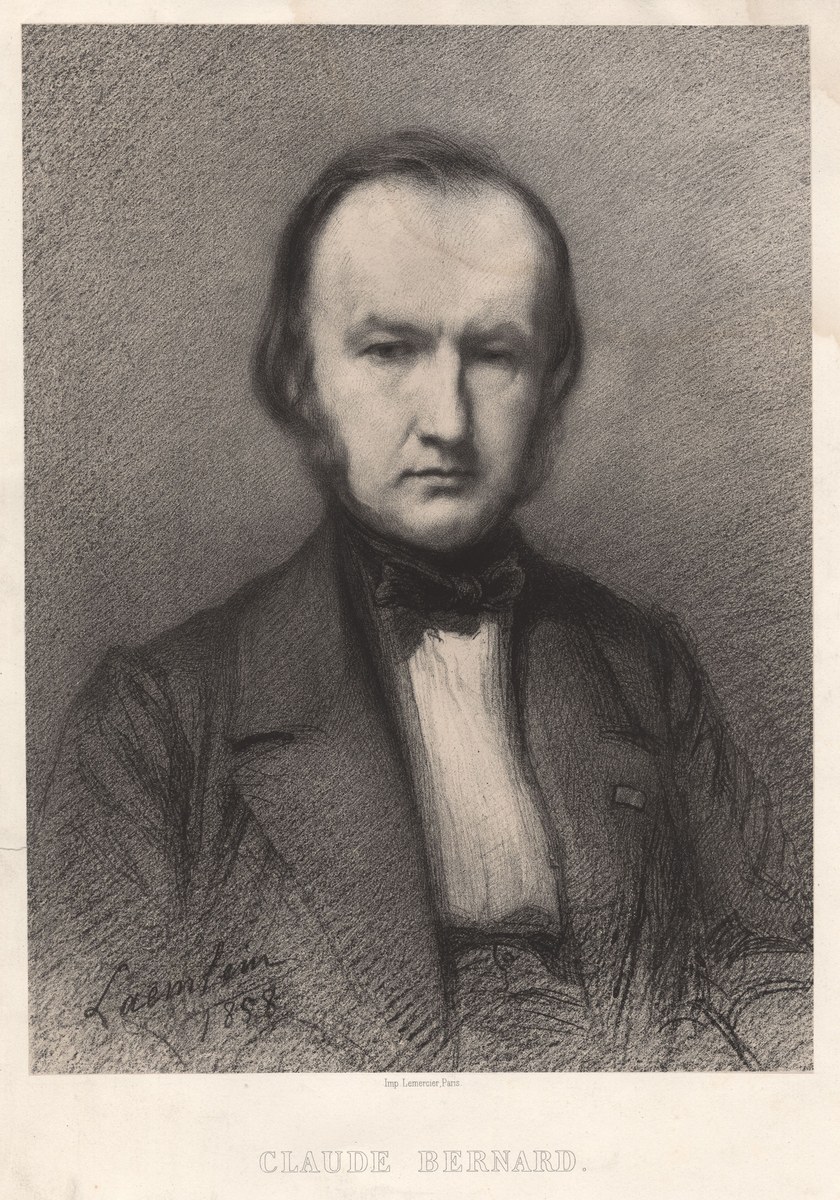

Alexandre Laemlein, 1858, BIU Sante, Universite Paris Cite (CIPC0168), Licence ouverte · Lithograph portrait 'Claude Bernard', signed 'Laemlein 1858', printed by Lemercier, Paris; Bibliotheque interuniversitaire de sante (BIU Sante), Universite Paris Cite, record CIPC0168 (stamp of R. Blanchard). A contemporary printed portrait made when he was 45; the holder record does not document a sitting. Digital master 2645 x 3779 pixels; this copy downscaled to 840 x 1200 (never enlarged). · Licence ouverte (Etalab) stated on the BIU Sante record; the lithograph is also public domain by age (Laemlein died 1871)
과학자 · 19세기
클로드 베르나르
1813–1878
주요 업적 분야
아직 성격 매칭에 포함되지 않았습니다 — 기록된 근거가 성격 모델 전체를 다루기에는 충분하지 않습니다. 이 페이지의 다른 모든 내용은 자유롭게 확인하실 수 있습니다.
핵심 특성
주요 업적
생명과학에서 실험의 원칙을 확립하는 데 큰 역할을 해 실험의학의 창시자 중 한 사람이 되었으며, 1865년의 『실험의학 연구 입문』은 지금도 널리 읽히는 고전이다.
췌장액이 지방 소화에서 하는 역할, 간의 글리코겐 생성 기능, 혈액 공급을 조절하는 혈관운동신경을 밝혔고 쿠라레와 일산화탄소가 몸에 작용하는 방식을 보여 주었다.
몸의 내부 환경이 일정하게 유지되는 것이 독립된 생명의 조건이라는 내부 환경 개념을 발전시켰으며, 브리태니커는 이것이 오늘날의 항상성 이해로 이어졌다고 설명한다.
삶의 장면들
일부 토끼가 탁한 소변이 아니라 맑은 소변을 보는 것을 우연히 보고 의아해한 그는 토끼들이 먹이를 먹지 못해 자기 조직으로 살고 있다고 추론했고, 고기를 먹여 이를 확인했으며, 부검을 통해 소화에서 췌장이 하는 역할을 밝혀내는 데 이르렀다.
이는 예상 밖의 관찰을 검증 가능한 가설과 확인 실험으로 이어가는 습관과 부합한다. 호기심
갓 떼어낸 개의 간에서 당을 씻어낸 뒤 하루가 지나자 간이 다시 당으로 풍부해진 것을 확인하고 간에 당을 만드는 물질이 있다고 추론했으며, 1857년에는 간에서 순수한 글리코겐을 분리했다.
이는 생리학적 착상을 장기에서 직접 시험하고 그 결과에서 다음 추론을 이끌어내는 실험 방식과 부합한다. 실험 성향
전환점
1860년부터 병으로 쉬어야 했던 그는 1862~63년 요양 기간에 『실험의학 연구 입문』을 구상하면서, 구체적인 사실의 추구에서 생물학의 방법과 원리로 관심의 무게를 옮겼다.
이는 결과를 모으는 데서 그것을 분야의 틀로 일반화하는 쪽으로 옮겨 갔다는 점과 부합한다. 시스템적 사고
비슷한 인물
전체적인 프로필이 이 사람과 닮은 사람들이에요.
출처
- Claude Bernard (Q208230), verified live via the Wikidata API (2026-11-04): label 'Claude Bernard', description 'French physiologist (1813-1878)', born 1813-07-12, died 1878-02-10, citizenship France, Korean label 클로드 베르나르. Orientation only; not used as support for any row.
- Encyclopaedia Britannica, 'Claude Bernard' (Britannica Editors), article body read as served (through the sections on digestion, the liver, the vasomotor nerves, carbon monoxide and curare). CANONICAL SIGNIFICANCE SOURCE: French physiologist known chiefly for discoveries on the role of the pancreas in digestion, the glycogenic function of the liver and the regulation of the blood supply by the vasomotor nerves; one of the founders of experimental medicine who advanced beyond the vitalism and indeterminism of earlier physiologists; his most seminal contribution was the concept of the internal environment, which led to the present understanding of homeostasis; career from apothecary's apprentice and failed playwright to Magendie's assistant and deputy at the Collège de France, the chance observation of rabbits passing clear urine that led to the pancreas work, the 1856 discovery of glycogen. Scholarly modern reference.
- Complete Dictionary of Scientific Biography, entry 'Bernard, Claude' (as reproduced on Encyclopedia.com), full entry read: his work as Magendie's preparateur from 1841, the modest private laboratory in the Cour du Commerce and the neighbouring Pelouze laboratory, Magendie teaching him vivisection and suspicion of accepted doctrines, the failed teaching examination and resignation of 1844, the unsuccessful attempt at a free course, the 1847 deputyship and the 1852 chair, the discoveries (pancreatic juice and fat, the perfused liver and glycogen in 1855-57, vasodilating nerves in 1858, the milieu interieur in 1857), the shift from laboratory work to methodological synthesis in the Cahier rouge of 1850-60, the 1860-63 convalescence in which he drafted the Introduction, honours, his teaching 'science in the making', his posthumously published fermentation notes and Pasteur's angry reply ('there was truth and error on both sides'), and his criticism of Pasteur on spontaneous generation and of Virchow's cell theory. Scholarly historical dictionary; the entry's own judgments on Bernard's errors are used where cited.
- Science and Its Times, entry 'Claude Bernard' (as reproduced on Encyclopedia.com), read in full: sugar in the blood of meat-fed animals and the conversion of other substances to glucose in the liver, the concept of internal secretions and of the internal environment ('the constancy of the internal milieu is the condition for free and independent life'), the 1860 convalescence and the Introduction, the influence on Henderson and Cannon, and the note that a close examination of his research notebooks indicates the path to each discovery was much more confused and tortuous than the published accounts admit. Student-oriented reference work, independent of the Dictionary entry; the notebook remark is the counter-voice on his published method.
- Encyclopedia of Modern Europe, entry 'Bernard, Claude' (as reproduced on Encyclopedia.com), read in full: failed the agregation but his position let him do extensive research; the Rapport of 1867; the inaugural lecture to the Academie francaise seeking to reduce oppositions between materialism and spiritualism; the Introduction (1865) and its reception; the view that he regarded philosophers including Comte with quiet disdain and was suspicious of 'making a specialty of generalizations'; and that his determinism and attacks on vitalism raised criticism and debates that continue. A historiographical overview; used for the positivism and criticism points.
- Encyclopedia of World Biography, entry 'Claude Bernard' (as reproduced on Encyclopedia.com), read in full: apprenticeship and theatre ambitions, medical studies from 1834 and internship in 1839, honours, Pasteur's remark on the 1865 Introduction ('never has anything clearer, more complete, more profound, been written about the difficult art of experiment'), the starved rabbits and clear urine, the pancreatic juice and fat absorption, the washed dog liver that was again rich in sugar a day later and the isolation of glycogen in 1857, the sympathetic-nerve cuts of 1851-52, curare from 1844 and carbon monoxide, and the early errors (the function of the chorda tympani and of the nerve to the vocal cords misinterpreted). Reference biography; independent of the Dictionary entry in wording but built on the same secondary literature.
- Science Museum Group Collection, people record 'Claude Bernard 1813-1878' (biography text, read in full): a developer and teacher of experimental methods in medicine, professor of physiology in Paris, author of the influential Introduction to the Study of Experimental Medicine (1865); the museum notes that much of his work used experiments on living animals and that many people opposed the method. Short museum biography; the counter-voice on the use of vivisection (the museum's remark about his family is private life and is not used).
- Claude Bernard, Introduction a l'etude de la medecine experimentale (Paris, 1865), French original on Project Gutenberg, the passages on vivisection (part II, section III) and on the laboratory as 'the true sanctuary of medical science' read: SELF-REPORT of his own method and its defence ('without this mode of investigation there is no physiology or scientific medicine'). Self-authored; used only to show how he described his method, never as sole support for a row.
- Bibliotheque interuniversitaire de sante (BIU Sante, Universite Paris Cite), image bank record CIPC0168, 'Claude Bernard', lithograph by Alexandre Laemlein, 1858 (Licence ouverte). Holder record for the portrait only.