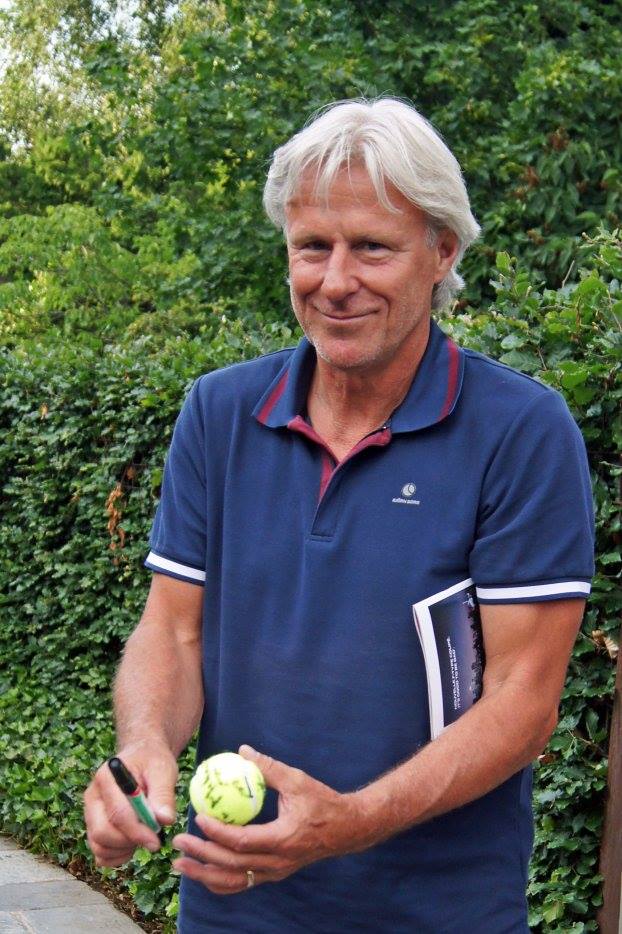

Photo: Michaël Bemelmans, 2014, CC BY-SA 4.0 · Wikimedia Commons, 'Bjorn Borg en 2014.jpg' -- photograph by Michaël Bemelmans, taken 10 May 2014 and uploaded to Commons by the photographer himself ('Own work', 7 May 2016) under CC BY-SA 4.0. Original 622 x 934 pixels (SHA-1 f6a4ed5b, matches the Commons record); saved unchanged at its original size, never upscaled. · CC BY-SA 4.0
운동선수 · 현대
비에른 보리
b. 1956
주요 업적 분야
아직 성격 매칭에 포함되지 않았습니다 — 기록된 근거가 성격 모델 전체를 다루기에는 충분하지 않습니다. 이 페이지의 다른 모든 내용은 자유롭게 확인하실 수 있습니다.
핵심 특성
주요 업적
보리는 1976년부터 1980년까지 5년 연속 윔블던 남자 단식 정상에 올랐다. 국제 테니스 명예의 전당은 1976년 일리 나스타세와의 결승을 첫 우승으로, 1980년 존 매켄로와의 5세트 결승을 역사상 최고의 경기 중 하나로 꼽는다. AP 통신은 1980년 결승 스코어를 1-6, 7-5, 6-3, 6-7, 8-6으로 전했다.
보리는 18세에 1974년 프랑스 오픈 결승에서 마누엘 오란테스에게 첫 두 세트를 내주고도 우승해 당시 이 대회 최연소 챔피언이 되었다. 국제 테니스 명예의 전당과 브리태니커는 그가 이 대회에서 통산 여섯 번, 1978년부터 1981년까지 4연속을 포함해 우승했다고 적는다.
보리는 1974년부터 1981년까지 8년 동안 메이저 단식 11승을 거두었고 1975년 스웨덴의 데이비스컵 우승을 이끌었다. 국제 테니스 명예의 전당은 그의 강한 톱스핀 포핸드와 양손 백핸드가 유행이 되어 모든 수준의 선수가 그의 스타일과 절제된 코트 태도를 따라 하려 했다고 쓴다. 그는 1983년 1월 23일 26세로 은퇴를 발표했다.
삶의 장면들
1974년 프랑스 오픈 결승에서 18세의 보리는 마누엘 오란테스에게 첫 두 세트를 2-6, 6-7로 내주었지만 이어진 세 세트를 6-0, 6-1, 6-1로 따냈다. ATP에 따르면 그는 대회 1회전 마지막 세트에서도 1-4 열세를 뒤집은 적이 있었다.
크게 뒤진 뒤에도 경기를 포기하지 않는 태도와 일치한다. 끈기
크리스천 사이언스 모니터는 1981년 독학에 가까운 보리가 그립과 양손 백핸드를 바꾸라는 사람들의 말을 늘 공손히 들었지만, 자신에게 편하고 통하는 방식에는 손대기를 거부했다고 썼다. 이 신문은 그가 이른 아침 훈련을 계속하고 톱스핀 샷을 자면서도 칠 수 있을 때까지 연습한다고도 덧붙였다.
외부 조언보다 자신의 방식을 믿고 그것을 꾸준히 연마하는 태도와 일치한다. 독립적 사고
전환점
스탠 스미스는 ATP에 1973년 17세의 보리를 이겼을 때 그가 큰 샷을 노리다 실수를 너무 많이 했지만, 1974년에는 그럴 필요가 없다는 것을 깨달은 '인간 볼 머신'이 되어 있었다고 회상했다. 보리는 그해 6월 프랑스 오픈에서 자신의 첫 메이저 타이틀을 땄다.
한 시즌에서 다음 시즌으로 넘어가며 전술적 접근을 바꾼 것과 일치한다. 적응력
비슷한 인물
전체적인 프로필이 이 사람과 닮은 사람들이에요.
출처
- Björn Borg (Q104506) -- verified live via the Wikidata API (2026-10-22): English label 'Björn Borg', description 'Swedish tennis player (born 1956)', born 6 June 1956, no date of death, citizenship Sweden, Korean label '비에른 보리', English and Korean Wikipedia sitelinks present. Orientation only; not used as support for any row.
- International Tennis Hall of Fame, 'Björn Borg' (Class of 1987) biography page (tennisfame.com), read in full: 11 major singles titles in 1974-81, six French Open titles (four in a row, 1978-81) and five straight Wimbledon titles (1976-80), a 1975 Davis Cup win for Sweden, the 1974 French Open title at 18 after losing the first two sets to Manuel Orantes, the 1980 Wimbledon final against John McEnroe, the 1981 final loss to McEnroe, four losing US Open finals, and his retirement announced on 23 January 1983 at age 26; descriptions of his controlled on-court demeanour ('ice man'), heavy-topspin style that many players tried to copy, racquets strung tighter than anyone else's, and coach Lennart Bergelin; quotations from McEnroe, Ilie Nastase and Borg himself about his on-court composure. Institutional hall-of-fame narrative, admiring. CANONICAL SIGNIFICANCE SOURCE (with Britannica). Its passages on burnout, fame, fans and personal friends were not used.
- Encyclopaedia Britannica, 'Björn Borg' (britannica.com, revised August 2026) -- short reference biography, read in full: born 6 June 1956 in Stockholm; Wimbledon singles champion five years in a row (1976-80) until his 1981 loss to McEnroe; French Open champion six times (1974-75, 1978-81), four in a row; 1975 Davis Cup win for Sweden with a record singles streak; never won the US Open or Australian Open; abrupt retirement in January 1983 and a short-lived comeback in 1991; inducted into the International Tennis Hall of Fame in 1987. CANONICAL SIGNIFICANCE SOURCE (with the Hall of Fame page). Brief and uncritical; the entry's statement that he joined the professional circuit at 14 conflicts with the Hall of Fame page and the ATP biography (professional debut in 1973) and was not used; its sportswear-business sentence was not used.
- ATP Tour, 'Bjorn Borg: 1974 Roland Garros Title, 50 Years On' (atptour.com feature, 2024), read in full: Borg's route to his first French Open title at 18 (a deciding set from 1-4 down in round one, then the final won after losing the first two sets to Orantes) and a series of accounts from people who played against or worked with him -- Brian Gottfried (his groundstrokes' depth, his first-serve percentage under pressure, 'he didn't appear to have a nerve in his body'), Stan Smith (in 1973 Borg 'made too many mistakes' going for big shots, in 1974 he had become a 'human ball machine' who did not need to), Orantes, coach Lennart Bergelin (preparing 'even if a threat is not there, we see a threat'), former coach Percy Rosberg, and Borg himself (self; not used alone); details of racquets flown from Stockholm and superstitions at tournaments. Tour-published retrospective with several outside voices; friendly in tone.
- ATP Tour, 'Bjorn Borg' player biography page (atptour.com), first section read: precocious results (youngest Italian and French champion at the time, a Davis Cup singles-winning streak, the 1975 Cup), his 1972 Davis Cup debut at 16, a professional career that was 'so brief and bright' (retired before 26), and a description of his unorthodox, topspin-heavy style, strength and endurance. Institutional career summary; used only to confirm career facts, no trait row rests on it.
- Phil Elderkin, 'Tennis champion Borg plays like an inspired robot', The Christian Science Monitor, 24 June 1981, read in full -- contemporaneous newspaper profile on the eve of Wimbledon: argues he is more than a 'machine' because of his drive, preparation and handling of adverse situations; praises his consistency, stamina and touch, his returns and calm when coming from behind; says he sometimes struggles to find his groove in early rounds; reports that after losses in March and April 1981 there were rumours he had lost determination, followed by his five-set French Open win over Ivan Lendl; says he is largely self-taught, 'always listened politely' to those wanting to change his grip and two-handed backhand but 'refused to tamper' with a method that worked, and 'continually pays dues' with early-morning workouts and topspin practice; quotes Harold Solomon (via Time) that playing him was like a good high-school team facing the Pittsburgh Steelers. Independent contemporaneous press, admiring; the closing lines on his money and homes were not used.
- Geoffrey Miller (Associated Press), 'AP Was There: McEnroe wins tiebreaker, Borg wins Wimbledon' (AP report of 5 July 1980, republished 12 July 2020 on news4jax.com), read in full -- wire report of the 1980 Wimbledon final: Borg won 1-6, 7-5, 6-3, 6-7, 8-6 after McEnroe saved seven match points and won the fourth-set tiebreaker 18-16; Borg says he had never been so disappointed on a court as when he lost that set, and then 'served like a master' in the fifth, dropping three points in seven service games; McEnroe says he thought Borg might give up after the long tiebreaker and Borg instead came back stronger; Borg calls it his hardest and best Wimbledon match. Contemporaneous wire report; its passage about his fiancee was not used.
- Michael Graham, 'Tennis Tales: The disastrous Monte Carlo comeback of the original King of Clay, Bjorn Borg', Tennis365, 24 April 2018, together with Alexandre Sokolowski, 'April 23, 1991: The day Bjorn Borg came back on the Tour with his wooden racquet', Tennis Majors, 23 April 2025 -- two retrospective features on the 1991 Monte Carlo comeback, both read in full and treated as ONE perspective: Borg, after about eight years away, took a wild card and lost to world No 52 Jordi Arrese 6-2, 6-3, using ten old wooden racquets shipped to London (Tennis365) while the game had moved to larger graphite frames; Boris Becker says 'he hits with no power', John McEnroe and Stefan Edberg call it hard to understand and sad; Borg says in 2007 that he knew he was not playing well and 'I knew that if I wanted to do well I had to use another racket but I thought, you know: why change?'; Tennis Majors says he lost the following matches and retired for good in 1993. The tennis-only facts and remarks are used; the Tennis365 passages on his finances, burnout, businesses and rumours were deliberately excluded. Critical counter-voice on his professional judgement; later-dated retrospectives.
- Wikimedia Commons file page 'Bjorn Borg en 2014.jpg' (with the Commons API record and file history) -- checked for the portrait's licence: photograph by Michaël Bemelmans, taken 10 May 2014, source 'Own work', uploaded by the photographer on 7 May 2016 and published under CC BY-SA 4.0; later page edits are category and structured-data changes only. Not used for any scoring.