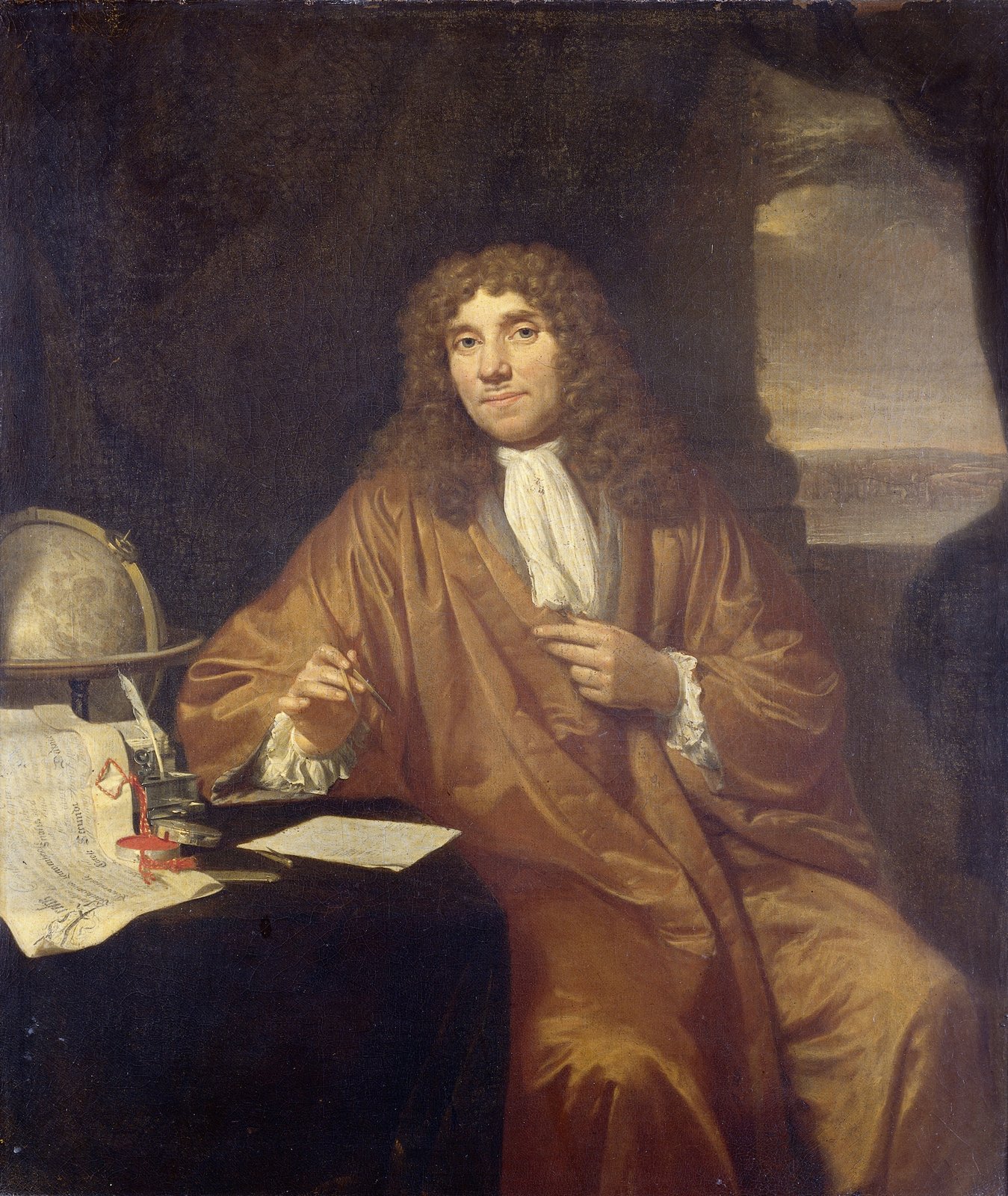

Jan Verkolje (I) (1650-1693), Portrait of Anthonie van Leeuwenhoek, natural philosopher and zoologist in Delft, oil on canvas, 56 x 47.5 cm, dated 1680-1686 by the Rijksmuseum, Rijksmuseum Amsterdam SK-A-957 (purchased 1879); public domain (painter died 1693); photograph released by the Rijksmuseum under CC0; saved as JPEG q85 at 1349x1600 from the 2148x2547 original · Jan Verkolje (I), oil on canvas, Rijksmuseum, Amsterdam (SK-A-957; on loan to Rijksmuseum Boerhaave, Leiden, accession P07252), via Wikimedia Commons · Public domain (painter d. 1693)
핵심 특성
주요 업적
레이우엔훅은 1673년부터 1723년까지 자신이 만든 현미경으로 관찰한 내용을 네덜란드어 편지로 왕립학회에 보냈고, 버치의 기록에 따르면 1679/80년 1월 29일(구력) 크룬 박사의 발의로 회원에 선출되었다. 도벨에 따르면 그는 회의에 참석하러 런던에 간 적이 없으며, 1723년에는 딸이 은제 틀에 끼운 렌즈 26개가 든 함을 학회에 보냈는데, 이는 그가 1701년에 사후 학회에 남기도록 마련해 둔 것이었다.
1669년 2월 4일 홀란트 궁정법원은 수학자 게네시위스 바엔이 기하학 시험을 치른 뒤 레이우엔훅을 선서 측량사로 허가했다. 도벨은 네덜란드 국립문서보관소의 이 문서를 인용하며, 《전집》 편집자들은 이 시험을 들어 그가 '기예(arts)'에 전혀 문외한은 아니었다고 지적한다.
삶의 장면들
왕립학회가 1677년 2월 그의 관찰 방법을 알려 달라고 요청하자, 레이우엔훅은 3월 23일 자신의 특별한 현미경을 아직은 공개할 결심이 서지 않는다고 썼다. 1677년 10월 5일에는 목사와 공증인을 포함한 델프트 증인들이 모세관 속 후추물을 그가 검사하는 것을 지켜보았다는 진술서를 보냈고, 증인들에게 본 것의 절반만 적어 달라고 부탁했다고 썼다. 버치는 이 진술서가 1677년 11월 1일(구력)에 낭독되었고, 로버트 훅이 두 번 실패한 뒤 11월 15일에 직접 그 생물들을 관찰했다고 기록한다.
증인들에게 수를 낮춰 적어 달라고 부탁한 점은 이 프로필의 중간 수준 분석적 엄밀성 점수와 부합하며, 기록이 엇갈리기 때문에 점수는 높지 않다. 이 경우 그는 방법을 알려 주는 대신 증언을 제출했고, 1685년 토머스 몰리뉴는 그의 추론이 때로 빗나간다고 생각했다. 분석적 엄밀성
1685년 2월 토머스 몰리뉴는 왕립학회 서기의 부탁으로 델프트에서 레이우엔훅을 방문했고, 버치가 실은 편지에서 보통 형태의 현미경 십여 개를 보았다고 보고했다. 레이우엔훅은 자기 말고는 아무도 들여다본 적 없는 다른 종류가 있다고 말하면서도 그것은 보여 주지 않았다. 몰리뉴는 보여 준 렌즈가 다른 어떤 것보다 훨씬 맑다고 보았고, 레이우엔훅의 '유일한 비밀'은 더 나은 연마일 것이라고 짐작했다.
공식 방문객에게 가장 좋은 기구를 보여 주지 않은 점은 이 프로필의 높은 자율성 욕구 점수와 부합한다. 이 자료에는 그의 이유가 나와 있지 않고 후대 저자들은 여러 설명을 내놓으며, 그는 1701년에 사후 학회로 보낼 렌즈함도 마련해 두었다. 자율성 욕구
전환점
1673년 4월 28일 델프트의 의사 레이니르 더 흐라프는 왕립학회 서기 헨리 올든버그에게 레이우엔훅이라는 사람이 자신이 본 어떤 것보다 뛰어난 현미경을 만들었다고 쓰고 관찰을 담은 편지를 동봉했다. 1673년 8월 15일의 답장에서 레이우엔훅은 자신이 문체가 없고 언어나 기예가 아니라 장사를 배우며 자랐으며 비난이나 반박을 달가워하지 않아 관찰을 글로 옮기는 것을 여러 번 사양했으나 더 흐라프의 청을 받아들였다고 쓰고, 자신의 관찰이 오직 자기 안의 충동과 호기심에서 나온 것임을 회원들이 기억해 달라고 청했다. 학회에 보내는 편지는 이후 50년간 이어졌다.
자신의 작업이 충동과 호기심에서 나왔다는 설명은 이 프로필의 호기심 점수와 부합하지만, 학술 단체에 보낸 첫 편지 속의 자기 서술이므로 그런 성격으로 감안해야 한다. 호기심
비슷한 인물
전체적인 프로필이 이 사람과 닮은 사람들이에요.
출처
- Antonie van Leeuwenhoek (English Wikipedia; lead section fetched via the MediaWiki API) -- orientation only (dates, Delft, draper, self-taught, microscopist); not used as support for any scored row. The Korean Wikipedia article 'ko:안토니 판 레이우엔훅' was confirmed through the ko.wikipedia API (lead read for the name only).
- Antonie van Leeuwenhoek (Q43522) -- identity verified live through the Wikidata API (wbgetentities: labels, descriptions, aliases, claims, sitelinks): en label 'Antonie van Leeuwenhoek', nl label 'Antoni van Leeuwenhoek', ko label '안톤 판 레이우엔훅', kowiki sitelink title '안토니 판 레이우엔훅', born 1632-10-24, died 1723-08-26 (a second value 08-30 is also listed), citizenship Q170072 (mapped to NL), born and died in Delft (Q690), P18 = Rijksmuseum print 'Portret van Antonie van Leeuwenhoek, RP-P-1903-A-23563.jpg'. The en description ('Father of Microbiology') is a fame label and is NOT used. Orientation only.
- Clifford Dobell, Antony van Leeuwenhoek and His 'Little Animals' (Harcourt, Brace, New York/London, 1932), archive.org OCR full text (id antonyvanleeuwen00dobe, 1.0 MB) downloaded and read locally: the whole Life chapter (pp. 19-100: Delft drapery, chamberlain 1660, surveyor 1669, wine-gauger 1679, de Graaf's 1673 introduction and Oldenburg's reply, Constantijn Huygens sr's 1673 character note, the 1680 Fellowship, Thomas and William Molyneux 1685/1692, Constantijn Huygens jr's 1685 report of the Landgrave's visit, de la Crose 1693, Uffenbach's 1710 visit in Dobell's translation, the 1710-11 letters on visitors, the 1716 Louvain medal, the last letters, the 1701 cabinet and its 1723 delivery); Part II chapter 2 (pp. 167-190: Letters 19, 21 and the eight Delft attestations, Christiaan Huygens's 1675 doubt and 1677-78 note, Hooke's 1677 letter and Birch's minutes as quoted, Letters 23 and 26); Elucidations (ii) language, (iii) microscopes (Folkes 1724, Baker 1740, the 1747 sale catalogue) and (vi) portraits (pp. 346-355). Dobell is a modern protozoologist-translator who admires L. (friendly modern-scholar perspective, ONE perspective) and translates the Dutch, Latin and German texts himself; his interpretive remarks (e.g. that L. 'strongly opposed' spontaneous generation, that Uffenbach was 'fatuous') are not relied on. Chapters 1, 3, 4 of Part II and the Envoy were not read. Used for dated documents by OTHER people (Molyneux, Huygens jr, Uffenbach, Folkes, attestations) and flagged wherever a row would rest on his translation alone. NOTE ON USE: where a row relies on a document by another person that I reached only in Dobell's translation (Constantijn Huygens Sr 1673, Constantijn Huygens Jr 5 Nov 1685, William Molyneux 1692, de la Crose 1693, Uffenbach 1710, Folkes 1724, the 1747 sale catalogue), the rationale says so. Uffenbach's German original (Merkwuerdige Reisen, vol. 3, 1754, pp. 349-360) was NOT read: the only archive.org scan I could fetch (Fraktur OCR, id bub_gb_4Ec7AAAAcAAJ) did not contain the Delft passage; Cocquyt et al. 2021 independently cite Uffenbach for the denial of globular lenses.
- Alle de brieven van Antoni van Leeuwenhoek / The Collected Letters, Deel 1: 1673-1676 (Swets & Zeitlinger, Amsterdam, 1939), DBNL PDF (6.7 MB) downloaded and text-extracted: read Letter 2 (15 Aug 1673: reluctance to write, lack of schooling, 'own impulse and curiosity alone'), Letter 11 [6] (7 Sept 1674: the mistaken tendon/nerve identification corrected by the Delft anatomist Schravesande; the chalk passage 'out of curiosity' after an English trip about six years earlier, with the editors' note that Dobell over-reads it as proof of microscope work in 1668), Letter 13 [8] (4 Dec 1674: 'at first I intended to stop my observations for a time, but your kind letter has encouraged me to continue') and the opening of Letter 18 [12] (14 Aug 1675: Oldenburg's advice to call in other judges, and L.'s answer), with the edition's English translation and notes. SELF-authored (one perspective, however many letters); the editorial notes are used only to check what a letter says. The rest of the volume was not read.
- Alle de brieven van Antoni van Leeuwenhoek / The Collected Letters, Deel 2: 1676-1679 (Swets & Zeitlinger, Amsterdam, 1941), DBNL PDF (6.9 MB) downloaded and text-extracted: read Letter 26 [18] (9 Oct 1676) at the passage where he says he does not impart his method and at the day-by-day entries; Letter 31 [19] (23 Mar 1677: the counting method with its 'I imagine' hedge, the refusal 'as yet' to make his particular microscopes public, the frozen-water test); Letter 33 [21] (5 Oct 1677) read in context from start to end of its English text (Oldenburg's request about the skin of Africans that he had not yet followed up, eel worms and eel blood after buying six eels, the flea eggs carried in his pocket and the disagreement with Swammerdam, re-weighing of the millet-seed measure, the eight attestations and his request that witnesses state half their count); the five signed attestations printed with it (Petrie 20/30 Aug 1677 in English; Haan and Cordes 18 May 1677 in Latin with the edition's Dutch and English translation; Hodenpijl, Boogert-Poitevin-Burch, Gordon) -- independent contemporary witness documents, recruited by L.; Letter 34 (16 Oct 1677, to Brouncker after Oldenburg's death) and Letter 35 [22] (Nov 1677, the Latin letter on animalcules in semen, including his request that it be kept private, published or destroyed at the recipient's discretion). SELF-authored letters (same perspective as vols. 1 and 12) plus the witnesses' own statements.
- Alle de brieven van Antoni van Leeuwenhoek / The Collected Letters, Deel 12: 1696-1699 (Huygens Instituut / Royal Netherlands Academy edition), DBNL PDF (3.4 MB) downloaded and text-extracted: read the header, summary and the English passages of Letter 200 [116] (9 June 1699, to the Royal Society), in which he disputes a published claim (Dalenpatius / de Plantade, Nouvelles de la Republique des Lettres, May 1699) that spermatozoa show a complete human form. SELF-authored (same perspective as vols. 1-2); the rest of the volume was not read.
- Thomas Birch, The History of the Royal Society of London, vols. 3 (1756) and 4 (1757), archive.org OCR (long-s text) downloaded and searched locally. Vol. 3, 1677 entries read in context: 1 Feb and 15 Feb (the Society orders that L. be asked for his method of observing), 5 Apr (his 23 March letter read; Grew to try the observations), a meeting between 15 Oct and 1 Nov (his letter after Oldenburg's death; Hooke told to make a microscope 'after a way' likely to do as much as L.'s), 1 Nov (the eight testimonials read; Hooke's pipes test), 8 Nov (nothing seen) and 15 Nov (Hooke sees the animals in nine-to-ten-day pepper-water; nine named witnesses). Vol. 4: 29 Jan 1679/80 (election on Dr Croone's motion), 23 Nov 1681 (Henshaw moves that L. be asked to communicate or publish his invention; Hooke thinks the glasses are the kind described in his Micrographia), 1682 (L.'s reply to Hooke's request about crab and shrimp muscle fibrils) and the letter of Thomas Molyneux to Aston, Leyden, 13 Feb 1685 N.S., printed in full (civil and complaisant; showed only ordinary microscopes; another sort 'no man living' had looked through kept for his own observations and not shown; his 'only secret' probably clearer, better-polished glasses; ignorant of letters; 'wholly trusting to his own' thoughts, which 'now and then lead him into extravagancies'). Contemporary Royal Society minutes and a visitor's letter as printed 72-79 years later: independent institutional perspective (dates Old Style; OCR partly garbled).
- Tiemen Cocquyt, Zhou Zhou, Jeroen Plomp and Lambert van Eijck, 'Neutron tomography of Van Leeuwenhoek's microscopes', Science Advances 7(20) eabf2402 (May 2021), open-access full text read through Europe PMC (PMC8121416) -- Rijksmuseum Boerhaave / TU Delft study of two preserved microscopes; it quotes Uffenbach (1710) on globular lenses, Hooke's 1678 complaint that L. would not impart his method, and the Molyneux visit. The authors' reading that L. kept silent to conceal a debt to Hooke is ONE interpretive step and is not used as fact. Limits stated by the authors: only two instruments examined. Independent modern museum-science perspective.
- Lens on Leeuwenhoek (lensonleeuwenhoek.net; single author Douglas Anderson, guest researcher at the Huygens Institute 2016-2024) -- pages 'About', 'Hooke's Three Tries', '1677: To confirm his observations' and 'Wrote Letter L-040 of 1676-10-09' read through WebFetch summaries (not full page text); used only for orientation and to cross-check the Birch dates (its dates are New Style); NOT used as support for any scored row.
- Rijksmuseum, Amsterdam, collection page SK-A-957 (WebFetch) plus the Commons File page for the same painting -- object record for Jan Verkolje (I), Portrait of Anthonie van Leeuwenhoek, oil on canvas, 56 x 47.5 cm, dated 1680-1686, purchased 1879, Public Domain Mark; used ONLY for the portrait chain (see provenance.notes and the portrait block), not for any scored row.