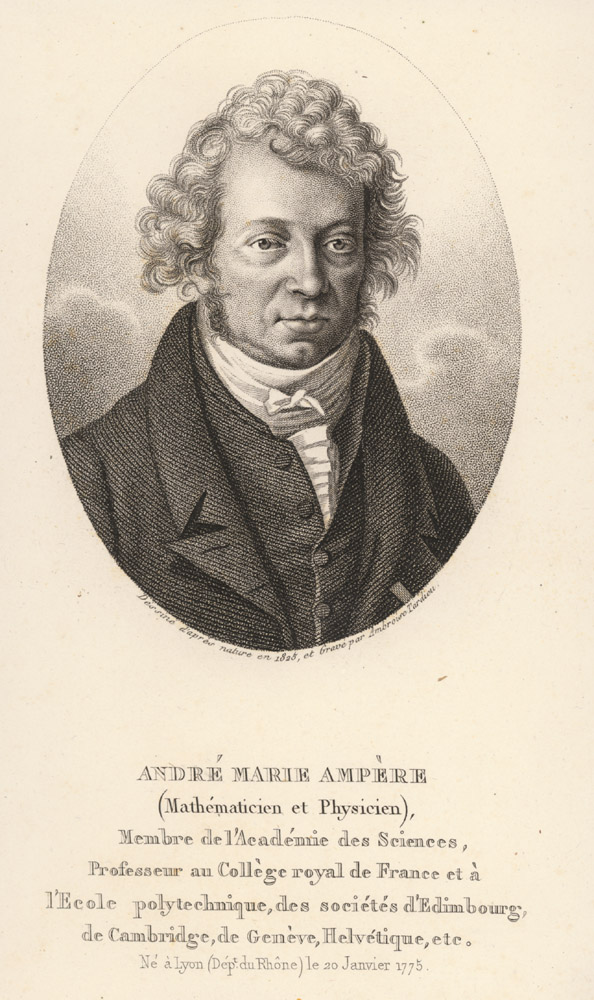

Ambroise Tardieu (engraver, after a drawing from life of 1825); image from the Smithsonian Libraries and Archives Dibner Library collection, via the Scientific Identity portrait gallery · Stipple engraving of André-Marie Ampère by Ambroise Tardieu, printed with the legend 'drawn from life in 1825 and engraved by Ambroise Tardieu'; Smithsonian Libraries and Archives, Dibner Library portrait collection (Scientific Identity), item SIL14-A4-05 · Public domain (engraving published in France in or about 1825; engraver Ambroise Tardieu died in 1841)
물리학자 · 19세기
앙드레마리 앙페르
1775–1836
주요 업적 분야
아직 성격 매칭에 포함되지 않았습니다 — 기록된 근거가 성격 모델 전체를 다루기에는 충분하지 않습니다. 이 페이지의 다른 모든 내용은 자유롭게 확인하실 수 있습니다.
핵심 특성
주요 업적
1820년 9월, 외르스테드의 발견 소식이 파리 과학 아카데미에 전해진 지 일주일 만에 앙페르는 전류가 흐르는 평행한 두 도선이 전류의 방향이 같으면 서로 끌어당기고 반대이면 서로 밀어낸다는 사실을 보였다. 그는 이어 전류 요소 사이에 작용하는 힘의 수학적 법칙을 도출하여 1826년의 전기역학 현상에 관한 수학적 이론 논문에 담았고, 이 새로운 학문에 전기역학이라는 이름을 붙였다. 맥스웰은 이 연구를 '과학에서 가장 눈부신 업적 중 하나'라고 평가했으며, NIST는 2019년까지 암페어의 정의가 앙페르가 1820년대에 수행한 실험을 일반화한 것이었다고 설명한다.
앙페르는 자기 현상 자체가 전기적인 것이라고 보았다. 자석의 성질은 그 분자 속을 도는 작은 닫힌 전류에서 비롯되며, 지구의 자기도 지구를 동에서 서로 도는 전류들의 체계로 설명할 수 있다는 것이다. 그는 도선을 나선형으로 감은 장치에 솔레노이드라는 이름을 붙였는데, 이것은 전류가 흐르면 막대자석처럼 작용한다. 휘태커는 또한 앙페르가 전류가 흐르는 회로의 자기 효과가 자기 껍질(자기 이중층)과 같다는 것을 보였다고 기록한다.
전기역학에 앞서 앙페르는 수학자로 알려져 있었다. 도박꾼에게 확률이 불리하다는 것을 보여 준 1802년의 우연 게임 수학 논문 덕분에 그는 리옹과 파리에서 자리를 얻었고, 1809년부터 1828년까지 에콜 폴리테크니크의 수학 교수로 있었다. 1814년에 발표한 편미분방정식 분류는 같은 해 11월 그가 학사원(Institut)에 선출되기 직전의 업적이다. 만년에는 인간의 모든 지식을 자연스럽게 분류하려는 시도인 『과학 철학 시론』을 썼다.
삶의 장면들
앙페르는 1820년 12월과 1821년 2월의 편지에서 친구들에게, 석 달 동안 전류와 자석이 서로에게 미치는 작용이라는 한 가지 생각뿐이었고, 강의 두 개를 맡은 채 밤늦게까지 깨어 있으며, 그때까지 가장 좋아하던 형이상학마저 제쳐 두었다고 적었다. 두 번째 편지에서는 자신의 논문이 극도로 서둘러 토막토막 쓰여 충분히 명료하지 않다고 인정하기도 했다.
다른 관심사를 접고 밤을 새워 한 가지 문제에 몰두한 모습은 깊은 집중과 일치한다. 서두른 탓에 논문이 명료하지 못했다는 본인의 시인은 그 대가를 보여 주며, 이 서술은 찬미하는 전기 작가 발송이 전한 그의 편지에 근거한다. 몰입
앙페르는 1816년까지 빛의 방출설을 열렬히 지지했다. 전기 작가 C.-A. 발송(Valson)은 프레넬의 연구가 『화학과 물리학 연보』에 소개되자 앙페르가 아끼던 이론을 고통스럽게 포기했다고 스스로 인정했다고 전하며, 1816년에는 비오와 라플라스에 맞서 프레넬 편에 서서 파동설을 옹호했다. 프레넬은 1822년부터 1827년 사망할 때까지 앙페르의 집에서 지냈다.
경쟁 이론의 근거가 제시되자 애착이 있던 이론을 내려놓은 것은 믿음을 고쳐 가는 태도와 일치한다. 입장 수정 성향
전환점
전류가 자침에 미치는 작용에 관한 외르스테드의 실험은 1820년 9월 11일 과학 아카데미에서 재현되었다. 이레 뒤인 9월 18일 앙페르는 이미 장치를 만들어 놓은 더 일반적인 결과를 발표했고, 이후 몇 주 동안 학자들이 그의 서재를 찾아 백금 도선이 지구의 작용에 따라 방향을 잡는 것을 보았다. 발송(Valson)은 이후 몇 해 동안 그가 형이상학 연구를 접었다고 적고 있으며, 그는 1826년 콜레주 드 프랑스에서 직접 구성한 강의로 전기역학을 가르치기 시작했다.
다른 연구에서 새로 보고된 실험으로 며칠 만에 방향을 돌린 것은 기회 포착과 일치한다. 그가 한 학문 분야 전체를 미리 내다보았다는 말은 찬미하는 이들의 서술일 뿐이므로 여기서는 주장하지 않는다. 기회 감지
비슷한 인물
전체적인 프로필이 이 사람과 닮은 사람들이에요.


앨런 튜링

에이다 러브레이스

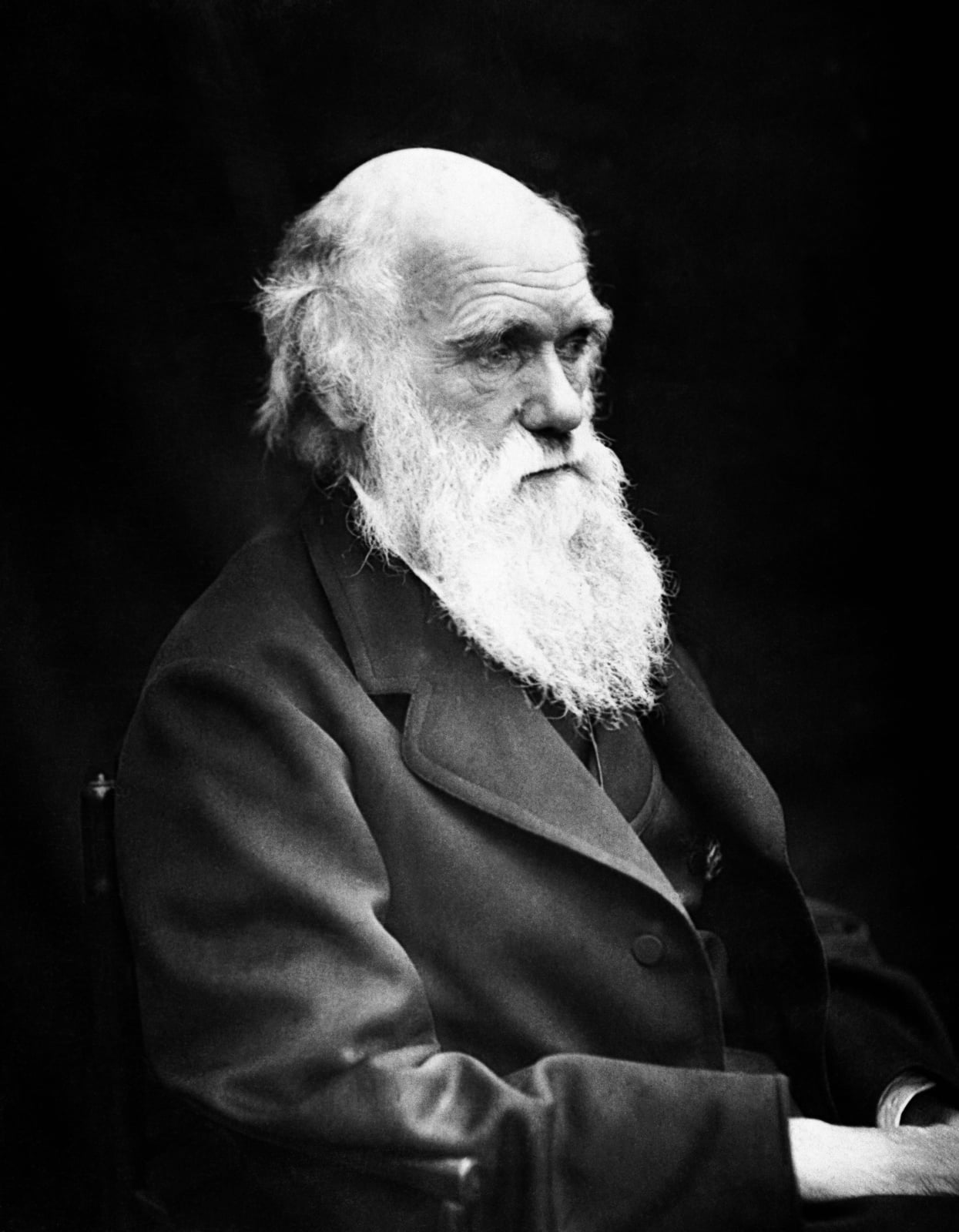
찰스 다윈

아리스토텔레스

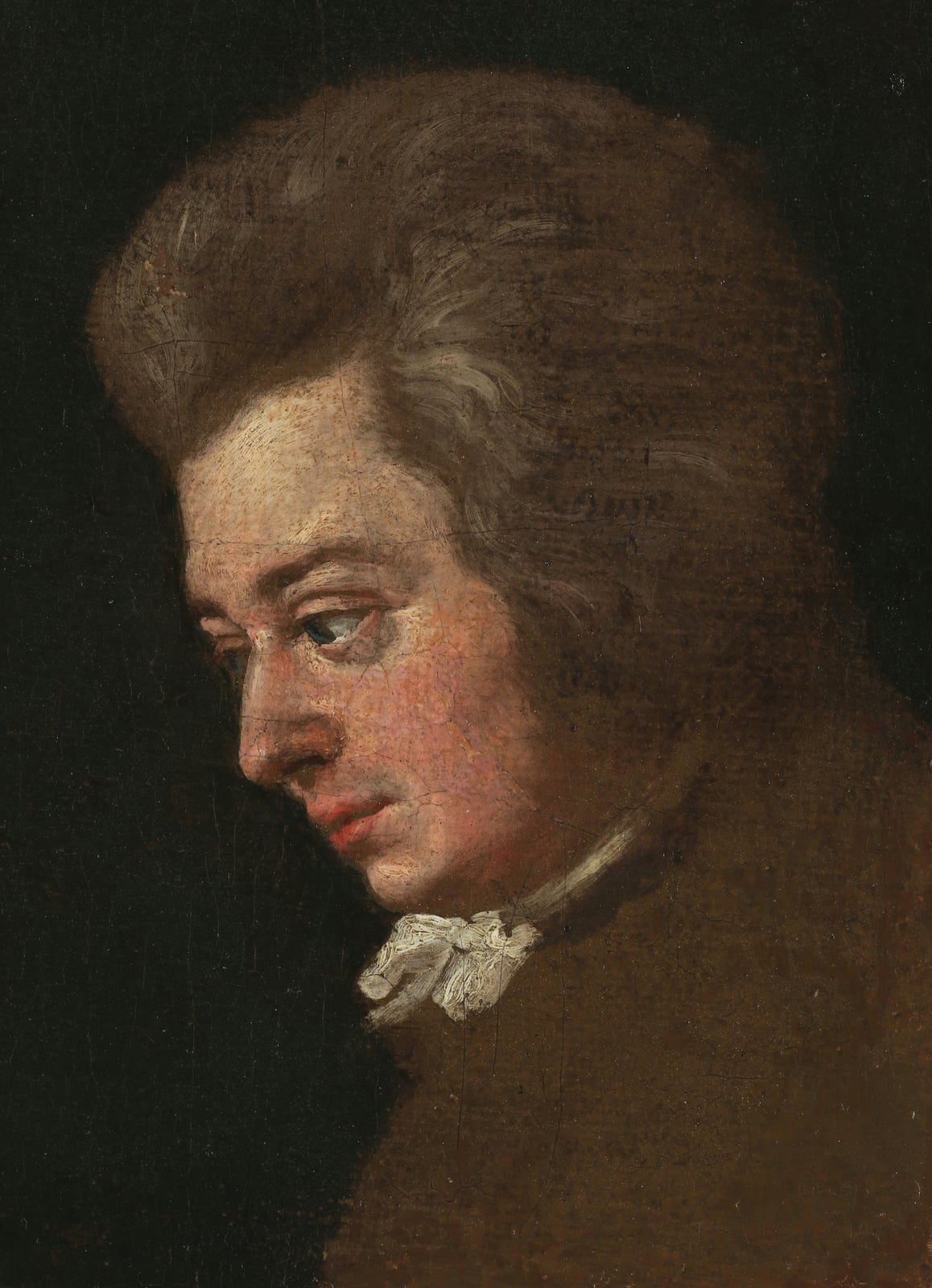
볼프강 아마데우스 모차르트
출처
- André-Marie Ampère (Q675) -- verified live (2026-10-10) via Special:EntityData: en label 'André-Marie Ampère', description 'French physicist and mathematician (1775–1836)'. Orientation only; not used as support for any row.
- J. J. O'Connor and E. F. Robertson, 'André-Marie Ampère', MacTutor History of Mathematics archive (University of St Andrews) -- scholarly summary biography that draws on James R. Hofmann's 1995 biography (quoted in it), Blondel and Dictionary of Scientific Biography; used for dates, the Académie sequence of September-November 1820, the École polytechnique teaching, the 1814 Institut election and the Savary/Liouville/Fresnel working relationships. Read in full (references list skimmed).
- 'Ampère, André Marie', Encyclopaedia Britannica, 11th edition (1911), vol. 1, via Wikisource -- short encyclopaedia entry (non-self, neutral) used only to cross-check the 11 and 18 September 1820 dates, the 1802 probability treatise and the naming of electrodynamics. Read in full.
- François Arago (Perpetual Secretary of the Académie des sciences and Ampère's friend of more than thirty years), 'Ampère' -- biographical éloge read to the Académie in 1839, in Oeuvres complètes de François Arago, vol. 2 (Notices biographiques II), Paris 1854, Internet Archive scan -- INSIDER/FRIEND colleague account, openly affectionate, but unusually detailed on the September 1820 sequence, the early objections to the electrodynamic theory, the Essai sur la philosophie des sciences (which Arago also criticises) and Ampère's working habits. Read in full for the electrodynamics, classification and character sections; the early-life and metaphysics sections were skimmed.
- James Clerk Maxwell, A Treatise on Electricity and Magnetism, vol. 2 (Oxford, 1873; 1881 edition scan), arts. 526-528 -- later physicist's assessment (independent, admiring but analytical) of Ampère's experimental and mathematical work and of how it was presented, including the 'Newton of electricity' sentence and the remark that the published demonstration hides the route of discovery. Read the cited passage and surrounding articles.
- E. T. Whittaker, A History of the Theories of Aether and Electricity: From the Age of Descartes to the Close of the Nineteenth Century (London, 1910), pp. 85-93 (chapter 'Galvanism, from Galvani to Ohm') -- independent historian-mathematician's account of Oersted's discovery, Ampère's 18 September 1820 communication, the Biot-Savart announcement of 30 October 1820, Ampère's four laws, his assumption of central forces (which Whittaker calls the weak point), and the magnetic-shell and molecular-current development. Read the cited pages in full.
- C.-A. Valson (Dean of the Catholic Faculty of Sciences, Lyon), La vie et les travaux d'André-Marie Ampère (Lyon, 1886), Internet Archive scan -- ADMIRING (and at times hagiographic) biography that quotes Ampère's own letters of 1811-1822 from the 1875 'Correspondance et souvenirs' and passages by Littré, Sainte-Beuve and Arago. Used for the chapters on the scientific work (1811-1822 letters, the solenoid, the reception of the theory, Fresnel and the wave theory) and the portrait/character chapter. Read those chapters; the chapters on family and Jean-Jacques Ampère were not read.
- Henry Bence Jones, The Life and Letters of Faraday (London, 1870), vol. 1, Internet Archive scan -- contemporary NON-FRENCH perspective: Faraday's 1813 travel journal (Ampère with Clément and Desormes showing the new substance iodine to Davy), Faraday's letter to De la Rive of 12 September 1821 on Ampère's experiments and theory (SKEPTICAL of the theory, respectful of the experiments), and Ampère's own letter to Faraday of 1830 via Hachette. Read the cited letters and journal entries.
- Journal et correspondance d'André-Marie Ampère (Paris, 1869; collected by Mme H. Cheuvreux, his daughter-in-law), Internet Archive scan -- SELF source (his early journal and letters 1793-1805); only the editor's introduction (with its quotations of Arago and Littré) was used. The private journal and letters were deliberately not used for any trait row.
- National Institute of Standards and Technology (NIST), 'Ampere: Introduction' (SI redefinition pages) -- institutional (non-self) statement that the SI base unit of electric current, the ampere, was until 2019 defined by a general version of an experiment conducted by André-Marie Ampère in the 1820s (current in two parallel wires). Used only for the legacy-of-the-unit sentence in an Achievement card; not used for any trait row. Read in full.