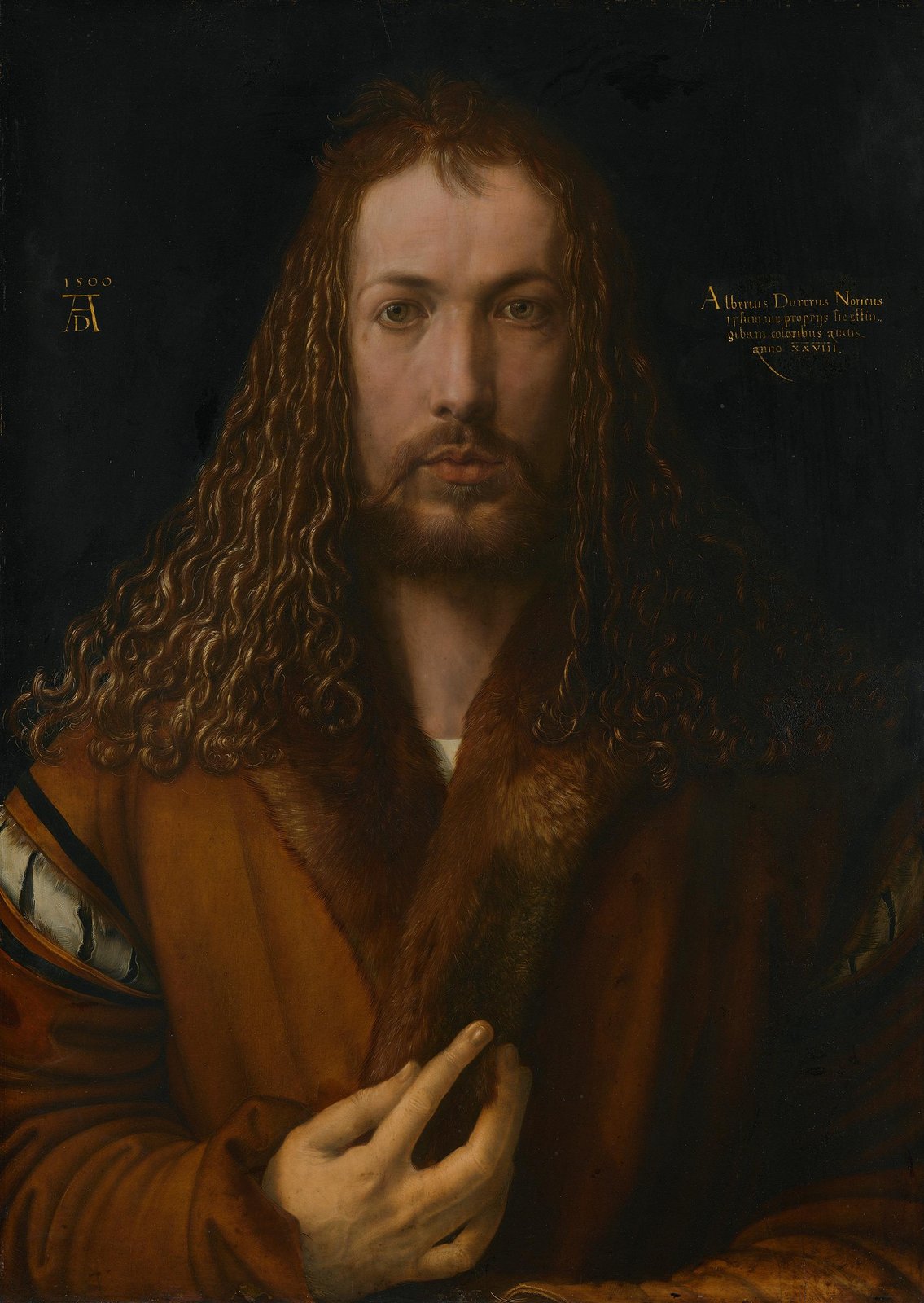
Albrecht Dürer, Self-Portrait, 1500, Bayerische Staatsgemäldesammlungen - Alte Pinakothek, München; painting in the public domain (artist d. 1528; PD-Art/PD-old-100-expired on Commons); the museum also publishes this image under CC BY-SA 4.0; downscaled · Albrecht Dürer, Self-Portrait (Selbstbildnis im Pelzrock), 1500, oil on limewood, Bayerische Staatsgemäldesammlungen - Alte Pinakothek, Munich (inv. 537), museum digital image via Wikimedia Commons · Public domain
핵심 특성
주요 업적
뒤러는 1500년 무렵까지 「요한 묵시록」(1498)을 포함해 종교적 주제를 다룬 대형 목판화 연작 세 가지를 완성하거나 시작했다. 1511년에는 뉘른베르크의 자기 인쇄소에서 목판화집 네 권을 펴냈고, 1513~14년에는 동판화 「기사, 죽음, 악마」, 「서재의 성 히에로니무스」, 「멜랑콜리아 I」을 제작했다.
뒤러는 학생을 위한 기하학·원근법 교본인 『측정술 교본』(1525)과 도시 요새화에 관한 논고(1527)를 직접 쓰고 삽화를 그렸다. 『인체 비례에 관한 네 권의 책』은 그가 세상을 떠난 1528년에 나왔으며, 친구 빌리발트 피르크하이머가 출판을 마무리했다.
두 번째 베네치아 체류 중 그는 그곳의 독일 상인들을 위해 「장미 화관의 축제」(1506)를 그렸다. 1526년에는 두 폭으로 된 「네 사도」를 뉘른베르크 시 참사회에 기증했고, 참사회는 그해 10월 이를 받아들였다. 이 그림은 현재 뮌헨 알테 피나코테크에 있다.
삶의 장면들
프랑크푸르트 상인 야코프 헬러에게 보낸 뒤러의 편지(1507~09)에는 약 130플로린에 주문된 제단화의 제작 과정이 담겨 있다. 뒤러는 울트라마린 바탕을 대여섯 번 겹쳐 칠하겠다고 쓰고 200플로린을 요구했으며, 지연을 두고 헬러와 날카로운 편지를 주고받은 끝에 1509년 8월 그림을 보냈다. 남아 있는 것은 뒤러 쪽 편지뿐이며, 이 그림을 위한 습작 스물한 점이 대부분 1508년 날짜와 함께 지금도 전한다.
여러 겹으로 칠한 작업과 긴 준비 과정은 이 프로필의 높은 완벽주의 점수와 부합한다. 그렇게 공을 들이는 일은 "수지가 맞지 않는다"는 뒤러 자신의 말은 이 항목을 양면적으로 표시한 이유 가운데 하나다. 완벽주의
1520년 12월 네덜란드에 머물던 뒤러는 제일란트의 지릭제이에 거대한 고래가 떠밀려 왔다는 소식을 듣고 말과 배를 타고 그곳까지 갔지만, 고래는 이미 조수에 휩쓸려 가고 없었다. 그의 일기에 이 여정이 기록되어 있다. 같은 바다에서 잡힌 바다코끼리를 그린 1521년 날짜의 소묘가 대영박물관에 있다.
겨울에 일주일이 넘는 길을 돌아 낯선 동물을 보러 간 일은 이 프로필의 높은 호기심 점수를 뒷받침하는 한 가지 사례가 된다. 호기심
전환점
뒤러는 출간되지 않은 원고에서, 젊은 시절 베네치아 화가 야코포 데 바르바리가 비례 체계에 따라 그린 남녀 인물상을 보여 주었지만 그 원리는 설명해 주지 않았다고 회상했다. 이후 그는 비트루비우스를 읽고 스스로 인체를 측정하고 구성하기 시작했으며, 1500년 날짜가 적힌 여성 비례 소묘가 남아 있다. 이 작업은 평생 대부분 이어져 『인체 비례에 관한 네 권의 책』으로 이어졌다.
공개되지 않은 방법을 고전 문헌과 자신의 측정으로 재구성하려 한 일은 이 프로필의 체계적 추상화 점수와 나란히 놓인다. 친구 요아힘 카메라리우스는 훗날 그가 회화를 규칙과 원리 위에 올려놓았다고 묘사했다. 시스템적 사고
비슷한 인물
전체적인 프로필이 이 사람과 닮은 사람들이에요.
출처
- Albrecht Dürer (English Wikipedia) -- orientation only; not used as support for any scored row. Korean Wikipedia title '알브레히트 뒤러' confirmed via the Wikidata sitelink.
- Albrecht Dürer (Q5580) -- verified live via wbgetentities (2026-09-26): en label 'Albrecht Dürer', description 'German painter, printmaker, mathematician, and theorist (1471-1528)', ko label '알브레히트 뒤러', born 1471-05-21, died 1528-04-06, citizenship Q47261, P18 'Dürer Alte Pinakothek.jpg', kowiki '알브레히트 뒤러'. Orientation only.
- Dürer's OWN letters, diary and writings in English translation in W. M. Conway, Literary Remains of Albrecht Dürer (Cambridge, 1889), archive.org OCR full text (literaryremainso00conw) -- SELF, one perspective, never sole support for a row. Read: the Venice letters to Pirckheimer of 7 Feb., 8 Sept., 23 Sept. and c. Oct. 1506 (ch. IV); all nine letters to Jacob Heller, 28 Aug. 1507 - 26 Aug. 1509 (ch. V; Heller's side does not survive, his complaints are known only as Dürer quotes them); the Netherlands diary entries for Bamberg (July 1520), Brussels (Aug.-Sept. 1520) and the Zeeland trip (3-14 Dec. 1520) (ch. VII); the 1524 letter to the Nuremberg Council and the 1526 letter presenting the Four Apostles (ch. VIII); the manuscript draft on Jacopo de' Barbari and Vitruvius (ch. X); the 1525 dedication of the Underweysung der Messung to Pirckheimer (ch. XI); the extract from the Third Book of Human Proportion (ch. XII).
- W. M. Conway, Literary Remains of Albrecht Dürer (1889) -- the editor's own narrative and notes, SCHOLAR perspective (19th-century, admiring; some motive readings, e.g. that the Heller picture was undertaken as advertisement, are NOT used). Read: ch. IV-V (Venice 1505-07; the Heller altarpiece, incl. the note that 21 preparatory studies survive, most dated 1508, and that the wings were executed by apprentices), ch. VI (Dürer as printer-publisher: the 1511 'three great books' with the imprint 'Printed at Nürnberg by Albrecht Dürer, the painter', his own press, the fair stalls; and the note that he did other graphic work in the evenings while painting the altarpieces), ch. VII notes (Zeeland trip; British Museum walrus drawing dated 1521), ch. VIII (1524 annuity; Council's acceptance of the Four Apostles on 6 Oct. 1526; 1525-28 publications), ch. IX-X (curiosity; proportion studies from before 1500, the 1500 measured drawing, the shift to 'words of difference' and temperaments).
- Joachim Camerarius, preface to his Latin translation of Dürer's Four Books of Human Proportion (Nuremberg, 1532), English translation of the biographical passages in Conway 1889 ch. VIII pp. 136-141, read in full -- NON-SELF, FRIEND/INSIDER perspective (a Nuremberg gymnasium professor and 'intimate friend', writing four years after Dürer's death, partly from his own acquaintance and partly from 'the conversations of others'; eulogistic). The Bellini brush and Mantegna stories are secondhand (Dürer's own telling or others'); the stolen horse-proportion notes are Camerarius's own report.
- Philipp Melanchthon's recollections of Dürer as quoted in Conway 1889: (a) his account, quoted from the Edinburgh Review (civ, p. 47), with a second wording in Conway's footnote, of Dürer's saying that as a youth he loved bright, florid and unusual designs but as an older man sought nature's simplicity and groaned at his own paintings (ch. X, p. 185); (b) Caspar Peucer's report (Tractatus historicus de Ph. Melanchthone, 1569, via Strobel) of Melanchthon's story of Dürer's table disputes with Pirckheimer c. 1525 (ch. VIII p. 133). NON-SELF friend perspective, but (a) relays Dürer's own self-description and (b) is a second-hand retelling; weighted accordingly.
- Jacob Wisse (Stern College for Women, Yeshiva University), 'Albrecht Dürer (1471-1528)', Heilbrunn Timeline of Art History, The Metropolitan Museum of Art, October 2002 -- short SCHOLARLY/MUSEUM essay read in full (via the Internet Archive capture of 4 Jan. 2020; the live Met site returned HTTP 429): apprenticeship, the woodcut series of 1497-1511, the Meisterstiche of 1513-14 'intended more for connoisseurs and collectors', the Italian journeys of 1494-95 and 1505-07, the Underweysung der Messung (1525) and Four Books (1528), and the characterisation of his letters and diaries as showing an 'insistently scientific perspective'. Independent of Conway.
- British Museum, collection record 1895,0122.714, Albrecht Dürer, The Rhinoceros (woodcut, 1515, first edition) -- curator's comments read in full (Internet Archive capture of 30 Sept. 2023; the live page returned HTTP 403): the animal arrived in Lisbon on 20 May 1515, Dürer never saw it, and his design was very likely based on a Portuguese newsletter description with some sort of sketch; his preparatory drawing (BM Sl,5218.161) carries the inscription on which the printed text is based. Independent MUSEUM/CURATORIAL perspective.