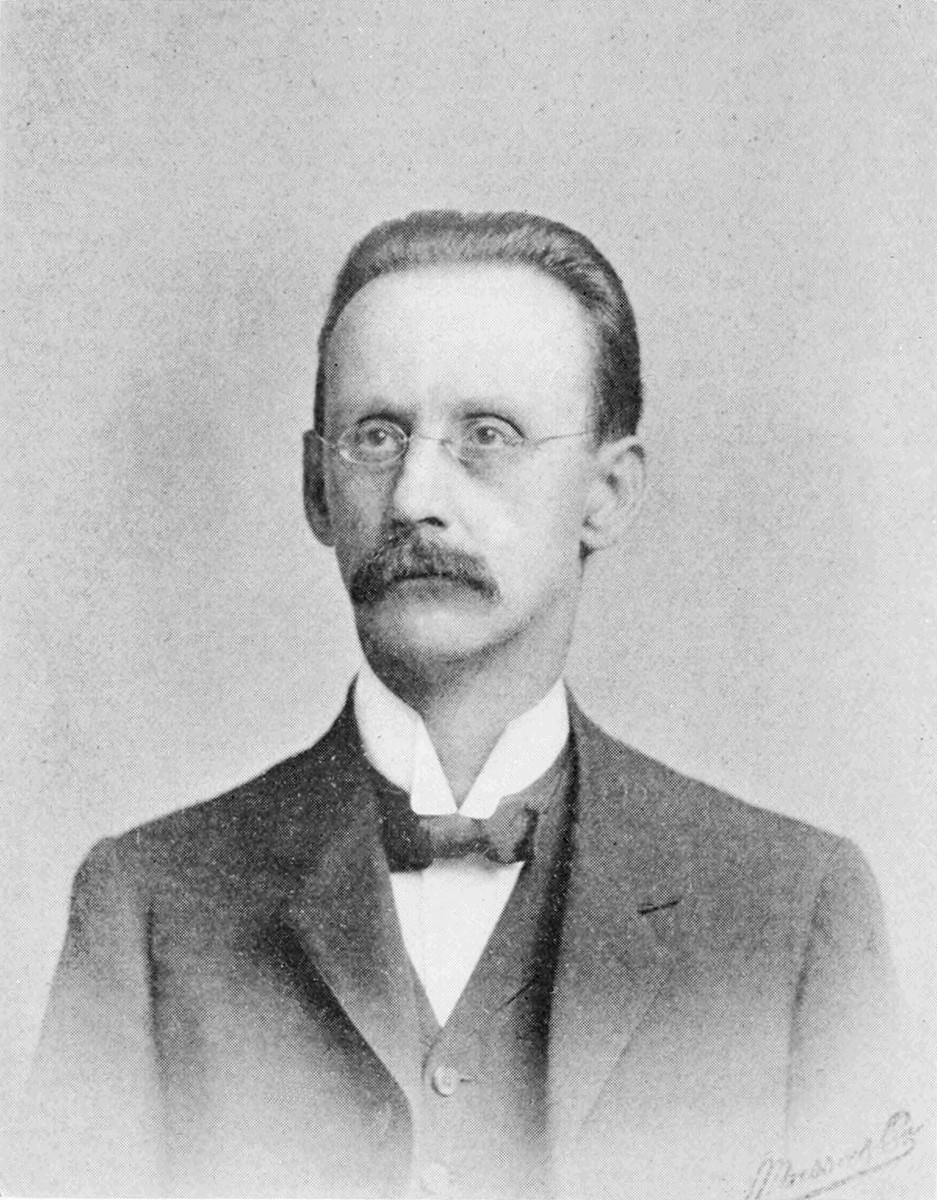
Photograph of Adolfo Lutz by an unidentified studio photographer, as printed in L. O. Howard, 'Some pioneers in mosquito sanitation and other mosquito work, II', The Popular Science Monthly 87 (December 1915), p. 170; scan via the Internet Archive and Wikimedia Commons (public domain). Downscaled. · Halftone photographic portrait of Dr. A. Lutz, printed with the caption 'Dr. A. Lutz, chef de service, Oswaldo Cruz Institute, Rio Janeiro, Brazil, formerly director of the Bacteriological Institute, Sao Paulo' in L. O. Howard's article in The Popular Science Monthly, volume 87, December 1915, plate p. 170 (credited on the plates to the U.S. Department of Agriculture). The studio photographer's signature at the lower right is illegible. The file is the Commons-extracted plate (1197 x 1533 pixels, original size) downscaled to 937 x 1200 with no upscaling. · Public domain in the United States: published in New York in 1915 (before 1931). The Internet Archive item for the volume carries no copyright-status statement and the Wikimedia Commons file page carries a United States public-domain tag with the Internet Archive volume as its source; the underlying studio photographer is unidentified, so the basis is the 1915 US publication date, not a holder licence.
핵심 특성
주요 업적
1893~1908년 상파울루 세균학연구소(현 아돌푸 루츠 연구소)를 이끌며, 현지의 콜레라와 페스트 유행과 '상파울루 열병'이 장티푸스임을 규명했다.
1902~1903년 상파울루에서 모기를 매개로 한 황열 전파 실험을 재현했고, 에밀리우 히바스와 함께 매개 모기 방제 계획을 세웠다.
오늘날 파라콕시디오이데스진균증으로 불리는 질환의 1908년 증례 보고를 발표했고, 주혈흡충의 달팽이 숙주와 브라질 모기를 포함한 기생충을 연구했다.
삶의 장면들
1902년 12월 황열 시험에서 유충부터 모기를 길러 가벼운 환자로부터 감염시키고 12일 넘게 보관한 뒤 성인 자원자 여섯 명에게 시험했다.
실험 설계에 신중하고 통제된 접근을 취했다는 점과 부합한다. 실험 성향
1940년 사망할 때까지 나병의 모기 전파설을 계속 옹호했고, 당대의 한 비판자는 40년이 지나도 그가 아무 증거도 내놓지 못했다고 말했다.
근거가 따라오지 못한 가설을 오래 고수한 지속성과 부합한다. 끈기
전환점
1908년 세균학연구소를 떠나 리우의 오스왈두 크루스 연구소로 옮겼고, 한 역사학자는 그곳에서 동물학과 혼자 하는 실험실·현장 연구로 돌아갈 수 있었다고 본다.
한 역사학자의 해석처럼, 공중보건 지도자 역할보다 혼자 하는 연구를 선호했음과 부합한다. 주도 성향
비슷한 인물
전체적인 프로필이 이 사람과 닮은 사람들이에요.
출처
- Adolpho Lutz (Q199652), verified live via the Wikidata API (2026-11-06): English label 'Adolpho Lutz', alias 'Adolfo Lutz', description 'Brazilian physician and zoologist (1855-1940)', born 18 December 1855, died 6 October 1940, citizenship Brazil, no Korean label. Orientation only; not used as support for any row.
- English Wikipedia, 'Adolfo Lutz' (read for orientation and to find references; flagged on the page for unsourced statements; not used as support for any row).
- L. Rey, 'Adolfo Lutz' (portrait note in the pioneers series), Revista do Instituto de Medicina Tropical de Sao Paulo 1, 1959, p. 179 (PDF, Portuguese and English texts read in full). CANONICAL SIGNIFICANCE SOURCE: after Swiss medical studies and European laboratories he practised in Limeira, worked with Unna in Hamburg, studied leprosy in Hawaii, headed the Bacteriological Institute of Sao Paulo (now the Instituto Adolfo Lutz) from 1893 to 1908 and then worked at the Oswaldo Cruz Institute until 1940; almost two hundred papers on a wide range of subjects, about a quarter on helminths including snail hosts of the schistosome; in microbiology he first identified cholera and plague outbreaks locally and the typhoid nature of the 'Sao Paulo fevers'; with Splendore studied sporotrichosis (1907) and made fundamental contributions to South American blastomycosis; in 1902, on hearing of Reed's yellow-fever results, repeated the transmission experiments in Sao Paulo, being bitten with others by infected Aedes aegypti, and planned a prophylaxis programme with Emilio Ribas; in 1903 said Aedes aegypti was not the only yellow-fever vector; anopheline breeders in bromeliads; Culicidae and other fly families, scorpions, snakes and frogs. Short admiring institutional-journal note with no criticism.
- Casa de Oswaldo Cruz / Fiocruz, 'Adolfo Lutz' biographical note in the scientific-correspondence holdings (page read in full). Born in Rio de Janeiro in 1855 and educated in Switzerland; clinic in Limeira; Hamburg research with Unna on leprosy bacteriology; leprosarium in Hawaii 1889-1892; director of the Bacteriological Institute of Sao Paulo from 1893 where he 'played a decisive role' against infectious diseases; Oswaldo Cruz Institute from 1908 until his death; 'tireless researcher' with foundational studies in parasitology, veterinary medicine and microbiology. Brief institutional note, admiring; gives the Swiss diploma year as 1890 where other sources say 1878-1879.
- Jaime Larry Benchimol, 'Adolpho Lutz: um esboco biografico' (Adolpho Lutz: a biographical sketch), Historia, Ciencias, Saude-Manguinhos 10(1), 2003 (SciELO full text, Portuguese, read in the relevant sections: Hawaii, the Bacteriological Institute, the yellow-fever controversy and the final assessment). Scholarly historian's account up to 1908: conflicting versions of why he left Hawaii (a haughty reply to an inquiry commission in one, an incident involving a missionary he disliked in his daughter's); that he and a nurse alone among the doctors did not fear contagion (reported from earlier biographers); that he was 'the soul, the brain and the main work force' of the Bacteriological Institute, which he directed for 15 years, and fought hard controversies with most of the medical field; that his diagnoses rested on laboratory proofs most doctors could not use; the 1902-03 yellow-fever experiments he designed (mosquitoes bred from larvae to exclude contamination, a mild source case, six adult Brazilian volunteers, a longer maturation period to avoid severe infection); his mosquito-collecting network from 1898 and the delayed publication (1903) of his bromeliad-malaria discovery; and the closing judgement that he lacked Oswaldo Cruz's qualities as chief and gatherer of disciples, disliked publicity, left public credit to Emilio Ribas and preferred solitary laboratory and field work, moving to Manguinhos to return to zoology. Independent, critical in places; the leadership judgement is one historian's interpretation.
- Jaime L. Benchimol and Magali Romero Sa, 'Adolpho Lutz and controversies over the transmission of leprosy by mosquitoes', Historia, Ciencias, Saude-Manguinhos 10 (suppl. 1), 2003 (SciELO English full text; the abstract and the sections on the 1915-1922 commissions and congresses, the 1940s and the critics were read; the earliest sections were skimmed). COUNTER-VOICE: from Hawaii on he held that leprosy was transmitted by mosquitoes and sought proof for decades; the research was not successful, yet he kept his conviction until his death in 1940; the Brazilian leprosy commission accepted a mosquito-prophylaxis clause in 1915 but he found less support by 1921-22; the leprologist Belmiro Valverde, quoted at length, called the thesis dogmatic and said that after forty years Lutz still could not give the slightest documentation; later work by Souza Araujo in the 1940s argued that haematophagous insects might transmit leprosy under some conditions. Scholarly, with a quoted contemporary critic.
- Silvio Alencar Marques, 'Paracoccidioidomicose: centenario do primeiro relato de caso' (Paracoccidioidomycosis: a century from the first case report), Anais Brasileiros de Dermatologia 83(3), 2008 (SciELO full text, read in full). Dermatology-history article: Lutz's April 1908 article described clinical, histopathological and mycological findings of two oral cases ('mycose pseudococcidica'); he had examined the index patient of Posadas and Wernicke's coccidioidomycosis case in 1897 and so knew the disease; he excluded an epithelial cancer histologically, cultured the agent, described budding and the difference between tissue and culture forms; a founding member of the Brazilian Society of Dermatology. Admiring centenary tribute that relies on his original article.
- Silvana Campos da Rocha Calixto and Pedro Antonio Federsoni Jr. (Instituto Adolfo Lutz, MemorIAL), centenary note on Chagas disease and American cutaneous leishmaniasis, Boletim do Instituto Adolfo Lutz 2009 (two-page PDF; read in part). Institutional history: the Bacteriology Laboratory was headed by Lutz from April 1892 (per this note), took the name Bacteriological Institute in mid-1892 and was officially created on 4 September 1893. Short institutional note; its 1892 start differs from Benchimol's 1893 appointment date, so rows avoid the date.
- L. O. Howard, 'Some pioneers in mosquito sanitation and other mosquito work, II', The Popular Science Monthly 87, December 1915, plate p. 170 (Internet Archive full text of volume 87 read around the plate). Caption: 'Dr. A. Lutz, chef de service, Oswaldo Cruz Institute, Rio Janeiro, Brazil, formerly director of the Bacteriological Institute, Sao Paulo, Brazil; well-known worker in helminthology, pathology and bacteriology, as well as entomology; he has done much work on the mosquitoes of Brazil, and has conducted studies of great importance in regard to the relation of insects and disease.' A contemporary US entomologist's description of his standing; used for the portrait and as context only, not as support for any row.