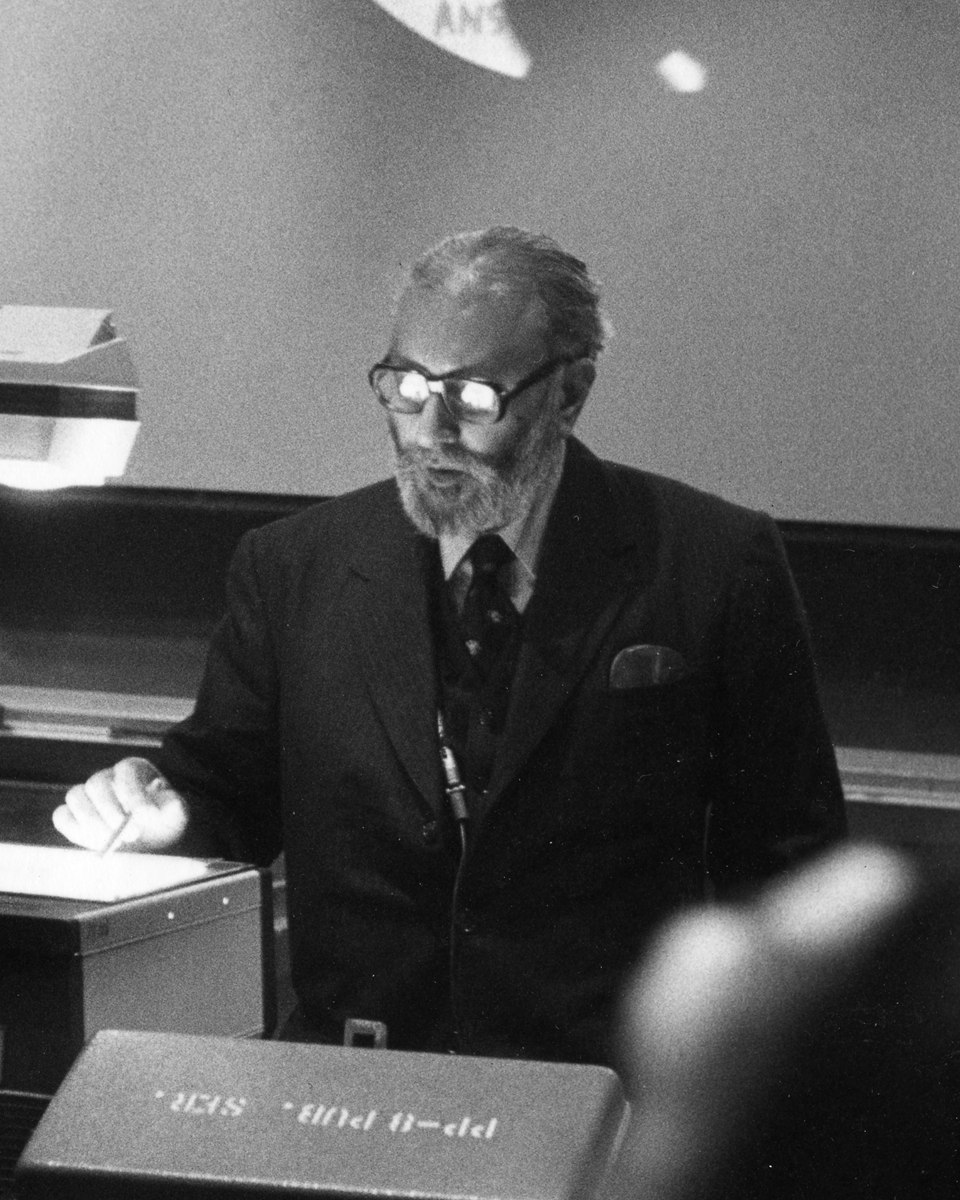

Photograph by Emilio Segre, courtesy of AIP Emilio Segre Visual Archives, Segre Collection, c. 1979, CC BY 4.0 (cropped) · Photograph 'Abdus Salam lecturing at Stanford circa 1979' by Emilio Segre, AIP Emilio Segre Visual Archives, Segre Collection (repository item 122245), uploaded to Wikimedia Commons as 'Abdus Salam lecturing at Stanford.jpg' (original 3704 x 2421) with the AIP statement that American Institute of Physics is the copyright holder and freely gives permission to use the image with the credit line, consistent with the AIP archive's published copyright guide. Cropped to the lecturer (region 1600 x 2000 of the original) and downscaled to 960 x 1200; no upscaling. The AIP repository page itself returned HTTP 403 to automated requests, so the 'copyright holder' line could not be seen on the AIP page directly; the basis rests on the Commons page quoting AIP plus the AIP guide. · CC BY 4.0
물리학자 · 20세기
압두스 살람
1926–1996
주요 업적 분야
아직 성격 매칭에 포함되지 않았습니다 — 기록된 근거가 성격 모델 전체를 다루기에는 충분하지 않습니다. 이 페이지의 다른 모든 내용은 자유롭게 확인하실 수 있습니다.
핵심 특성
주요 업적
셸던 글래쇼, 스티븐 와인버그와 함께 약한 상호작용과 전자기 상호작용을 통합한 이론으로 1979년 노벨 물리학상을 공동 수상했으며, 세 사람은 각자 별도의 연구로 이 이론을 발전시켰다.
1964년 이탈리아 트리에스테에 국제이론물리센터(ICTP)를 설립해 수십 년간 이끌었고, 개발도상국 젊은 물리학자를 위한 연구 지원 프로그램을 만들었다.
임페리얼 칼리지에서 일류 이론물리 그룹을 키웠고, 1964년 존 워드와 SU(2) x U(1) 대칭성을 규명했으며, 1973년 조게시 파티와 대통일 모형을 제안했다.
삶의 장면들
1956년 그는 질량 없는 왼손잡이 중성미자가 패리티 위반과 잘 맞는다고 제안했지만 파울리가 이를 일축했고, 그의 논문은 실험 결과가 나온 뒤에야 발표되었다.
이는 권위 있는 인물에 대한 존중 때문에 비정통적인 아이디어가 미뤄진 모습과 부합한다. 독립적 사고
1984년 그린-슈워츠 프리프린트가 나온 뒤 그는 ICTP 연구진에게 저차원 모형의 일관성을 검토하게 했고 10주도 되지 않아 6차원 모형을 제출했다.
이는 새로운 연구 분야로 빠르게 뛰어드는 습관과 부합한다. 실행 속도
전환점
1951년 파키스탄으로 돌아온 그는 그곳에서 이론물리 연구가 불가능하다고 판단해 1954년 떠났고, 훗날 다른 이들이 같은 선택을 하지 않도록 ICTP 설립을 제안했다.
이는 개인적 좌절을 기관 설립 사업으로 바꾼 흐름과 부합한다. 선제적 행동력
비슷한 인물
전체적인 프로필이 이 사람과 닮은 사람들이에요.
출처
- Abdus Salam (Q28189) -- verified live via the Wikidata API (2026-10-26): English label 'Abdus Salam', description 'theoretical physicist, and Nobel Prize in Physics recipient', born 1926-01-29, died 1996-11-21, Korean label present, P18 image 'Abdus Salam 1987 (cropped).jpg' (rejected for the portrait, see notes). Orientation only; not used as support for any row.
- Nobel Foundation, 'The Nobel Prize in Physics 1979' (prize summary page), read in full. CANONICAL SIGNIFICANCE SOURCE: the prize was awarded jointly to Sheldon Lee Glashow, Abdus Salam and Steven Weinberg, one third each, 'for their contributions to the theory of the unified weak and electromagnetic interaction between elementary particles, including, inter alia, the prediction of the weak neutral current'. Award-body statement: authoritative on what was recognised, admiring in nature.
- Nobel Foundation, 'Award ceremony speech, Nobel Prize in Physics 1979' (presentation by the Royal Swedish Academy of Sciences), read in full: explains that the theory, developed in separate works by the three prizewinners in the 1960s, shows the weak and electromagnetic forces as aspects of one electroweak interaction, that it implies neutral currents, and that experiments in the 1970s fully confirmed that prediction. Explanatory, retrospective, admiring.
- Nobel Foundation, 'Abdus Salam - Biographical' (written at the time of the award by Miriam Lewis, a former staff member of the ICTP), read in full: schooling and Cambridge degrees, the return to Lahore and departure abroad when research there proved impossible, Professor at Imperial College from 1957, director of the ICTP from 1964, the ICTP Associateships for young physicists from developing countries, and that he spent his Atoms for Peace award and his Nobel share on funds for physicists from developing countries. Insider and admiring; political-adviser roles and personal-life passages were read and excluded from scoring.
- ICTP, 'News from ICTP 82 - Features - Abdus Salam: The Man and the Mission' (1997 newsletter, reminiscences by ICTP physicists Seifallah Randjbar-Daemi and Faheem Hussain), read in full: Salam's range of interests, his work on supersymmetry and superspace with John Strathdee, the speed with which he moved into superstrings after Green and Schwarz in 1984, that some of his speculative ideas 'were great successes' and others 'quite big' failures, why he proposed the ICTP, and Hussain's view that he implanted science in some developing countries 'but not as much as he or others would have liked'. Institutional and affectionate, with some candid critical remarks by colleagues.
- Imperial College London, 'Professor Abdus Salam (1926-1996), Nobel Prize in Physics 1979' (Nobel winners page), read: 1957 appointment and build-up of the theoretical physics group with Paul Matthews and Tom Kibble, the 1964 SU(2) x U(1) electroweak symmetry with John Ward, the 1967 incorporation of the Higgs mechanism with unpublished lectures and a 1968 Nobel Symposium publication, comparable work by Weinberg, the 1973 Pati-Salam grand unified model, and the ICTP. Institutional pride page; the Pakistan-government and religion passages were not used.
- Pervez Hoodbhoy, review of Gordon Fraser's 'Cosmic Anger: Abdus Salam - The First Muslim Nobel Scientist' (Physics Today, August 2009), read in full: Imperial group-theory work and students (Ne'eman, Shaw), Pauli's rejection of Salam's parity/left-handed neutrino proposal, the lack of immediate notice of his 1968 electroweak talk, Salam's three passions, the failure of his Islamic science foundation scheme, and the reviewer's criticism that Fraser's book is partly hagiographic and skips controversial issues. Review by a Pakistani physicist; COUNTER-VOICE. Pakistan-politics, nuclear-programme and religion passages were read and excluded.
- Mark Alford, 'Review of Cosmic Anger by Gordon Fraser' (Washington University in St. Louis, January 2009), read in full: summary of Fraser's account of the parity-violation and massless-neutrino episode, Salam's 'furious inventiveness', 'tireless traveling and lobbying' to create the ICTP, and Fraser's three-goal verdict: a 'lukewarm verdict' on his fundamental discoveries ('did not help our knowledge move forward any faster than it would have without him'), the ICTP a 'resounding success', and the Islamic-countries goal a failure; the reviewer also disputes Fraser's framing of the publication delay. Independent physicist reader; COUNTER-VOICE. Religion, family and UNESCO-campaign passages read and excluded.
- AIP Emilio Segre Visual Archives, Segre Collection, 'Abdus Salam lecturing at Stanford circa 1979' (photograph by Emilio Segre), the Wikimedia Commons file page 'Abdus Salam lecturing at Stanford.jpg' (licence CC BY 4.0 with an AIP statement), and the AIP guide 'Determining Copyright and Permissions'. Checked for the portrait only.