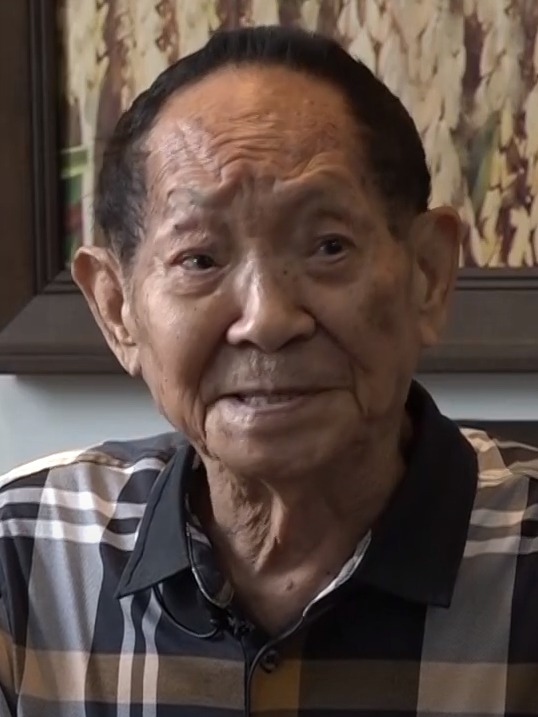
Photo: China News Service, 2019, CC BY (YouTube Creative Commons Attribution) · Wikimedia Commons 'Yuan Longping at news conference (cropped).png', a frame from a China News Service video of 5 September 2019 (Changsha press interview) uploaded to the official China News Service YouTube channel, which shows the Creative Commons Attribution licence on the live watch page (checked 2026-10-24); the Commons file carries a YouTube licence review dated 29 September 2023. Saved at the Commons cropped size of 538 x 717 pixels (converted from PNG to JPEG with no resizing or upscaling). The licence is the YouTube-stated Creative Commons Attribution licence (CC BY 3.0 in YouTube's terms), a platform-level licence on a single video from the news agency's own channel; no conflicting account-level or institutional notice was found. · CC BY 3.0 (YouTube Creative Commons Attribution)
agronomist · 20th Century
Yuan Longping
1930–2021
Known For
Not yet included in personality matching — the documented evidence doesn't yet cover enough of the personality model. Everything else on this page is fully available.
Trait Constellation
Key Achievements
Developed hybrid rice by using male sterility to produce hybrid seed in a self-pollinating crop, against the view that rice shows no significant hybrid vigour; with colleagues, including his assistant Li Bihu who found the key wild male-sterile plant, he brought hybrids to wide use in China by 1976 at yields 20-30 percent higher.
Led China's national cooperative research on hybrid rice and later proposed and led the two-line and super-hybrid rice programmes that extended the technology.
Shared hybrid rice techniques and breeding materials with scientists abroad, with training for some 14,000 people from over 80 countries, and received the 2004 Wolf Prize in Agriculture.
Moments That Reveal Them
In 1964 he began research on hybrid rice and published 'Male Sterility in Rice', proposing male sterility as the way to use hybrid vigour in a crop where hand emasculation is impractical, despite the prevailing view that rice showed no significant heterosis.
This is consistent with a researcher willing to work against the prevailing view of his field on the strength of his own reasoning. Independent Thinking
In 2012 he set a goal of 15 tonnes of super-hybrid rice per hectare by 2015; critics said the record plots cost far more than a farmer could spend and that the rice resisted disease poorly, while his research centre replied that yield was its assigned focus and the plots were experimental.
This is consistent with a strong drive to push yield records, whose practical value for farmers was disputed. Achievement Drive
Turning Points
At the end of 1970 his assistant Li Bihu found a wild male-sterile rice plant in Hainan that Yuan named 'YeBai'; from it the first male-sterile and maintainer lines were produced in 1972, the restorer line followed in 1973, and hybrid rice was in widespread production by 1976.
This is consistent with a long-running programme reaching practical scale once a key plant was found and a team built the full breeding system. Persistence
Similar People
People whose overall profiles resemble theirs.


Jane Goodall

Elizabeth Cady Stanton

Elizabeth Blackwell

Wangari Maathai

Nelson Mandela
Sources
- Yuan Longping (Q3141326) -- verified live via the Wikidata API (2026-10-24): English label 'Yuan Longping', description 'Chinese biologist (1930-2021)', died 2021-05-22, Korean label '위안룽핑', multiple conflicting birth dates (1929 and 1930) so only the year 1930 given by the Wolf Foundation and other read sources is used, P18 image 'Yuan Longping at news conference (cropped).png'. Orientation only; not used as support for any row.
- Wolf Foundation, 'Yuan Longping' Wolf Prize in Agriculture 2004 laureate page (wolffund.org.il), read: citation 'for innovative development of hybrid rice and discovery of the genetic basis of heterosis in this important food staple', shared with Steven Tanksley; says he developed strategies using cytoplasmic male sterility that led to hybrid rice; that under his leadership and after a decade of cooperative research among hundreds of rice scientists from numerous institutes and universities yields rose about 20 percent and China's rice production by 50 percent; that he pioneered 'super hybrids' using inter-specific heterosis; and that he shared knowledge, techniques and breeding materials with scientists worldwide. CANONICAL SIGNIFICANCE SOURCE. Award-body language, retrospective and admiring, but it explicitly credits a large cooperative effort.
- Kenneth M. Quinn, 'Yuan Longping, 1930-2021: The Father of Hybrid Rice', Review of Agrarian Studies 11(1), 2021 (ras.org.in), read in full: a tribute by the president emeritus of the World Food Prize Foundation (an acquaintance, so friendly) describing his education from 1949, a research environment that limited genetics, the famine memories behind his motivation, secret reading of Mendel, the hybrid-rice breakthrough as a discovery in a field near Sanya rather than a laboratory, his preference for fieldwork and work clothes, the 1976 scale-up and 20 percent rise in Chinese output, sharing research with IRRI after 1978, building a research centre that drew scientists from over 50 countries, the 2004 World Food Prize shared with Monty Jones, and the 2019 Medal of the Republic (state honour, not scored). Admiring first-hand tribute.
- Qian Qian, Fan Zhang and Yeyun Xin, 'Yuan Longping and Hybrid Rice Research', Rice 14:101 (2021, open access, PubMed Central), read in full: colleagues' memorial summary stating that in 1964 he challenged the prevailing view that self-pollinating rice shows no significant heterosis and published 'Male Sterility in Rice'; the 1970s national cooperative research; wild-rice distant hybridisation to make male-sterile lines; the 1972 male-sterile and maintainer lines produced 'together with his assistant', the restorer line in 1973 and the hybrid Nanyou 2; widespread use by 1976 with 20-30 percent yield advantage; his 1986 three-phase strategy (three-line, two-line, one-line); the 1997 super-hybrid project and yield records; salt-tolerant rice; chief consultant to FAO, 30 visits to IRRI and 140 international training courses for 14,000 people from over 80 countries. Written by Chinese colleagues, admiring.
- Bulletin of the Chinese Academy of Sciences, 'Towards Next-generation Rice: Following the Footprints of Late Academician YUAN Longping' (bcas.cas.cn, 1 July 2021), the opening passage read: states that at the end of 1970 his assistant Li Bihu discovered the wild male-sterile rice plant near a ditch at Nanhong Farm in Sanya, which Yuan named 'YeBai' and which laid the foundation for the three-line system; says Yuan and his team together with other breeders achieved the hybrid-rice result. Used only for the credit structure of the discovery.
- China Development Brief, 'World mourns Father of Hybrid Rice Yuan Longping' (chinadevelopmentbrief.org, 28 May 2021), read in full: quotes an IRRI scientist placing his hybrid-rice discoveries alongside Borlaug's wheat work in the green revolution; quotes his memoir on witnessing famine and resolving to raise rice production; says he shared major discoveries with scientists worldwide, with about 60 countries and regions running hybrid-rice trials, 14,000 technicians trained for more than 80 developing countries, and hybrids yielding 20 percent more than local breeds on about 7 million hectares abroad. Obituary reporting from an NGO-run outlet; partly sourced to Xinhua.
- Stephen Chen, 'Bid to lift hybrid rice yield to 15 tonnes a hectare slammed', South China Morning Post, 4 December 2012 (republished by GRAIN at grain.org), read in full: reports Yuan's goal of 15 tonnes per hectare by 2015 from a 13.5-tonne record, and critics including an IRRI researcher who said the team spent 10,000-20,000 yuan per mu against a few hundred for a typical farmer so the record was 'unimpressive, if not meaningless', an unnamed Hangzhou rice-institute researcher who said the super-hybrid had little disease, pest and drought resistance and was driven by Yuan's 'personal obsession' with yield, and a seed-company manager who said farmers would find it too expensive; the Hunan Hybrid Rice Research Centre replied that yield was its division-of-labour focus and the target was for experimental fields. Independent critical journalism; the critics' views are their own and partly anonymous.
- Rice Today (International Rice Research Institute magazine), 'Q&A with the Father of Hybrid Rice' (ricetoday.irri.org), read in full: an interview in which he says a natural hybrid plant with strong heterosis in a farmer's field in 1962 inspired the project, explains how government seed policy and a three-tier seed-production system helped hybrid rice spread in China, and says hybrid yields are about 1.35 tons per hectare higher than ordinary rice (2 tons for super hybrids). Self-account in an institute magazine, used only to confirm his own account of origins and never as sole support.
- Wikimedia Commons file page 'Yuan Longping at news conference (cropped).png' (wikitext and API record) and the live YouTube watch page of the source video, checked for the portrait's licence: frame from a China News Service video of 5 September 2019 uploaded to the official 'China News Service' YouTube channel under the Creative Commons Attribution licence, with a YouTube licence review on Commons dated 29 September 2023; cropped file 538 x 717 pixels. Not used for any scoring.