Nelson Mandela
90% Profile Match
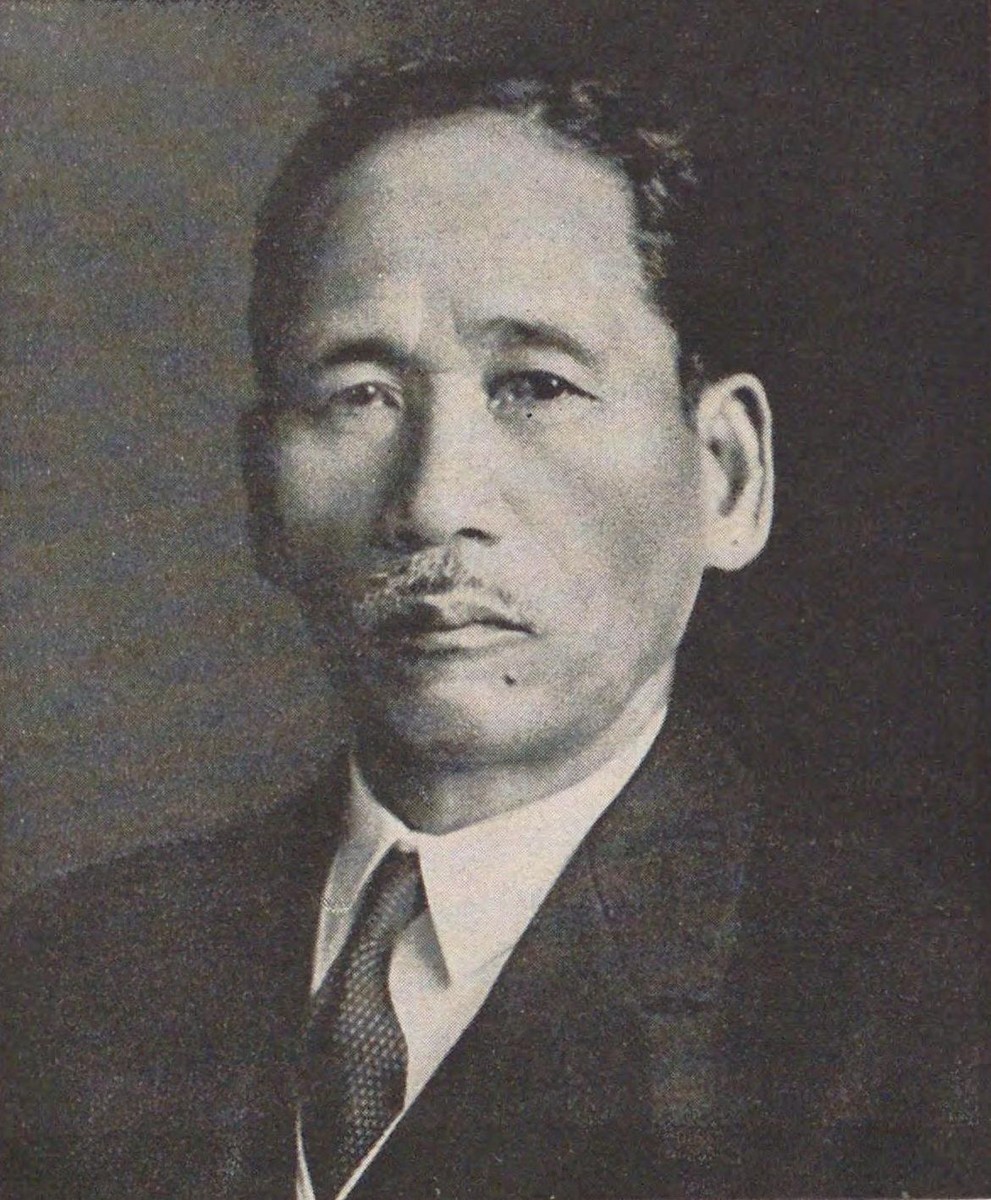
Photographer unknown, published 1942 in Horikawa Toyonaga, Kindai Nihon no kagakusha vol. 2. Source: Portraits of Modern Japanese Historical Figures, National Diet Library, Japan (https://www.ndl.go.jp/portrait/) · Portrait photograph of Umetaro Suzuki, photographer unknown, published in the book Kindai Nihon no kagakusha (Scientists of Modern Japan), volume 2, by Toyonaga Horikawa (Jinbunkaku, Tokyo, 1942), as reproduced in the National Diet Library's digital exhibition 'Portraits of Modern Japanese Historical Figures' (entry for SUZUKI Umetaro, source item NDL Digital Collections pid 1793218). The library's entry names the sitter, and the source book contains a biography chapter on him. The file is the library's published image (1171 x 1418 pixels) downscaled to 991 x 1200 with no cropping and no upscaling; it is a halftone book reproduction, so the grain is that of the print. · Public domain (declared by the National Diet Library for all images in 'Portraits of Modern Japanese Historical Figures'; the photograph was published in Japan in 1942)
scientist · 20th Century
1874–1943
Not yet included in personality matching — the documented evidence doesn't yet cover enough of the personality model. Everything else on this page is fully available.
Japanese agricultural chemist who in 1910 extracted an anti-beriberi substance from rice bran, named aberic acid and later oryzanin (today associated with vitamin B1), founding vitamin research in Japan; scholars note his extract was not pure thiamine and that credit for the discovery remains disputed.
At RIKEN, whose Chemistry Division he directed from 1917, his laboratory's vitamin A work (purified from cod liver oil by his student Katsumi Takahashi in 1922) became RIKEN Vitamin, whose sales covered half of RIKEN's research budget between the wars.
He became the first president of the Agricultural Chemical Society of Japan in 1924, trained many leading scientists, and received the Order of Culture in 1943.
He presented his paper on aberic acid to the Chemical Society of Tokyo on 13 December 1910; physicians who held beriberi to be infectious attacked it, even in the newspapers, and Suzuki went back to his laboratory, confirmed his results and published further studies.
This is consistent with a researcher who kept to a contested result under hostile criticism and answered it with more experiments. Persistence
After the 1918 rice-price riots, concerned that rice was being used for sake, he set out to make a synthetic sake from other materials, which RIKEN later produced as RIKEN-shu.
This is consistent with a chemist who turned a national food problem into a research task. Impact Motivation
In 1915 Suzuki was ordered to stop his beriberi research and put his energies into synthesising Salvarsan, which wartime blockade had cut off; two years later he became a chief researcher at the newly founded RIKEN, where his laboratory's vitamin work turned into an industrial product line.
This is consistent with a research career that moved from a university research question into industrially applied chemistry. Cross-Domain Range
People whose overall profiles resemble theirs.



Not a rival — a different profile shape worth a look.