Jane Goodall
93% Profile Match
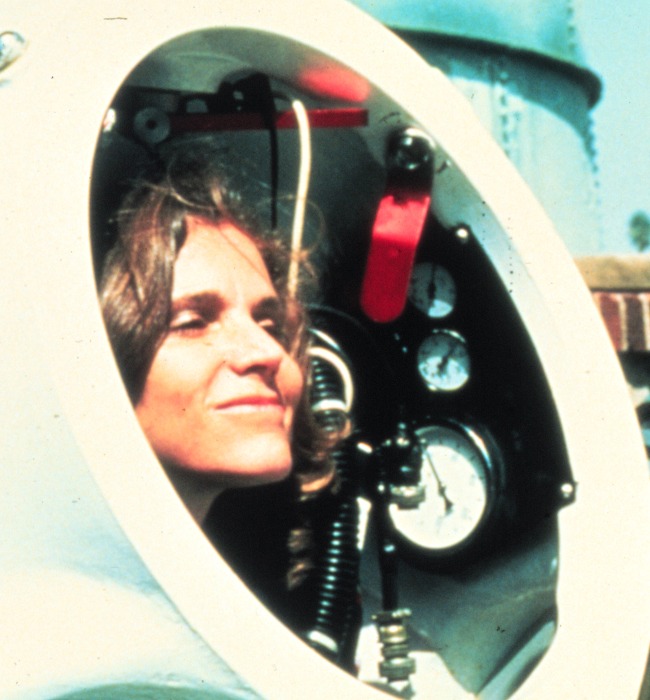
Photo: OAR/National Undersea Research Program (NURP), NOAA Photo Library, public domain · Wikimedia Commons 'File:Sylvia Earle-nur07563.jpg' = NOAA Photo Library image nur07563, 'Dr. Sylvia Earle prepares to dive in a JIM suit', credit OAR/National Undersea Research Program (NURP), Commons template PD-USGov-NOAA, undated. Original 1816 x 1208 (SHA-1 ad58692b matches the Commons record); cropped to 650 x 700 around her face inside the suit window (crop only, never upscaled). NOAA's own digital-library page could not be opened (CAPTCHA), so no institutional notice could be read directly; no conflicting notice was observed. · Public domain (US Government work, NOAA/NURP)
scientist · Contemporary
b. 1935
Not yet included in personality matching — the documented evidence doesn't yet cover enough of the personality model. Everything else on this page is fully available.
For her 1966 Duke doctorate Earle collected more than 20,000 algae samples to catalogue Gulf of Mexico plant life, one of the first scientists to use SCUBA to study marine life directly, according to the National Women's History Museum; Britannica describes her as celebrated for research on marine algae.
In 1970 Earle led the first all-female team of aquanauts in the Tektite II underwater-habitat experiment off the US Virgin Islands, and on 19 September 1979 she descended to 381 m in a pressurized Jim suit, which Britannica and Guinness describe as the deepest untethered dive.
Earle and engineer Graham Hawkes founded Deep Ocean Engineering in the early 1980s and designed the Deep Rover submersible; she served as NOAA chief scientist in 1990-92, the first woman in the post, and in 2009 founded Mission Blue, whose Hope Spots network seeks protection for ocean areas, though a recent feature notes Hope Spot status is not legal protection.
The Mariners' Museum records that Earle's 1970 Tektite II crew documented 154 marine plant species, 26 of them not previously recorded in the Virgin Islands, and that on a 1964 expedition she named a newly found plant Humbrella after her mentor.
This is consistent with an exploratory, cataloguing curiosity about the natural world. Curiosity
Duke's profile says Earle reached 3,281 feet in 1986 aboard Deep Rover, the submersible she helped design, and that it remains the deepest solo dive by a woman; the National Women's History Museum says she detached from a submersible in a pressurized suit in 1979 and explored the sea floor for two and a half hours.
This is consistent with accepting substantial physical risk in pursuit of exploration, using purpose-built equipment. Risk Tolerance
Encyclopedia.com reports that when SCUBA's depth limits constrained her work, Earle and engineer Graham Hawkes founded Deep Ocean Technology and Deep Ocean Engineering in 1981 and sketched the Deep Rover design on a paper napkin.
This is consistent with building her own tools when existing equipment limited her research. Resourcefulness
People whose overall profiles resemble theirs.