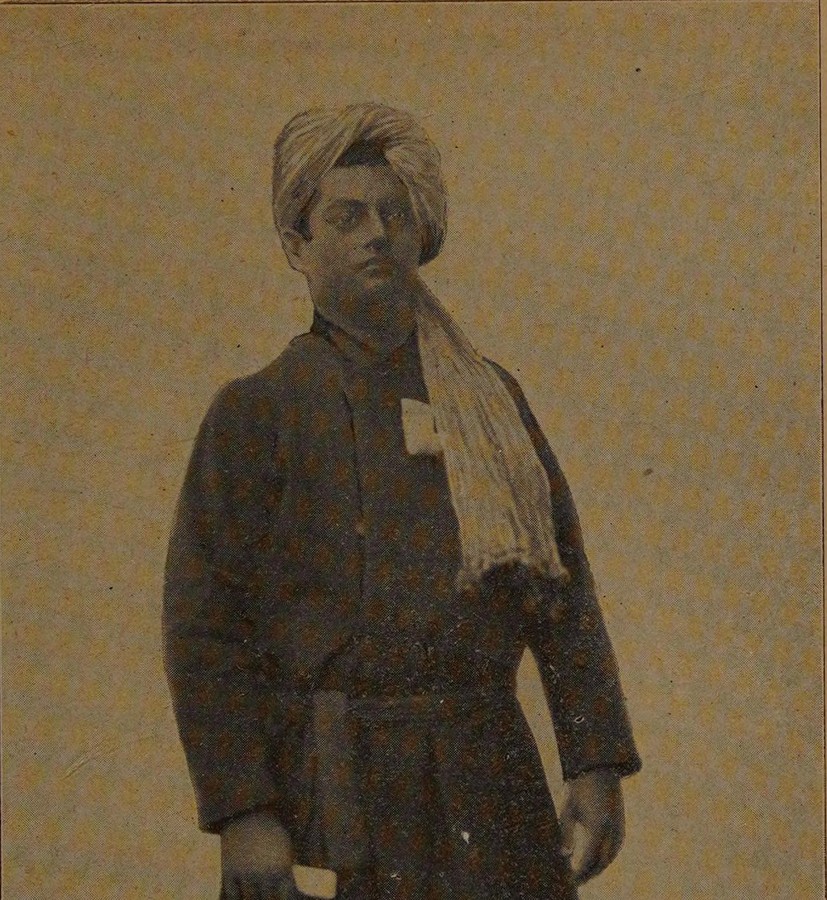
Photograph of Swami Vivekananda from Neely's History of the Parliament of Religions (F. T. Neely, Chicago, 1893), public domain, via the Internet Archive · Full-length photographic plate captioned 'Swami Vivekananda, Hindu Monk', printed in Neely's History of the Parliament of Religions and Religious Congresses at the World's Columbian Exposition (Chicago: F. T. Neely, 1893), facing page 505, imprint 'Copyrighted 1893 by F. T. Neely, Chicago'; Internet Archive scan neelyshistoryofp0000houg. The caption identifies the sitter, and it is a halftone reproduction of a photograph taken during the 1893 Parliament, so it is a likeness from his lifetime; the photographer is not credited in the book. The file is a plain crop of the head and upper body of the plate from the 1781 x 2847 pixel page scan, downscaled to 827 x 900 with no upscaling and no retouching; the halftone dot pattern and paper tone of the 1893 print remain visible. · Public domain (published in the United States in 1893)
religious leader · 19th Century
Swami Vivekananda
1863–1902
Known For
Not yet included in personality matching — the documented evidence doesn't yet cover enough of the personality model. Everything else on this page is fully available.
Trait Constellation
Key Achievements
At the 1893 World's Parliament of Religions in Chicago, he opened with 'Sisters and Brothers of America' to applause that lasted several minutes, and became one of the Parliament's best-known speakers.
After the Parliament he lectured on Vedanta in the eastern United States and London for about three and a half years, drew Western followers and helped start Vedanta societies in New York and elsewhere.
He founded the Ramakrishna Mission on 1 May 1897 to combine Vedanta teaching with social service such as schools, hospitals and disaster relief, and the Ramakrishna Math monastery grew from it.
Moments That Reveal Them
Arriving in Chicago in late July 1893, he spoke in Boston while waiting for the Parliament to open and became a delegate with a letter of introduction from the Harvard professor John Henry Wright.
This is consistent with a person who took the initiative to secure a place at the Parliament rather than waiting for an invitation. Proactive Agency
Turning Points
Returning to India in 1897, he persuaded Ramakrishna's disciples to commit to social service and founded the Ramakrishna Mission on 1 May 1897, turning a small monastic brotherhood into a service organisation with a monastery near Calcutta.
This is consistent with a shift from a travelling monk and lecturer to the head of an organisation. Leadership Drive
Similar People
People whose overall profiles resemble theirs.


Nelson Mandela

Martin Luther King Jr.

Wangari Maathai

Susan B. Anthony

George Orwell
Opposite Profile
Not a rival — a different profile shape worth a look.
Wolfgang Amadeus Mozart
Sources
- Swami Vivekananda (Q47478), verified live via the Wikidata API (2026-10-31): label 'Swami Vivekananda', description 'Indian Hindu monk and philosopher (1863-1902)', born 12 January 1863, died 4 July 1902, citizenship British India, Korean label 비베카난다, image the 1893 signed portrait. Orientation only; not used as support for any row.
- 'Vivekananda', Encyclopedia.com page reproducing the Encyclopedia of Religion entry (Thomas J. Hopkins 1987, revised by Brian A. Hatcher 2005), the Encyclopedia of World Biography entry and two Oxford dictionary entries, read via a fetched summary of the whole page. CANONICAL SIGNIFICANCE SOURCE: born Narendranath Datta in a Calcutta family, met Ramakrishna in 1881 and accepted him as guru in 1885, Ramakrishna died in August 1886 and the disciples formed a monastic movement (monastic names in 1887); attended the 1893 Parliament of Religions in Chicago with travel funds from the maharaja of Khetri; drew Western followers and founded the Vedanta Society in New York (the dates 1895 and 1896 differ between entries) with chapters in London and Boston; returned to India in 1897 to a mixed reception and persuaded Ramakrishna's disciples to commit to social service; founded the Ramakrishna Mission on 1 May 1897 with a monastery (Ramakrishna Math) and bought land near Calcutta in 1898; a community near San Francisco in 1898; died 4 July 1902. The Hopkins and Hatcher entry also calls the question of his responsibility for Hindu chauvinism and Hindu-Muslim polarisation 'legitimate and complex', notes he praised Islam and tolerance, and notes possible influences from Schopenhauer, Deussen, Brahmo thought and Christianity. Scholarly reference with a critical note; the short Gale and Oxford entries are uncritical.
- EBSCO Research Starters, 'Vivekananda', read in full: passed the Calcutta University bachelor's examination in 1884; led Ramakrishna's disciples in forming a monastic order after 1886; wandered across India as a mendicant; sailed from Bombay in May 1893, reached Chicago in late July, spoke in Boston while waiting, and became a delegate after a letter of introduction from the Harvard professor John Henry Wright; the Parliament opened on 11 September; after it he lectured across the northeastern United States and the Midwest; organised a committee in December 1895 to spread Vedanta and the New York society was launched in October 1898; oversaw the founding of the Ramakrishna Mission in May 1897 (later schools, colleges, hospitals and disaster relief); a second Western journey from June 1899; died 4 July 1902. The entry itself carries unsourced details (a Freemason claim, a figure of sixteen centres), dates the New York society differently from Gale, and frames conventional Hinduism in a one-sided way. Independent reference used for dates and the Boston/Wright episode; flagged weaknesses are not relied on.
- Ramakrishna Math and Ramakrishna Mission (Belur Math), 'Swami Vivekananda', the order's official biography, read in full: born Narendra Nath Datta in Kolkata on 12 January 1863; graduated from Calcutta University; met Ramakrishna in November 1881; cared for him in his final illness; the disciples formed a monastic brotherhood at Baranagar and took sannyasa vows in 1887; from 1890 a long journey across India during which he concluded that the masses needed education and renewed self-belief; resolved to attend the 1893 Parliament partly to present his teacher's message and partly to seek support for his work among the poor; about three and a half years of teaching in the eastern United States and London; founded the Ramakrishna Mission on 1 May 1897 to combine practical Vedanta with social service (hospitals, schools, rural development, disaster relief); land at Belur in 1898; second Western visit from June 1899. The organisation he founded; admiring and institutional, so its statements of his purposes are self-framed.
- John Henry Barrows (ed.), The World's Parliament of Religions: An Illustrated and Popular Story of the World's First Parliament of Religions, Volume I (Chicago: Parliament Publishing Company, 1893), full OCR text on the Internet Archive searched for every mention of Vivekananda and the passages read: the chairman's account of the opening day (the Hindu monk 'clad in gorgeous red apparel', addressing the audience as 'sisters and brothers of America' to 'a peal of applause that lasted for several minutes'), his remarks with a fable of the frog in a well, addresses on Hinduism, and the remark that he 'was always heard with interest' but that 'very little approval was shown to some of the sentiments expressed in his closing address'; a later passage records a speaker endorsing his criticism of Christian charity limited to converts. Contemporary organiser's history, published by the Parliament's own promoters, so the reception is a friendly record; a primary account, not an independent assessment.
- Walter R. Houghton (ed.), Neely's History of the Parliament of Religions and Religious Congresses at the World's Columbian Exposition (Chicago: F. T. Neely, 1893), Internet Archive scan, the plate and chapter on Vivekananda read: a full-length photographic plate captioned 'Swami Vivekananda, Hindu Monk' with the imprint 'Copyrighted 1893 by F. T. Neely, Chicago', the chapter 'Most Ancient Order of Monks' reporting that a peal of applause lasted several minutes after he addressed the audience as 'Sisters and Brothers of America', and a chapter 'Hinduism as a Religion'. A second contemporary Chicago account, but it follows the same Parliament proceedings as Barrows and is not independent of it on the speech; used for the portrait and as a cross-check on the date and place of publication.