Wu Zetian
93% Profile Match
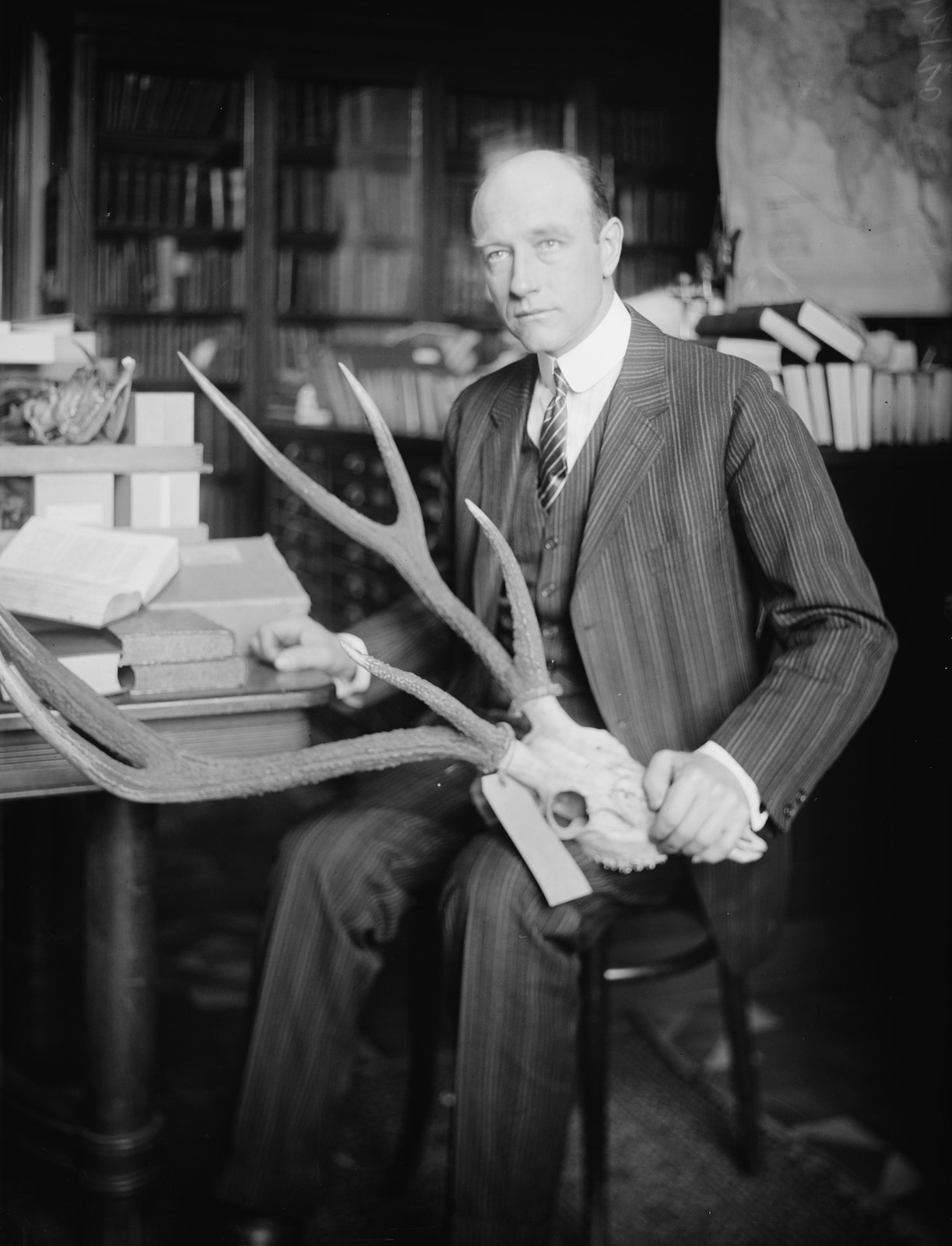
Bain News Service, publisher; George Grantham Bain Collection, Library of Congress; LCCN 2014719636 · Library of Congress, Prints and Photographs Division, George Grantham Bain Collection, LC-DIG-ggbain-50488 (Bain News Service glass negative), via Wikimedia Commons · Public domain (Bain News Service negative; Library of Congress: no known restrictions on publication)
From 1922 to 1930 Andrews led five Central Asiatic Expeditions of the American Museum of Natural History into Mongolia and northern China, using motor cars supplied by camel caravans to work across the Gobi. In 1925 the party included fourteen scientists and technicians, twenty-six assistants, five cars, two trucks and 125 camels, and the programme cost close to $700,000. It set out to test Henry Fairfield Osborn's idea that humans originated in Asia and found no human remains, but it recovered large collections of fossil mammals and dinosaurs and made maps and geological studies of a region little known to Western science.
In July 1923, at the Flaming Cliffs of the Gobi, members of the expedition including George Olsen found dinosaur eggs, widely described as the first scientifically recognised dinosaur eggs; an 1859 eggshell find in France had been taken for a giant bird's. The same site produced Protoceratops, named in 1923 for Andrews, and the small theropods Velociraptor and Oviraptor, named by Osborn in 1924. The eggs were first assigned to Protoceratops; after a 1993 find of an embryo in a similar nest at Ukhaa Tolgod, they were reassigned to an oviraptorid.
Before the Asian expeditions Andrews worked on whales for the museum. He studied different whale species and collected their skeletons in Korea, Japan and Alaska, and wrote a master's thesis at Columbia on whales (1913). His monograph on the California gray whale appeared in the museum's Memoirs in 1914, and Whale Hunting with Gun and Camera followed in 1916.
Andrews published more than twenty books, including On the Trail of Ancient Man (1926), The New Conquest of Central Asia (1932) and the children's All About Dinosaurs (1953), which later inspired the palaeontologists Phil Currie and Mike Novacek. He became director of the American Museum of Natural History in the mid-1930s and left the post around the end of 1941.
After the 1923 eggs made headlines, Andrews, back in New York to raise money, proposed to Osborn that one egg be auctioned and asked reporters to tell readers that small gifts were welcome. In his account Austin Colgate bought it for $5,000 for Colgate University and about $50,000 more arrived in donations. Mongolian and Chinese officials, who heard rumours of a far higher price, began to suspect commercial motives, and the next expedition was delayed by more than a year. Andrews later called the auction a boomerang.
Tying a discovery's publicity directly to fundraising is consistent with opportunity sensing; the sources agree the same move cost him goodwill with the governments whose permission he needed. Opportunity Sensing
In his own telling, at a lunch with Osborn in 1920 Andrews proposed a Gobi expedition to test Osborn's Asia theory, and answered the objection that earlier Russian parties had found little by arguing that motor cars could cover in one season what camels covered in ten. Asked how he knew cars could cross the Gobi, he replied that he did not know it but believed it could be done with careful preparation. He described a supply camel caravan sent ahead, like a supply ship to a fleet, and several self-sufficient working units.
Designing the logistics in advance, while admitting the central method was untested, is consistent with planning orientation; the account is Andrews's own and has the polish of a retelling. Planning Orientation
At the end of the 1928 season the expedition's collections, eighty-seven crates of fossils from Inner Mongolia, were confiscated at Kalgan by a Chinese nationalist group, the Committee for the Preservation of Ancient Objects, which accused the Americans of taking China's treasures. After negotiations involving the museum, the U.S. State Department and the Chinese government, the specimens were released. Andrews spent 1929 negotiating, took two Chinese scientists on a restricted 1930 season limited to palaeontology, and gave half the valuable collections to the Chinese society. 1930 was the last season; Chinese scholars saw the fossils as national heritage, while Andrews argued that they belonged to all mankind.
Spending a year negotiating terms for one more season, rather than ending the programme at once, is consistent with persistence; he himself judged the restricted terms to have crippled the work. Persistence
People whose overall profiles resemble theirs.
Not a rival — a different profile shape worth a look.