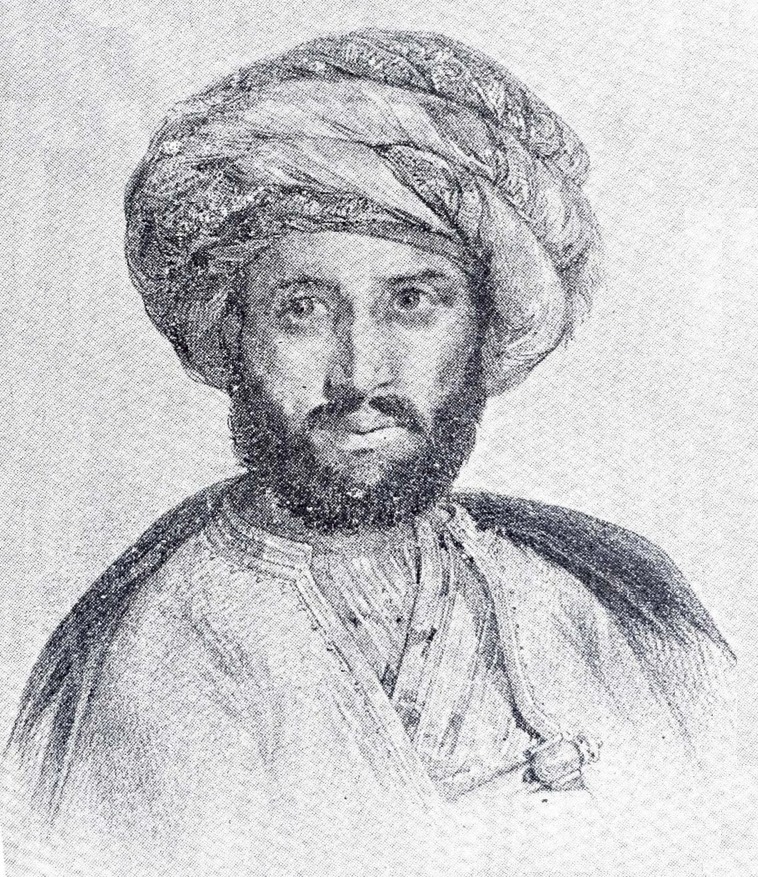
Anonymous, portrait drawing of Rifa'a al-Tahtawi, printed in Jurji Zaydan, Tarajim Mashahir al-Sharq vol. 2 (Cairo, 1922); public domain · Anonymous drawing of Rifa'a al-Tahtawi in Arab dress, artist and date unknown. The same drawing is printed as plate 3 (captioned 'Rifa'a Bey Rafi' al-Tahtawi') in Jurji Zaydan's Tarajim Mashahir al-Sharq, volume 2, third edition (Cairo: Matba'at al-Hilal, 1922), Internet Archive scan from the Bibliotheca Alexandrina (item AAlexandrina-084569), where the text calls it his portrait; that 1922 print is the verified publication basis. The file is the clearer Wikimedia Commons scan of the same drawing ('Rifa'a el-Tahtawi.png', which its uploader attributes to a 1912 edition of his Manahij al-Albab), converted to JPEG on a white background at its original 758 x 877 pixels, not upscaled. · Public domain (anonymous drawing published in 1922, before 1931)
scholar · 19th Century
Rifa'a al-Tahtawi
1801–1873
Known For
Not yet included in personality matching — the documented evidence doesn't yet cover enough of the personality model. Everything else on this page is fully available.
Trait Constellation
Key Achievements
From 1835 he directed Egypt's School of Languages, widening its curriculum to history, geography, mathematics and law, and later headed the Translation Bureau, where students and staff translated French works into Arabic.
He went to Paris in 1826 as imam of Muhammad Ali's student mission and wrote Takhlis al-Ibriz, his account of France, which was printed in Egypt and became one of the early Arabic travel accounts of nineteenth-century France.
He edited the official gazette al-Waqa'i al-Misriyya and, from 1870, the schools journal Rawdat al-Madaris, wrote an 1872 treatise on the education of girls and boys, and in 1850 set up a school in Khartoum.
Moments That Reveal Them
He translated a large volume of Malte-Brun's geography in sixty days in 1265 AH, though his biographer Zaydan adds that the translation appears to have been done in haste.
Consistent with a fast working pace that the biographer himself saw as costing polish, though it rests on a single early biography. Execution Speed
After the School of Languages was closed and he was sent to Khartoum in 1850, he set up a school there and spent four years completing translations, including Fenelon's Telemaque.
Consistent with continuing educational and translation work through a forced move, though the closure and reassignment were the ruler's decisions, not his. Persistence
Turning Points
In Paris from 1826, as imam of the mission, he took up French on his own initiative and went on to study history, geography and other modern subjects, which led to his career as a translator and teacher after his return in 1831.
Consistent with self-directed curiosity about Western learning, though Gran argues that his Azhar and Tahta formation had already prepared him. Curiosity
Similar People
People whose overall profiles resemble theirs.

Abraham Lincoln

Louis Pasteur

Maya Angelou

Gertrude Bell

Jane Goodall
Opposite Profile
Not a rival — a different profile shape worth a look.
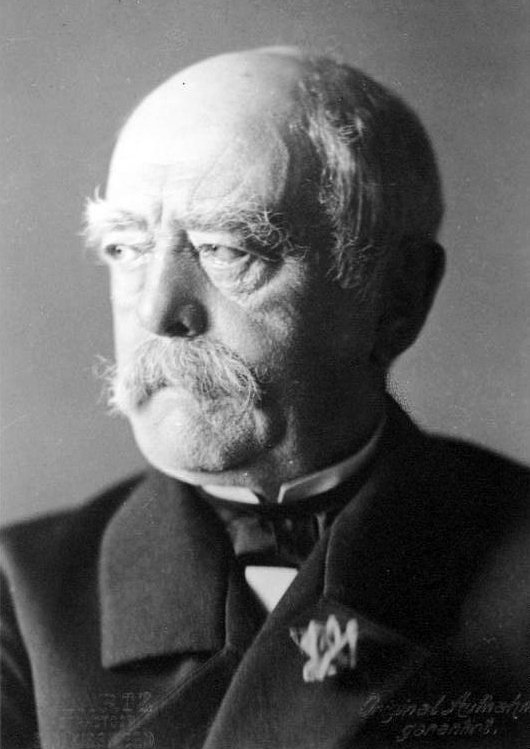
Otto von Bismarck
Sources
- Rifa'a at-Tahtawi (Q981929), verified live via the Wikidata API (2026-11-01): label "Rifa'a at-Tahtawi", description 'Egyptian scholar (1801-1873)', born 15 October 1801, died 27 May 1873, no Korean label, image 'Tahtawi.jpg' (150 x 216). Orientation only; not used as support for any row.
- 'Rifaa et-Tahtavi', TDV Islam Ansiklopedisi (Turkish Religious Foundation Encyclopedia of Islam), read in full in Turkish. CANONICAL SIGNIFICANCE SOURCE: presents him as an Egyptian scholar of language, literature, history and geography and a translator, who studied at al-Azhar (1817-21) under Hasan al-Attar, went to Paris in 1826 as imam of Muhammad Ali's student mission and wrote the Takhlis al-Ibriz about it, directed the School of Languages from 1835 (adding history, geography, mathematics and law to the curriculum; a preparatory school 1841, an accounting school 1845), edited the official gazette al-Waqa'i al-Misriyya from 1841, was sent by Abbas to Khartoum in 1850 to found a school there and returned in 1854, directed the military school 1856-60, and from 1863 headed the revived Translation Bureau and edited the journal Rawdat al-Madaris; lists his translations (geography, logic, geometry, the French Civil Code with a student, Fenelon's Telemaque) and his 1872 education treatise, and says efforts he supported led to a girls' school opened in January 1873. The entry is descriptive, gives no sustained critique, and ties his career closely to the rulers' changing patronage.
- Jurji Zaydan, 'Rifa'a Bey Rafi' al-Tahtawi', in Tarajim Mashahir al-Sharq fi al-Qarn al-Tasi' 'Ashar, vol. 2, third edition (Cairo: Matba'at al-Hilal, 1922), Internet Archive scan from the Bibliotheca Alexandrina (item AAlexandrina-084569), pages 22-25 read as page images in Arabic: an early twentieth-century biography based, as Zaydan says, on Salih Majdi's manuscript biography of Tahtawi; gives his early life, Azhar teaching, appointment as imam of the 1241 AH mission to France, learning French at his own initiative, return in 1247, translation work at the medical, artillery and later other schools, the establishment of the gazette in 1248 AH with his help, the School of Languages opened in 1251 AH and entrusted to him (50 pupils at first, then 250), the Translation Bureau formed in 1258 AH, exile to Khartoum under Abbas I, the military school under Said, the abolition of the schools in 1277 AH and his return to the Translation Bureau and to editing Rawdat al-Madaris until his death in 1290 AH aged 75, and lists his works, noting that he translated one volume of Malte-Brun in sixty days and that the translation was hasty. Earlier-generation admiring biography relying on one manuscript source; the plate of his portrait in the same pages is the portrait review source.
- Peter Gran, 'Tahtawi in Paris', a scholarly essay (open PDF hosted by Ca' Foscari University of Venice, Hitrade project), read in full: argues for a less Eurocentric reading, that his formation owed much to Tahta's culture and the Azhar curriculum rather than only to the French sojourn, that the 'dominant paradigm' leans on his exceptionalism, that his teacher Hasan al-Attar and he 'broke rank' with the Azhar by working for the government and were criticised for it, that his earnings in Paris (250 piasters) were a tenth of a less productive fellow student's (2500), that his mother objected to his going, and that the French loan words and ideas he introduced (citizens' rights, the Copernican view) were less of a rupture than usually claimed. Revisionist counter-voice; the essay is an essay rather than a full archival study and says some of its points are speculation.
- Ines Ait Mokhtar, 'Tahtawi, le pionnier de la Nahda', Les cles du Moyen-Orient (French online magazine; published 2013, updated 2018), read in full in French: summary portrait: Azhar from 1817, Paris 1826-31, Takhlis al-Ibriz ('L'Or de Paris'), direction of the School of Languages and translations of French works (including Montesquieu on the Romans), publication of Arabic classics, exile to Khartoum under Abbas until 1854 where he translated Telemaque; notes he preferred an enlightened ruler to popular government (Hourani's 'conventional Islamic point of view'), criticised Azhar conservatism and was liberal toward Jews and Christians; warns that the 'nationalist' reading is an interpretation and that his political stance limits calling him a liberal. Popular-press synthesis with a short bibliography.
- Abdallah Tagourramt El Kbaich, 'Al-Tahtawi en castellano', blog of the University of Barcelona project Cartografies literaries de la Mediterrania (27 November 2020), read in Spanish: review of the 2018 Spanish translation of the Takhlis al-Ibriz, describing its six essays (the journey to Marseille; Paris geography, customs, politics, education and the French Constitution; rhetoric and his relations with French orientalists; the 1830 revolution; the classification of French sciences and languages) and arguing that the book mirrors France to criticise Egypt and fits the adib ideal rather than the Azhar sheikh. Appreciative academic blog; no independent critical evaluation and no coverage of his school work.
- Farah Rafik, 'How Rifa'a Al-Tahtawi pioneered the Egyptian intellectual awakening', Egyptian Streets (22 June 2022), read in full: laudatory popular article giving the career outline (Azhar at 17, Paris 1826, School of Languages, translation bureau) and quoting others calling him a pioneer of the Nahda, with the unsourced claim that he oversaw more than 2,000 translated books (not used). Used only for the dates it shares with the other sources.