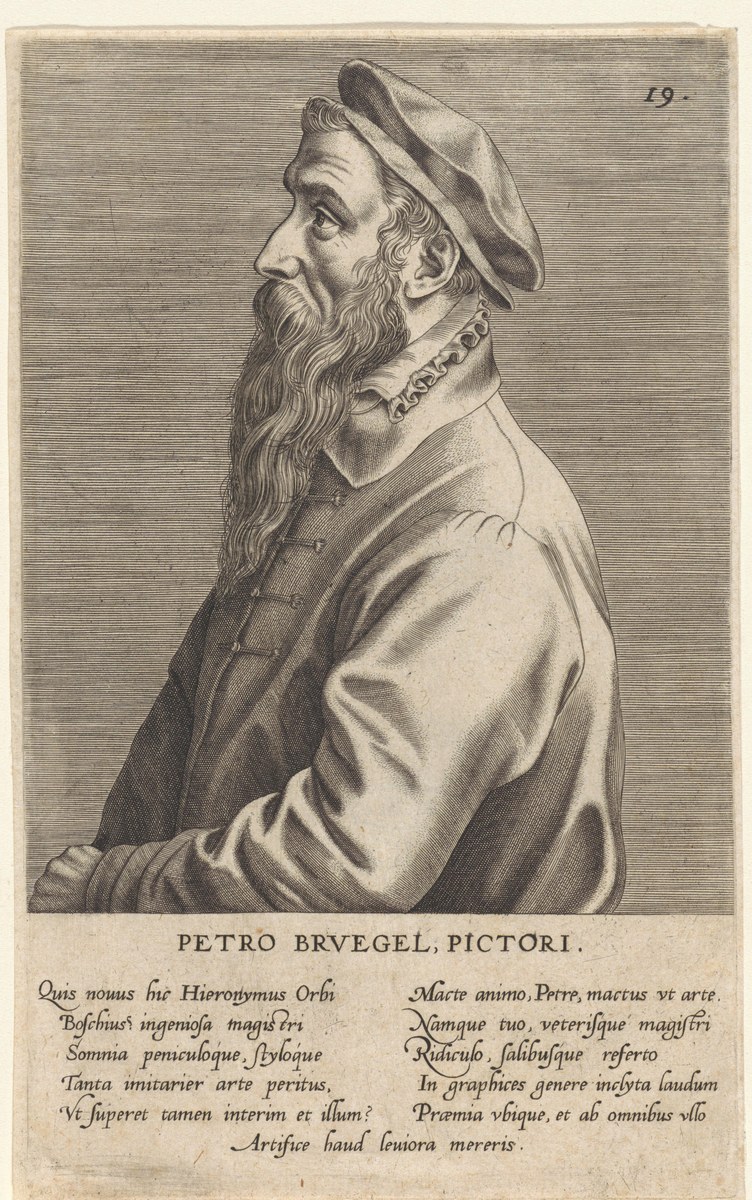
Attributed to Johannes Wierix, 1572, Rijksmuseum, Amsterdam (RP-P-1907-593), public domain · Engraving 'Portrait of the painter Pieter Brueghel', attributed to Johannes Wierix, Antwerp, 1572, number 19 in the series of portraits of famous painters of the Low Countries published after Dominicus Lampsonius's verses; Rijksmuseum, Amsterdam, object RP-P-1907-593, inscribed 'PETRO BRVEGEL, PICTORI'. A posthumous print made three years after the painter's death, not a portrait from life. Digital master 3672 x 5861 pixels; this copy downscaled to 752 x 1200 (never enlarged). · Public Domain Mark 1.0 (Rijksmuseum item-level statement; the 1572 print is also public domain by age)
painter · Early Modern
Pieter Bruegel the Elder
1525–1569
Known For
Not yet included in personality matching — the documented evidence doesn't yet cover enough of the personality model. Everything else on this page is fully available.
Key Achievements
Painted landscapes and vigorous, often witty scenes of peasant life that Britannica calls the work of the greatest Flemish painter of the 16th century.
Designed Alpine landscapes and, from 1556, satirical and moralising scenes in the manner of Bosch for the Antwerp print publisher Hieronymus Cock, prints on which his early fame rested.
After moving to Brussels in 1563 he painted his greatest works for leading collectors and patrons, and his sons Jan and Pieter founded a dynasty of painters that lasted into the 18th century.
Moments That Reveal Them
On his journey to Italy around 1552-54 he travelled as far as southern Italy and crossed the Alps, and drew mountain landscapes between 1553 and 1556 that Britannica calls almost without parallel for their rendering of high mountains.
This is consistent with a sustained interest in landscape and the natural world. Curiosity
In Rome in 1553 he worked with the miniaturist Giulio Clovio, whose estate inventory lists a miniature the two made together, and the figures in his landscape of that year were probably painted by Maarten de Vos.
This is consistent with working readily alongside other specialists. Collaboration
Turning Points
From 1556 he turned to satirical, didactic and moralising subjects in the fantastic manner of Bosch, and Britannica says his inventiveness lifted these designs above mere imitation.
This is consistent with turning an inherited manner into something of his own. Creative Originality
Similar People
People whose overall profiles resemble theirs.


Ada Lovelace

Wolfgang Amadeus Mozart

Benjamin Franklin

Catherine the Great

Mark Twain
Sources
- Pieter Bruegel the Elder (Q43270), verified live via the Wikidata API (2026-11-02): label 'Pieter Brueghel the Elder', description 'Flemish painter (1526-1569)', birth recorded as 1525, 1520 and 1526 (year precision, conflicting), death 1569-09-09 or 1569-09-05, Korean label 대 피터르 브뤼헐. Orientation only; not used as support for any row.
- Encyclopaedia Britannica, 'Pieter Bruegel, the Elder' (Britannica Editors, updated October 2026), article body read in full. CANONICAL SIGNIFICANCE SOURCE: born c. 1525 probably near Breda and died in Brussels in 1569, 'the greatest Flemish painter of the 16th century', renowned for landscapes and vigorous, often witty scenes of peasant life; there is 'but little information about his life' and Van Mander's account of his apprenticeship to Pieter Coecke van Aelst, written 35 years after his death, is the main source; the Italian journey of about 1551-54 and the Alpine drawings, mostly free compositions made after the journey; designs for the Antwerp print publisher Hieronymus Cock, who commissioned his early fame; a turn from 1556 to satirical, didactic and moralising subjects in the manner of Bosch whose inventiveness 'lifted his designs above mere imitation'; collaboration with Giulio Clovio and with Maarten de Vos; marriage to Mayken Coecke and move to Brussels in 1563, where he produced his greatest paintings for collectors including Nicolaes Jonghelinck (16 paintings by 1566), Cardinal Granvelle and Abraham Ortelius, who called him the most perfect artist of the century; burial at Notre-Dame de la Chapelle; sons Jan and Pieter founded a painting dynasty. Scholarly reference; its praise is retrospective.
- Royal Museums of Fine Arts of Belgium, press file for Tine L. Meganck, 'Pieter Bruegel the Elder, Fall of the Rebel Angels: Art, Knowledge and Politics on the Eve of the Dutch Revolt' (Silvana, 2014), read in full: a dated biography after Manfred Sellink's catalogue raisonne (probably apprenticed to Pieter Coecke van Aelst, registered in the Antwerp Guild of St Luke in 1551, Italian journey 1552-54 with contacts including Giulio Clovio, work mainly as a print designer for Cock until about 1562, his only surviving etching in 1560, a turn to painting in 1561-62 possibly encouraged by Nicolaes Jonghelinck, Brussels from about 1562, patrons Ortelius, Jean Noirot and Granvelle, praise from Guicciardini in 1567 and Vasari in 1568, a late commission from the Brussels authorities for the canal); the book synopsis argues his emulation of Bosch was part of a wider interest in collecting and inspecting the artistic and natural world; quotations from Ortelius's epitaph and Lampsonius's verse. Museum publicity document built on scholarly sources.
- The Frick Collection, artist biography 'Pieter Bruegel the Elder (Netherlandish, ca. 1525-1569)', from 'Art in The Frick Collection' (Abrams, 1996), read in full: both the date and place of birth are uncertain, the earliest reference is his entry into the Antwerp painters' guild in 1551, he travelled to Italy about 1552 and was back in Antwerp by 1555, settled in Brussels in 1563 working for eminent private patrons and the city government, and his landscapes and peasant scenes had a powerful and lasting influence in the Netherlands. Short museum biography; independent of Britannica.
- Karel van Mander, 'Het leven van Pieter Brueghel, uytnemende Schilder van Brueghel', Het Schilder-Boeck (Haarlem, 1604), folios 233r-234r, Dutch original read on DBNL (1969 text): born near Breda in a village named Brueghel, trained under Pieter Coecke van Aelst whose daughter he later married, worked with Jeroon Cock, travelled through France to Italy, took his manner from Hieronymus Bosch and was called 'Pier den Drol', drew many views from life in the Alps, entered the Antwerp guild in 1551, went to fairs and weddings with the merchant Hans Franckert dressed as a peasant to study the peasants, was a quiet and skilled man of few words who liked to frighten people and his own servants with tricks, moved to Brussels on marrying, painted works then at the imperial court (a Tower of Babel, Christ carrying the cross, the Massacre of the Innocents and others) and a Peasant Wedding, was commissioned shortly before his death by the Brussels authorities to paint the canal, and on his deathbed had his wife burn drawings with biting captions. Written 35 years after his death from hearsay and anecdote: the disguised-peasant visits, the 'swallowed the mountains' remark and the burned drawings are legend or unverifiable and are NOT scored; used only as a near-contemporary record of how he was regarded and of his commissions. The 1969 text is a copyrighted edition and is cited, not reproduced.
- Rijksmuseum, Amsterdam, print RP-P-1907-593, 'Portrait of the painter Pieter Brueghel (I)', engraving attributed to Johannes Wierix, 1572, number 19 in the series 'Pictorum aliquot celebrium Germaniae Inferioris effigies' (Lampsonius), opened as the museum's linked-art record (Public Domain Mark) and read together with the print's own Latin verse: 'Who is this new Hieronymus Bosch, come back into the world to imitate his master's dreams with brush and stylus, so skilled that he surpasses him?' The verse is a contemporary tribute (three years after his death) by the humanist Lampsonius, so it shows how his circle regarded him and is admiring, not independent evidence of behaviour.
- Marie-Madeleine Renauld, 'Pieter Bruegel The Elder: A Flemish Renaissance Master', TheCollector (9 August 2021), read in full: a popular art-history article that retells Van Mander, says historians cannot agree on his birthplace or family background, states he went to Italy in 1553-54 mainly to study nature (the Alps), that the publisher Cock probably sponsored the journey, that a 1556 drawing 'Big Fish Eat Little Fish' bears his signature while the 1557 engraved version carries 'Hieronymus Bos. Inventor' (so possibly made after Bosch or marked as Bosch to sell), and that his later work shows a less dark view than Bosch's. Popular secondary article; used only as a cross-check and for the Bosch-signature caution.