
Benjamin Franklin
92% Profile Match
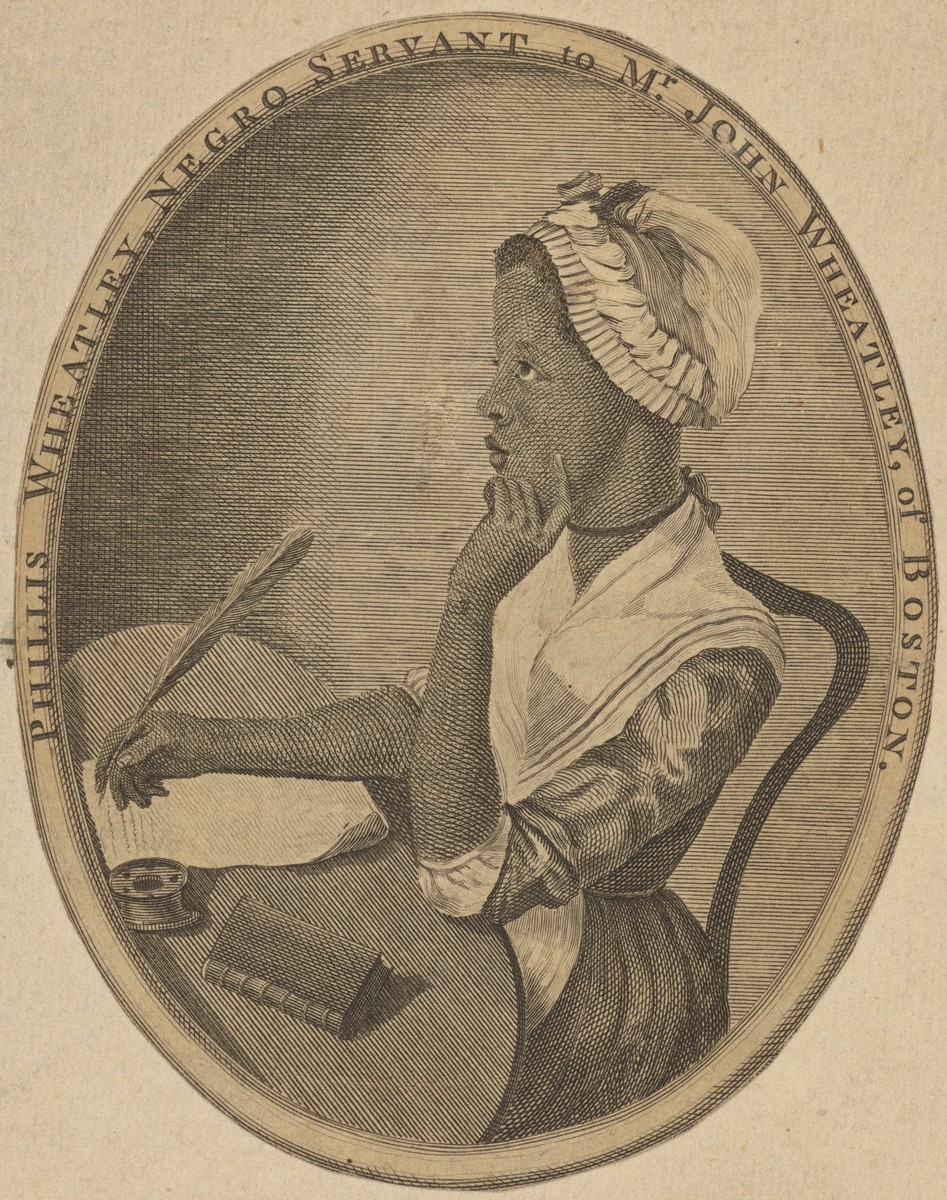
Scipio Moorhead, 1773, The Metropolitan Museum of Art, The Elisha Whittelsey Collection, The Elisha Whittelsey Fund, 1949, Open Access · Engraving 'Phillis Wheatley' by Scipio Moorhead, 1773, the frontispiece portrait of her book, lettered around the oval 'Phillis Wheatley, Negro Servant to Mr. John Wheatley, of Boston'; The Metropolitan Museum of Art, The Elisha Whittelsey Collection, The Elisha Whittelsey Fund, 1949 (accession 49.40.24, object 396463; oval sheet trimmed, 12.7 x 9.8 cm). The museum's image (3027 x 4000) was cropped to the oval print (2960 x 3750) and downscaled to 947 x 1200 with no upscaling. · Public domain: The Metropolitan Museum of Art Open Access (isPublicDomain true; no restriction field); an engraving of 1773
poet · Early Modern
1753–1784
Not yet included in personality matching — the documented evidence doesn't yet cover enough of the personality model. Everything else on this page is fully available.
In 1773, at about 20, she published Poems on Various Subjects, Religious and Moral in London, which the Library of Congress calls the first volume of poetry by an African American.
Her 1770 elegy on the evangelist George Whitefield drew international attention and the interest of the Countess of Huntingdon, whose backing made the London edition possible.
Her volume carried a signed attestation by eighteen leading Bostonians that she wrote the poems, and anthologies credit her with a founding role in African American literature.
Her owner's letter in the 1773 book says she learned English within sixteen months of arriving, that her own curiosity led her to writing, and that she wished to learn Latin; she later studied Latin and read Homer, Virgil and Ovid.
This is consistent with a self-directed appetite for learning, though the strongest wording comes from her owner's promotional letter. Curiosity
After a 1772 proposal to print her poems in Boston by subscription failed, her poems were sent to London and she sailed there in 1773; in 1779 she advertised a proposal for a second volume.
This is consistent with pursuing publication through a new route after a setback, though the sources credit her family and patrons as well. Proactive Agency
Her elegy for George Whitefield in 1770 brought her wide notice, and she wrote to the Countess of Huntingdon, Whitefield's patron, about it; the Countess later backed her London edition.
This is consistent with a poem that won an influential patron, though how much of the outcome was her own persuasion is not shown. Persuasiveness
People whose overall profiles resemble theirs.

Not a rival — a different profile shape worth a look.
