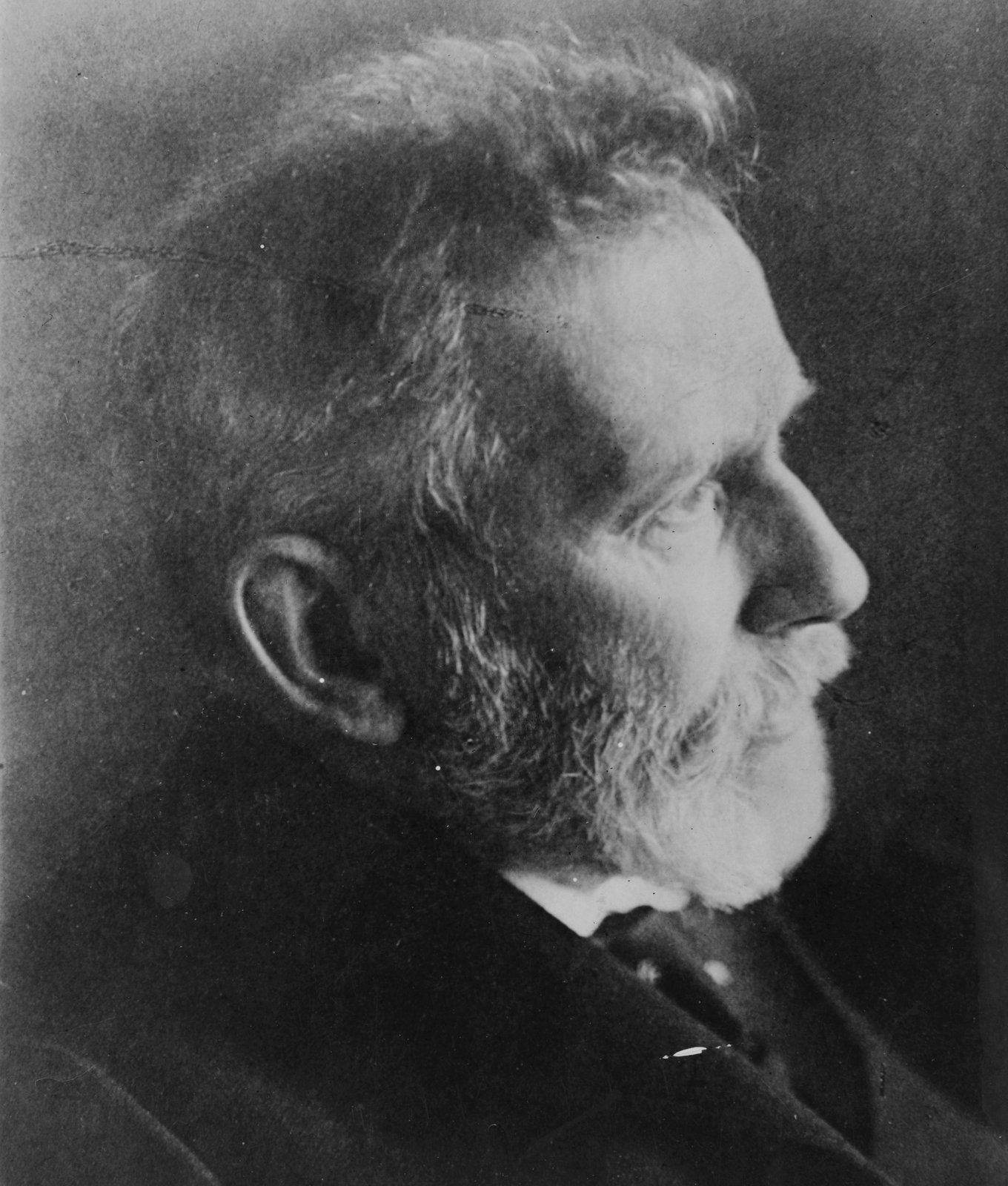
Bain News Service, Prof. Paul Ehrlich, photograph, 1909; Library of Congress, LCCN 00650787; no known restrictions on publication. Cropped to the photographic image area (handwritten caption, number and black border removed) and downsized to 1600 px. · Bain News Service, 'Prof. Paul Ehrlich', photographic print (Bain negative/print no. 728-1), 1909; Library of Congress Prints and Photographs Division, George Grantham Bain Collection, LCCN 00650787 (digital ID cph.3c26279), rights statement 'No known restrictions on publication'; via Wikimedia Commons (master TIFF 3319x4096). The Library of Congress item page itself is behind a bot-check and was not opened; the rights chain rests on the Commons file wikitext, which quotes the LoC statement and tags it PD-Bain and PD-old-70-1923 (US news-agency photograph, 1909). · Public domain
Trait Constellation
Key Achievements
Ehrlich and his co-workers made and tested a long series of arsenic compounds, and the 606th, arsphenamine, was made in 1907. After Sahachiro Hata showed in 1909 that it cured syphilis in infected rabbits, Ehrlich and Hata announced it on 19 April 1910 at the Congress for Internal Medicine in Wiesbaden, and Hoechst sold it as Salvarsan. Valent and colleagues describe it as the first synthetic agent against syphilis; it rested on Ehrlich's idea of a 'magic bullet' that would strike a parasite and spare the patient's own cells.
In 1897 Ehrlich proposed the side-chain theory: cells carry specific structures that bind a toxin, and when the cell makes more of them and releases them they act as antitoxin, or antibody. In 1900 he renamed these structures receptors. For his work on immunity he shared the 1908 Nobel Prize in Physiology or Medicine with Ilya Metchnikoff, whose theory of phagocytosis complemented his own.
From 1890 Ehrlich worked at Robert Koch's institute on Emil von Behring's diphtheria antitoxin. He showed that the antitoxin content of sera varied widely and defined units of antitoxin against a fixed standard, which the Nobel biography says became the basis of all later serum standardisation. From 1896 he directed the Prussian institute set up to control therapeutic sera, followed in 1899 by the Royal Institute of Experimental Therapy in Frankfurt.
As a student and young physician at the Charite in Berlin, Ehrlich sorted dyes into acid, basic and neutral kinds and used them to separate the granules in blood cells, work the Nobel biography says laid the foundations of haematology. In 1882 he published an improved stain for the tubercle bacillus that Koch had just identified, the basis of the later Ziehl-Neelsen method still in use.
Moments That Reveal Them
In 1906 at the Georg-Speyer-Haus, Ehrlich told three chemists that atoxyl was not the 'anilide' of the accepted 1863 formula but an amino-phenylarsonic acid with a free amino group, and ordered the work to proceed on that basis. In Marquardt's account two of them, von Braun and Schmitz, refused and left; Bertheim stayed, and the joint paper with Ehrlich appeared on 1 May 1907. The Nobel biography credits Ehrlich with Bertheim for establishing the correct structural formula.
Insisting on his own chemical reading against the accepted formula, and ordering the work on that basis even when it cost him two chemists, is consistent with independent thinking; the same account shows the stance came at a price in staff. Independent Thinking
In 1909 Sahachiro Hata reported that compound 606, set aside in 1907 as ineffective, worked in syphilitic rabbits. Ehrlich asked him to repeat the experiments again and again, and by Marquardt's account Hata grew impatient before Ehrlich accepted the result and prepared the 1910 announcement; the Nobel biography says hundreds of experiments repeatedly proved its efficacy.
Asking for repeated confirmation of a result he badly wanted to be true is consistent with perfectionism; the same demand wore on the person doing the work. Perfectionism
Turning Points
In 1906 Ehrlich became director of the Georg-Speyer-Haus in Frankfurt, a chemotherapy research institute built beside his institute with money donated by Franziska Speyer. Its chemical laboratory let him move from serum work to making and testing compounds of his own design; Valent and colleagues call the donation an essential basis of the screening that led to 606.
Turning from serum work to a chemistry laboratory he did not have, and getting it through a private gift, is consistent with resourcefulness. Resourcefulness
Similar People
People whose overall profiles resemble theirs.

Marie Curie

Alan Turing

Rosalind Franklin

Ada Lovelace

Jane Goodall
Sources
- Paul Ehrlich (English Wikipedia) -- orientation only; not used as support for any scored row. Korean Wikipedia title '파울 에를리히' confirmed via the Wikidata kowiki sitelink.
- Paul Ehrlich (Q57089) -- verified live via wbgetentities (2026-10-05): en label 'Paul Ehrlich', description 'Jewish-German physician and scientist (1854-1915)', ko label '파울 에를리히', P569 1854-03-14, P570 1915-08-20, P18 two images (Paul Ehrlich 3.jpg; the 1920 Voigt portrait). Orientation only.
- Martha Marquardt, 'Paul Ehrlich' (London: William Heinemann Medical Books, 1949; introduction by Sir Henry Dale; enlarged from her 1924 'Paul Ehrlich als Mensch und Arbeiter'), Internet Archive digitised copy (Digital Library of India scan, OCR text) -- chapters III, IV, V, VII, VIII, IX, X, XI, XIV, XV, XVI, XVII, XXI, XXIV and XXV read in full; VI, XII and XVIII read in part; I, II, XIII, XIX, XX, XXII and XXIII not read. INSIDER AND ADMIRING (Ehrlich's secretary 1902-1915, writing three decades after his death; much dialogue is reconstructed from memory; she is openly partisan about Wassmann and about credit for 606). It also relays letters and recollections from Henry Dale, William Bulloch, Reid Hunt, Edmund Landau, William Welch, Johan Almqvist, Hans Sundberg and Felix Pinkus, and long extracts from Ehrlich's own 1899 and 1906 letters and autobiographical notes -- each such passage is cited below as a relayed account, not a separate source. Read: Charite assistant years and the 1882 stain for the tubercle bacillus; the Behring contract dispute; the Steglitz and Frankfurt institutes; the Gruber debate over the side-chain theory; working habits, 'blocks', reading and forgetfulness; the 1906 atoxyl scene with the chemists; the arsenic series, 606 set aside and re-tested by Hata; distribution of Salvarsan in 1910; the early necrosis problem; the 1912 refusal of lay lectures; Neosalvarsan as a compromise; the 1914 Wassmann libel case; the last year.
- Peter Valent, Bernd Groner, Udo Schumacher, Giulio Superti-Furga and colleagues (Medical University of Vienna commemorative symposium), 'Paul Ehrlich (1854-1915) and His Contributions to the Foundation and Birth of Translational Medicine', Journal of Innate Immunity 8(2), 2016, 111-120 (open full text, DOI 10.1159/000443526), read in full (body text; reference list skimmed) -- SCHOLARLY REVIEW, ADMIRING BUT MODERN AND INDEPENDENT OF MARQUARDT. Read: the three phases of his career (staining and haematology 1878-1890; antitoxin standardisation and side-chain theory 1890-1900; chemotherapy 1904-1914), the receptor and chemoreceptor concept with Langley, the screening programme (methylene blue 1891, trypan red with Shiga, arsacetin, arsenophenylglycin, 606, 914), the roles of Bertheim and Hata, the 1910 Wiesbaden announcement and 65,000 free samples, the remark that he was criticised for a 'too lively' imagination and overinterpretation, and the post-Salvarsan limits (resistance, combination with mercury or bismuth).
- Paul Ehrlich, 'Partial Cell Functions', Nobel Lecture, 11 December 1908 (Nobel Lectures, Physiology or Medicine 1901-1921; NobelPrize.org PDF), read in full -- PRIMARY, SELF. Read: toxin-toxoid-antitoxin reasoning and the receptor concept, credit given by name to Morgenroth, Wassermann, Franke, Rohl, Gulbransen and Browning, the trypanosome recidive-strain experiments, his own statement that the work has gaps, and his claim that arsenophenylglycin was an 'entirely ideal remedy' in animals.
- NobelPrize.org, 'Paul Ehrlich - Biographical' (from Nobel Lectures, Physiology or Medicine 1901-1921, Elsevier 1967), read in full -- INSTITUTIONAL SUMMARY; its closing paragraph says it relies on Martha Marquardt's biography for personal habits, so it is NOT independent of her on character. Used for dated facts: staining work, serum standardisation, side-chain theory, the 606th substance set aside in 1907 and tested on Hata's syphilitic rabbits, Neosalvarsan as the 914th substance, the 1908 prize shared with Metchnikoff.
- Paul Ehrlich and S. Hata, 'Die experimentelle Chemotherapie der Spirillosen (Syphilis, Rueckfallfieber, Huehnerspirillose, Framboesie)' (Berlin: Julius Springer, 1910), Internet Archive copy (Yale Medical Historical Library) -- Ehrlich's preface (Vorwort) read in full in German; Hata's experimental chapters and the tables were not read (technical OCR text). PRIMARY, SELF. Read: his statement of method (a planned search for a type of remedy improved by modification and substitution, not aimless trial of substances), the list of named collaborators and chemists he thanks, the Hoechst, Cassella and Rockefeller (through Flexner) support, his admission of having been 'a spendthrift' with his own means in the early years, and his statement that without Hata's exact work the result would not have been reached.
- Dr. med. Heinrich Dreuw (Berlin dermatologist), 'Die Salvarsangefahr' (Berlin: Ritter-Verlag, 1914; this copy carries a Georg-Speyer-Haus library stamp), Internet Archive OCR text -- opening survey and the sections on how 606 was introduced, the restricted early distribution, the switch from subcutaneous to intravenous injection, and the Berlin Dermatological Society discussion read (about the first 17 pages of the text, OCR partly garbled); the remainder skimmed. ADVERSARIAL CONTEMPORARY CRITIC AND POLEMICIST: the author states he is waging a public campaign against 'Ehrlich-Hata 606', quotes a Prague pharmacologist (Hering) on inadequate animal toxicology, a newspaper report of a 1910 Berlin society meeting, and his own observation of necroses; his case counts (for example about 280 deaths in the literature) are not independently checked and are not used. Cited only for what Ehrlich is said to have claimed ('therapia magna sterilisans', 'ideal', 'hyperideal'), the early limited distribution to chosen physicians, and the complaint that he did not answer a September 1910 letter.