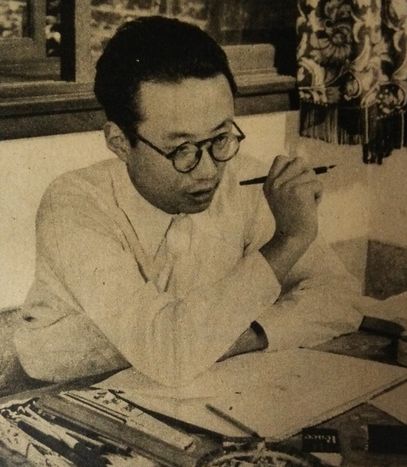
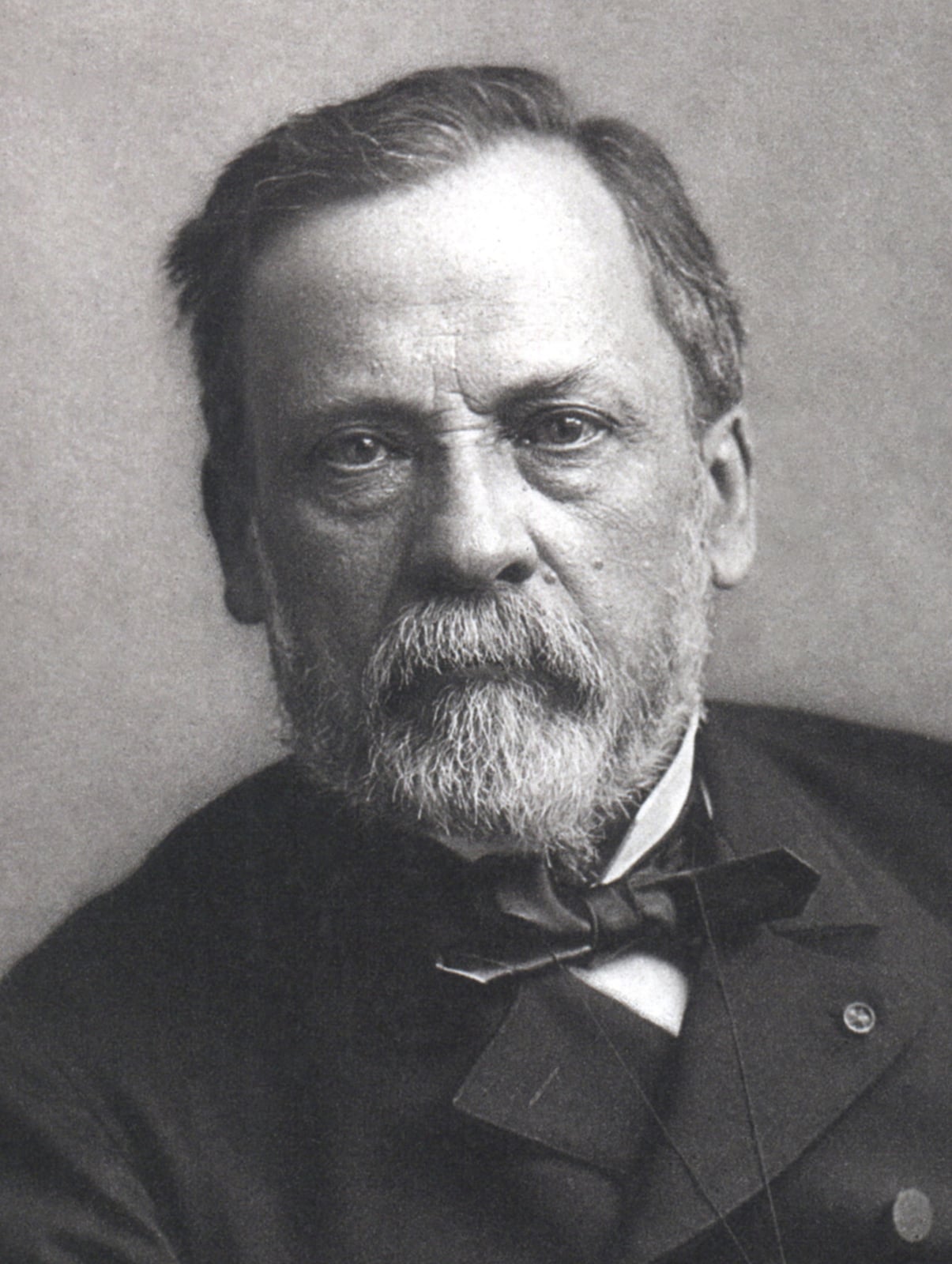
Asahi Shimbun company, Asahi Graph, 10 June 1953, public domain · Photograph of Osamu Tezuka from the Asahi Graph issue of 10 June 1953, credited to the Asahi Shimbun company, scanned and hosted on Wikimedia Commons as 'Tezuka Osamu.JPG'. Rights basis: published in Japan in 1953, before 1 January 1958, so public domain in Japan under the transitional rule for old photographs and therefore public domain in the United States (Japanese copyright expired before the 1996 restoration date); Commons tags it as an old-photograph public-domain file with no US-restoration warning. Same basis as the Asahi Graph photograph used for another Japanese subject in this roster. Saved at the Commons original size of 407 x 467, no resizing and no upscaling. Caveat: the individual photographer is not named, and the basis depends on the 1953 publication date given on the file page, which I could not check against the magazine itself. The Wikidata lead (a 1951 photograph, 595 x 508, unknown author) was rejected because its only source is a 1989 book and no earlier publication is documented. · Public domain (Japan, published before 1958)
artist · 20th Century
Osamu Tezuka
1928–1989
Known For
Not yet included in personality matching — the documented evidence doesn't yet cover enough of the personality model. Everything else on this page is fully available.
Trait Constellation
Key Achievements
Known in Japan as the god of comics, he reshaped postwar manga, drawing about 150,000 pages and creating long-running works such as Astro Boy, Jungle Emperor and Phoenix.
Astro Boy, adapted from his manga, is described as Japan's first animated television series, and he founded the Mushi Production animation studio to make it.
He earned a medical degree but chose a career in graphic arts, and his stories are characterized by humanism and a rejection of war.
Moments That Reveal Them
To make weekly 30-minute Astro Boy episodes, he told his staff to reduce the number of pictures and mask the lack of movement with lines, by his own account.
This is consistent with finding a workable low-cost method under production limits, though it is his own account. Resourcefulness
He began the Phoenix series in 1954 and continued it until his death, a story that, as one reviewer put it, spans 4,000 pages across past, future and present.
This is consistent with sustained commitment to a single long-term project over decades. Persistence
Turning Points
After graduating from medical school in 1951 and qualifying as a physician in 1960, he chose a career in graphic arts rather than medicine.
This is consistent with a decision to commit fully to drawing and storytelling over a conventional professional path. Cross-Domain Range
Similar People
People whose overall profiles resemble theirs.


Maya Angelou

Abraham Lincoln

Rabindranath Tagore

Mark Twain

Louis Pasteur
Opposite Profile
Not a rival — a different profile shape worth a look.
Otto von Bismarck
Sources
- Osamu Tezuka (Q193300), verified live via the Wikidata API (2026-10-31): label 'Osamu Tezuka', description 'Japanese cartoonist and animator (1928-1989)', Korean label present, image 'Osamu Tezuka 1951 Scan10008-2.JPG'. Orientation only; not used as support for any row.
- EBSCO Research Starters, 'Osamu Tezuka', article by Jennifer R. Coker (2024; read in full). CANONICAL SIGNIFICANCE SOURCE: pioneering figure in comics and animation, known in Japan as the god of comics; inspired by Walt Disney; chose graphic arts over medicine; works characterized by humanism and rejection of war; Phoenix series; Astro Boy described as Japan's first animated television series; about 150,000 pages drawn; awards at Venice, Asia and Zagreb festivals. Encyclopedic summary that gives the Mushi/Tezuka Productions founding as 1961, which differs from the company's own dating.
- Encyclopedia.com, 'Tezuka, Osamu 1928-1989' (Gale reference entry, read in full): lists works and awards, quotes Frederik Schodt on his humanism and on the many manga artists and animators who worked with him, records that his animation company was bankrupted by network budget limits before the success of Phoenix, that he never excelled as a businessman, and that his widow declined to act over the similarity between The Lion King and Kimba. Reference entry compiled from reviews and Schodt, mixed admiring and critical.
- Tezuka Productions, company profile and chronology (read in full; promotional insider source run by his own studio): debut 1946, first story manga New Treasure Island in 1947, about 150,000 manuscript sheets, about 700 titles, more than 1,000 characters and about 60 animation works; chronology of Astro Boy (1963), Jungle Emperor Leo, Phoenix in COM magazine (1966), the Kodansha Manga Award (1977); anecdote that he first refused paperback editions because he cared about page format. Counted as insider evidence only.
- Google Arts & Culture exhibit 'Tezuka Osamu the Dawn of TV animation', by Tezuka Productions (read in full; insider curation quoting his own words): his 1958 move into animation with Toei, the 1961 studio, the 1962 film Tales of the Street Corner, and his account of making weekly 30-minute Astro Boy episodes by cutting the number of pictures. Self-report and promotional; used only for his own described method.
- ImageTexT journal, review of Natsu Onoda Power's 'God of Comics: Osamu Tezuka and the Creation of Post-World War II Manga' by Tof Eklund (2021; read in full): independent scholarly review that credits the book with surveying about 150,000 pages of output, shows him at the forefront of shonen manga and arguably shojo manga, notes his vexed relationship with anime and varied depiction of women, and warns that the book overplays his importance and canonizes him. Counter-voice source on a scholarly book (the book itself was not opened).