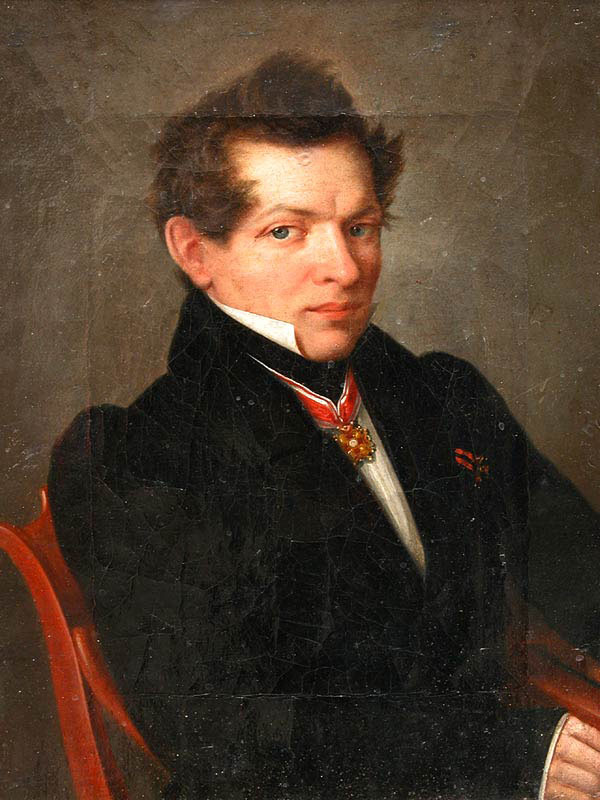
Lev Kryukov, Portrait of N. I. Lobachevsky, first half of the 19th century, public domain, via Wikimedia Commons · Portrait of Nikolai Ivanovich Lobachevsky, oil on canvas, by Lev Dmitrievich Kryukov (1783-1843), the painter employed at Kazan University, dated to the first half of the nineteenth century and in other lists to the 1830s or 1839, so painted in the sitter's lifetime by a painter who died in 1843. Because the painter died in 1843 the painting is in the public domain by age everywhere, and a faithful photograph of a flat painting adds no new copyright. The file is the unaltered 600 x 800 pixel image from Wikimedia Commons, whose page cites a Tatarstan museums-portal page (tatar.museum.ru, section 'univer') as its source; that page could not be opened, so the present owner of the canvas and any museum notice were not checked. No cropping, no resizing and no upscaling. · Public domain (painter died 1843)
Trait Constellation
Key Achievements
He published the first printed account of non-Euclidean geometry in Kazan in 1829-30, building a consistent geometry in which Euclid's parallel postulate fails.
As rector of Kazan University from 1827 to 1846, he oversaw new buildings, an observatory and laboratories and led the university through the cholera epidemic of 1830-31 and the fire of 1842.
He also found a method for the roots of algebraic equations, shared with Dandelin and Graeffe, and a convergence criterion for infinite series.
Moments That Reveal Them
According to the Dictionary of Scientific Biography, he calculated the angle sums of triangles with the stars Sirius, Rigel or 28 Eridani as a vertex to test whether the geometry of real space deviated from Euclid's by more than observational error.
This is consistent with a mathematician who tried to test an abstract geometry against astronomical measurement. Analytical Rigour
Britannica and MacTutor say he led the university through the 1830-31 cholera epidemic with a strict quarantine and acted personally to save the university during the 1842 fire.
This is consistent with an administrator who took charge during emergencies. Leadership Drive
Turning Points
After the St Petersburg academician Ostrogradsky reviewed his work unfavourably and a journal ridiculed it in 1834, he kept developing the geometry in Russian, French and German, and dictated Pangeometry in French in 1855 after he had gone blind; recognition came only after his death.
This is consistent with a mathematician who kept developing his work through ridicule and isolation. Persistence
Similar People
People whose overall profiles resemble theirs.

Rabindranath Tagore

Maya Angelou

Emmy Noether

Ada Lovelace

Alan Turing
Opposite Profile
Not a rival — a different profile shape worth a look.
Theodore Roosevelt
Sources
- Nikolai Ivanovich Lobachevsky (Q129199), verified live via the Wikidata API (2026-10-31): label 'Nikolai Ivanovich Lobachevsky', description 'Russian mathematician (1792-1856)', born 20 November / 1 December 1792 (three birth values in different calendars), died 12 / 24 February 1856, Korean label present. Orientation only; not used as support for any row.
- Valentin A. Bazhanov, 'Nikolay Ivanovich Lobachevsky', Encyclopaedia Britannica, read in full (life and mathematical research and legacy sections). CANONICAL SIGNIFICANCE SOURCE: Russian mathematician and founder of non-Euclidean geometry, developed independently of Bolyai and Gauss; first publication in 1829, Bolyai's in 1832, Gauss never published; rector of Kazan for 19 years; ideas met with misunderstanding and scorn from Ostrogradskii and Fuss; he continued stubbornly in isolation and dictated Pangeometry in French in 1855; his geometry was understood only after Riemann and Klein. Reference entry by a historian of science.
- MacTutor History of Mathematics (University of St Andrews), 'Nikolai Ivanovich Lobachevsky', read in full: schooling on a scholarship, his teacher Bartels, the difficult years under the curator Magnitskii, the rectorship from 1827 with a building programme, the 1830 cholera and 1842 fire, his retirement in 1846 (described as essentially a dismissal), the first printed account of non-Euclidean geometry in 1829 rejected by Ostrogradski for the St Petersburg Academy, the Dandelin-Graeffe method, the myths about Gauss that it calls false, and the later acceptance through Hoüel, Beltrami, Klein and Poincaré. Scholarly biography that corrects legends; its quotations from Vinberg and Laptev were read through it, not in the originals.
- B. A. Rosenfeld, 'Lobachevsky, Nikolai Ivanovich', Complete Dictionary of Scientific Biography (Scribner, 2008), read in full via the St Andrews copy of the Encyclopedia.com text: offices held (dean, librarian, rector 1827-46, assistant trustee), the 1826 report and 1829-30 publication, his early attempts to prove the fifth postulate, the calculation of angle sums for stellar triangles to test the geometry of space, priority over Bolyai and Gauss, the uncomplimentary review by Ostrogradsky and the pamphlet ridiculing him in 1834, Gauss's private praise without public comment, Cayley's failure to understand him, and the later work of Hoüel, Beltrami, Klein and Poincaré. Detailed reference article by a Soviet historian of mathematics.
- 'Lobachevsky, Nikolai Ivanovich', Biographical Encyclopedia of Astronomers (Springer, 2007), read in full via the St Andrews copy (two pages): remembered as a founder of non-Euclidean geometry, his rise at Kazan to rector in 1827, the February 1826 paper as the apparent first public disclosure, the 1829 version in the Kazan Messenger, the physical question whether space is Euclidean, the first neglect of the work and its later recognition through Klein, Poincare, Riemann and Hilbert. Short reference entry, anonymous in the copy opened.
- 'Kryukov, Lev Dmitrievich' (Russian Wikipedia), read for the portrait attribution only: serf-born painter and miniaturist employed at Kazan University from 1806, died 13 May 1843 in Kazan, author of portraits of Kazan figures including Lobachevsky, with a Lobachevsky portrait dated to the 1830s. Orientation only; never counted as a research source.