Mahatma Gandhi
94% Profile Match
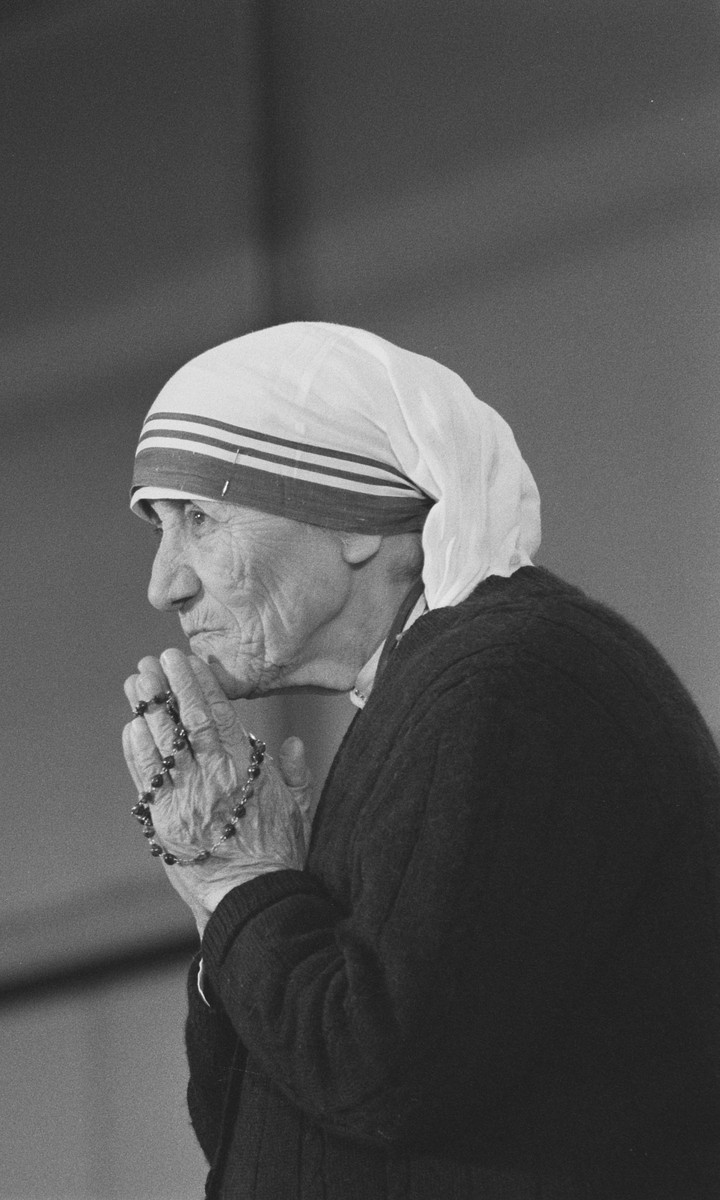
Rob Croes / Anefo, Nationaal Archief, 11 June 1988, CC0 · Black-and-white press photograph of Mother Teresa taken by Rob Croes (Anefo) at a Catholic meeting in Utrecht, the Netherlands, on 11 June 1988 (Nationaal Archief, Fotocollectie Anefo, file number 934-2638, originally photographed with a bishop, Philippe Bar, standing at her left). Cropped from the 3739 x 2481 original to the right-hand part showing only her, then downscaled to 720 x 1200; no upscaling. Rights basis: the Commons record quotes the archive record naming Nationaal Archief as rightsholder and carries the Nationaal Archief template with a CC0 tag, consistent with the archive's open release of the Anefo collection. Caveat: the archive's own page (proxy.handle.net record) is rendered by JavaScript and its licence text could not be read directly here, so the CC0 statement is taken from the Commons transcription of the archive record. · CC0 1.0 (Nationaal Archief, Anefo collection)
religious leader · 20th Century
1910–1997
Not yet included in personality matching — the documented evidence doesn't yet cover enough of the personality model. Everything else on this page is fully available.
In 1948 she left the Loreto convent school in Calcutta to work among the poorest, and in 1950 received Holy See permission to found the Missionaries of Charity.
Her order ran homes for the dying, orphanages, mobile clinics and leprosy centres, and by 1997 the Vatican counted about 610 foundations in 123 countries.
She received the 1979 Nobel Peace Prize; critics such as Christopher Hitchens and a 2013 University of Montreal review have questioned the quality of care in some homes and the order's finances.
In 1948, after a short medical course, she left the convent with no funds and began an open-air school for slum children, soon joined by former students.
This is consistent with starting work with very few resources and relying on others joining. Resourcefulness
In 1952 she asked Indian officials for a place where the dying could be cared for and was given part of an abandoned temple, which she renamed Nirmal Hriday.
This is consistent with taking the initiative to approach authorities for what the work needed. Proactive Agency
In 1948, after about two years of waiting for permission, she exchanged her teaching life at Loreto for work in the Calcutta slums.
This is consistent with giving up an established position for uncertain work. Risk Tolerance
People whose overall profiles resemble theirs.


Not a rival — a different profile shape worth a look.