
Maya Angelou
94% Profile Match
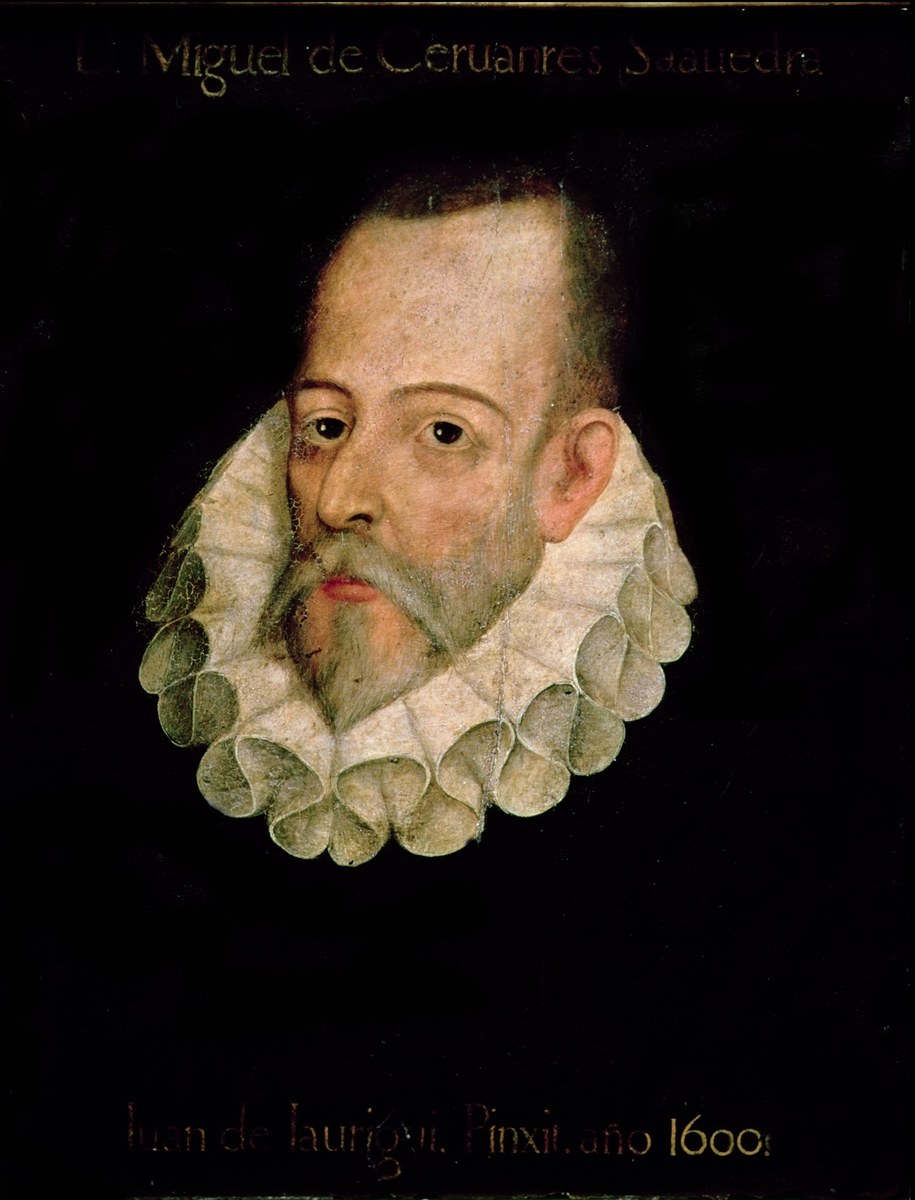
Attributed to Juan de Jauregui, c.1600, Real Academia de la Historia (traditional, unverified portrait of Cervantes), public domain · Wikimedia Commons, 'Cervantes Jauregui.jpg' -- oil on panel, about 1600, held by the Real Academia de la Historia (Madrid), attributed to Juan de Jauregui (died 1641); Commons credits the Biblioteca Virtual Miguel de Cervantes and Bridgeman Art Library object 119216, tagged PD-Art / PD-old-auto-expired. IMPORTANT: this is NOT a documented likeness. Commons and the Biblioteca Virtual (which captions it 'Cervantes (?)') state that no authentic portrait of Cervantes exists, that modern scholarship does not accept this image as authentic, that no document shows Jauregui painted it, and that the painted names are centuries later. It is shown only as the traditional, presumed portrait (a historical depiction). Original 1443 x 1893 pixels, 423,402 bytes (SHA-1 of the download fd1e1a67a565acf0a7e4110a14baa733d9c9ec95); stored copy downscaled only to 915 x 1200. Rights basis: a c.1600 painting by a painter who died in 1641, so out of copyright everywhere relevant; the file is a faithful photographic reproduction of a flat work. Residual caveat: the specific photograph's own rights are not stated on Commons beyond the PD-Art assertion; no conflicting notice was found on the Biblioteca Virtual image page (its legal page was not opened). · Public domain (painting c.1600; Commons PD-Art, PD-old-auto-expired)
writer · Early Modern
1547–1616
Not yet included in personality matching — the documented evidence doesn't yet cover enough of the personality model. Everything else on this page is fully available.
Wrote Don Quixote (Part I 1605, Part II 1615), which many scholars regard as the first modern novel; Britannica calls him the most important and celebrated figure in Spanish literature, and the book has been translated into more than 60 languages.
Worked in nearly every major genre: the pastoral romance La Galatea (1585), plays and interludes, the Exemplary Stories (1613), the verse Journey to Parnassus (1614) and the romance Persiles, published after his death.
After a rival's false sequel appeared in 1614, he finished and published the real Part II in 1615, answering the imitation inside the story and carrying Don Quixote's adventures to their end.
When a false continuation of Don Quixote appeared in 1614, he wrote its existence into his own Part II: Don Quixote leafs through the false book and meets one of its characters, who confirms the real hero.
This is consistent with an author who answered a rival by reworking his own project rather than ignoring it. Adaptability
He completed Persiles and Sigismunda, a romance promised in several earlier prefaces, four days before his death in 1616; it was published after he died.
This is consistent with a writer who kept working toward a long-promised book to the end of his life. Persistence
After Lope de Vega came to dominate the Madrid stage, he set his plays aside and in 1615 published them in print as eight comedies and eight interludes never performed, a break from the usual route to an audience.
This is consistent with a writer who changed channel when the usual one closed to him. Experimentation
People whose overall profiles resemble theirs.



Not a rival — a different profile shape worth a look.
