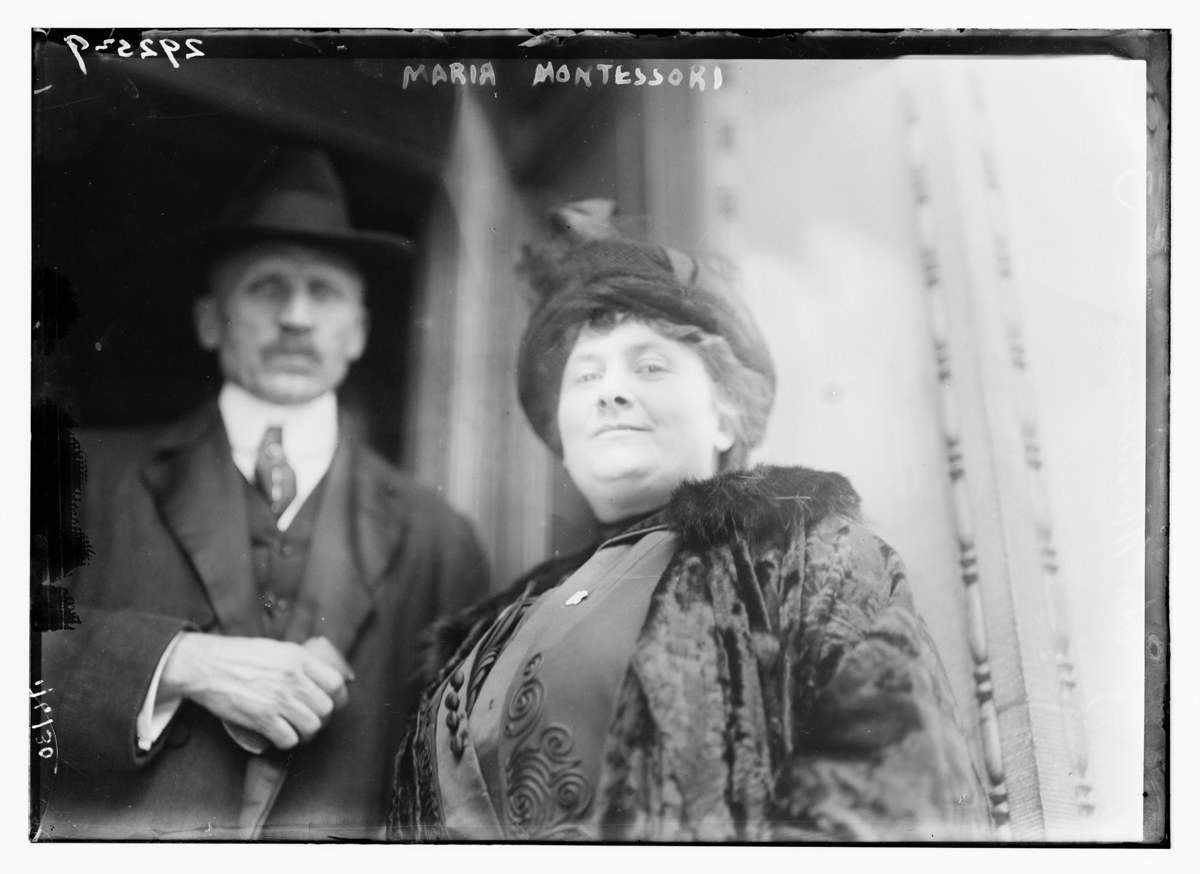
Photo: Bain News Service, c. 1910-1915, Library of Congress, public domain · Library of Congress, George Grantham Bain Collection, glass negative 'Maria Montessori' (LC-B2-2925-9, LCCN 2014694934), publisher Bain News Service, dated by the LoC 'between ca. 1910 and ca. 1915'; opened through Wikimedia Commons 'Maria Montessori LCCN2014694934.jpg' (PD-Bain, PD-old-70-1923) and the LoC's own Flickr Commons record (rights note 'No known restrictions on publication'). Original file 5779 x 4209; saved downscaled only to 1200 x 874. The negative also shows an unidentified man blurred at left; the image was not cropped. · Public Domain
physician · 20th Century
Maria Montessori
1870–1952
Known For
Not yet included in personality matching — the documented evidence doesn't yet cover enough of the personality model. Everything else on this page is fully available.
Trait Constellation
Key Achievements
A physician who moved into education: she directed the State Orthophrenic School of Rome (1899-1901), where she built on the work of Itard and Seguin and reported success with children then regarded as intellectually disabled.
In 1907 she opened the first Casa dei Bambini in Rome's San Lorenzo slum district and developed the Montessori method of self-directed work with specially designed materials, described in The Montessori Method (1909; English 1912).
Through teacher-training courses, lecture tours, books and the Association Montessori Internationale (founded 1929) the method spread to schools across Europe, the United States and India, although Dewey and Kilpatrick criticised it as rigid and over-individual.
Moments That Reveal Them
At the first Children's House, according to a retelling of her own account, children found a cupboard of materials left unlocked and began working with them; she replaced the locked cabinet with low open shelves so the materials were always available.
This is consistent with revising a classroom arrangement after observing what the children actually did. Experimentation
Initially refused entry to the University of Rome's medical programme, and opposed by her father, she was admitted after additional courses and graduated in 1896, working alone on dissections because mixed classes were not allowed.
This is consistent with continuing toward a goal despite repeated institutional and family obstacles. Persistence
Turning Points
Her work as co-director of the Orthophrenic School from 1900 marked, in AMI's words, a shift in her professional identity from physician to educator, as she began testing her ideas on teaching children in practice.
This is consistent with moving across fields when practical work opened a new line of inquiry. Cross-Domain Range
Similar People
People whose overall profiles resemble theirs.

Abraham Lincoln

Jane Goodall

Maya Angelou

Mahatma Gandhi

Louis Pasteur
Opposite Profile
Not a rival — a different profile shape worth a look.
Otto von Bismarck
Sources
- Maria Montessori (Q131117) -- verified live via the Wikidata API (2026-10-24): English label 'Maria Montessori', description 'Italian physician and educator (1870-1952)', Korean label, born 1870-08-31, died 1952-05-06, P18 'Maria Montessori (portrait).jpg'. Orientation only; not used as support for any row.
- Encyclopaedia Britannica, 'Maria Montessori' (britannica.com, article text read in full; the AI-generated summary boxes on the page were ignored): Italian educator and originator of the Montessori system, based on belief in the creative potential of children, their drive to learn and the right of each child to be treated as an individual; medicine degree at the University of Rome 1896; assistant doctor at the psychiatric clinic, interest in intellectually disabled children; director of the State Orthophrenic School of Rome 1899-1901 where her methods 'proved extremely successful'; lectured in pedagogy at Rome 1900-07 and held a chair in anthropology 1904-08; first Casa dei Bambini opened 1907 in the San Lorenzo slum for children aged three to six; for forty years travelled through Europe, India and the United States lecturing, writing and establishing teacher-training programmes; the didactic materials (graduated beads, slabs for left-to-right movement, graduated cylinders) and 'periods of sensitivity'; books from Il metodo della pedagogia scientifica (1909; The Montessori Method, 1912) to The Absorbent Mind (1949). CANONICAL SIGNIFICANCE SOURCE. The passages on her 1922 inspector appointment and her 1934 departure from Fascist Italy are political context and were not used for any row.
- Association Montessori Internationale, 'Biography of Maria Montessori' (montessori-ami.org), read in full: schooling and the technical institute she entered intending to become an engineer; opposition from her father and a refusal at the medical school ('I know I shall become a doctor'), scholarships and private tuition, dissections alone because mixed classes were not allowed; 1897-98 papers to the National Medical Congress and the National Pedagogical Congress urging medical-pedagogical institutes and training for teachers of children with learning difficulties; her reading of Itard and Seguin and translation of Seguin's book into Italian after visiting Bicetre in 1899; co-director of the Orthophrenic School, 'a shift in her professional identity from physician to educator'; the Casa dei Bambini opened 6 January 1907; five Children's Houses by autumn 1908; first training course in 1909 for about 100 students; The Montessori Method reached the US in 1912 and was later translated into 20 languages; three trips to America; the AMI set up in 1929. Written by the organisation she founded, so admiring and affiliated; private-life and war-exile passages were not used for any row.
- American Montessori Society, 'About Dr. Maria Montessori' (amshq.org), read in full: Casa dei Bambini opened 6 January 1907 in Rome; entered an all-boys technical institute at 13 to study engineering and then medicine, initially rejected by the University of Rome medical programme but admitted after additional courses, graduating 1896; co-director in 1900 of a new institute for special-education teachers using scientific observation and experimentation; the San Lorenzo centre for underserved children; first American Montessori school at Tarrytown, NY, 1911; extensive lecturing, writing and a teacher-training programme. Affiliated professional society (admiring); its remarks on feminism, peace education and wartime exile were not used for scoring.
- Timothy David Seldin, 'Montessori, Maria (1870-1952)', in Encyclopedia of Education (Gale; via encyclopedia.com, read in full): her scientific approach drawn from Itard and Seguin, the 1900 Orthophrenic School reforms (dismissing caretakers who treated the children with contempt and teaching less-disturbed children to care for themselves and others), 1900-01 search of Western European medical libraries, the first Children's House (fifty children, one untrained caregiver), child-sized furniture and the replacement of a locked cabinet by open low shelves after children took materials themselves (an account derived from Montessori's own writing), over 1,000 US Montessori schools by 1925 and near disappearance by 1940, revival from the 1960s, and the author's argument that Kilpatrick's critique was largely unfounded. The author is a Montessori-movement educator and the entry is advocacy-leaning; the Kilpatrick book is mis-titled and mis-dated there (1922 'Montessori Reexamined') and that detail was not used.
- Biola University Talbot School of Theology, 'Maria Montessori', Database: Christian Educators of the 20th Century (biola.edu), read in full: her theory as developed through observation and experimentation; the schools' freedom and 'active discipline'; first US trip in 1913 (received by Edison and Helen Keller) and the 1915 San Francisco exposition glass classroom; her 1915 Carnegie Hall lecture introduced by John Dewey although he opposed her approach; the Association Montessori Internationale founded in Amsterdam in 1929; critiques: Dewey (1916) and W. H. Kilpatrick (1914) judged the method over-individual, rigid and adult-directed with pre-made materials, her disdain for fantasy play, and that children who could not 'normalize' were excluded; Elkind's comparison with Piaget. A university reference work that deliberately sets her critics alongside her defenders; its discussion of her religious views and her dealings with Church and state were not used for scoring.
- William Heard Kilpatrick, 'The Montessori System Examined' (Houghton Mifflin, 1914), Internet Archive scan of the Berkeley copy: editor's introduction, preface, chapter outline and the concluding chapter read (the middle chapters were skimmed by outline only): a contemporary Columbia Teachers College critique after a visit to Rome; her debt to Seguin, 'insufficiency of her science', education as unfolding 'neither novel nor correct', reemphasis of freedom 'highly commendable', didactic apparatus and sense-training largely rejected, and the judgment that 'the Casa dei Bambini is after all her greatest contribution' and her greatest service the emphasis on a scientific conception of education and the practical use of liberty. Adversarial, contemporary, independent primary critique.
- Kirkus Reviews, review of Marie Tennent Shephard's (1996) young-adult biography 'Maria Montessori' (kirkusreviews.com, URL under the slug rita-kramer as served, which returns this Shephard review), read in full (short): 'brilliant woman devoted to work, whose iron determination overcame all obstacles'; deals with problems as well as triumphs, including 'her own ego and inflexibility' interfering with the spread of her movement. A trade review of a biography, so second-hand; used only for one hedged row. Kramer's 1976 biography was not opened (only cited through AMI and Biola).
- Wikimedia Commons file page 'Maria Montessori LCCN2014694934.jpg' (wikitext and API record) and the Library of Congress Flickr Commons record 4606574700 (both opened; loc.gov itself is bot-blocked, 403): Bain News Service glass negative, 'between ca. 1910 and ca. 1915', George Grantham Bain Collection, LC-B2-2925-9, rights note 'No known restrictions on publication'; Commons tags PD-Bain and PD-old-70-1923; original 5779 x 4209. Checked for the portrait's rights; not used for scoring.