
Sequoyah
94% Profile Match
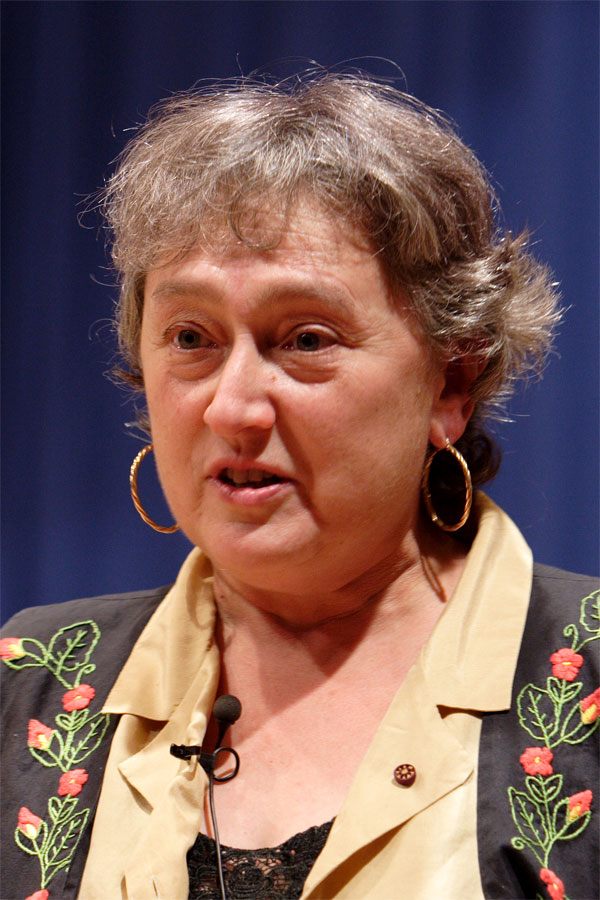
Photo: Javier Pedreira (Wicho), 2005, CC BY-SA 2.5 · Wikimedia Commons, 'Lynn Margulis.jpg' -- photograph by Javier Pedreira (Wicho) taken 9 November 2005 (EXIF-confirmed) at the III Congress on scientific communication in La Coruna, self-published by the photographer under CC BY-SA 2.5. Original 600 x 900 pixels (SHA-1 85400a7f matches the Commons record); saved unchanged, never upscaled. · CC BY-SA 2.5
biologist · 20th Century
1938–2011
Not yet included in personality matching — the documented evidence doesn't yet cover enough of the personality model. Everything else on this page is fully available.
In a 1967 paper in the Journal of Theoretical Biology, Margulis argued that mitochondria and chloroplasts descend from bacteria taken into host cells, reviving a symbiosis idea that Konstantin Merezhkovsky had proposed in 1905. Knoll and EBSCO both report that some fifteen journals rejected the paper before it was published; EBSCO says she later drew 'enormous hostility' for it.
Knoll writes that she restated the idea in cell and molecular terms, which made it testable, and that later work showed both organelles are membrane-enclosed and carry their own DNA, with chloroplast genes grouping with free-living cyanobacteria and mitochondria nesting within the proteobacteria. He counts it among the great advances of 20th-century science. She was elected to the National Academy of Sciences in 1983 and received the National Medal of Science in 1999.
Margulis backed James Lovelock's Gaia hypothesis and tied it to an alternative biology built on cooperation, arguing that symbiosis drives the origin of new species. Knoll says most biologists now accept a larger role for cooperation but few agree that symbiosis drives speciation, and that her claim that flagella arose from symbiotic bacteria never gained strong support; THE reports that Richard Dawkins was openly hostile and most scientists regarded Gaia as unnecessary.
Margulis's 1967 endosymbiosis paper was rejected by some fifteen journals before it appeared in the Journal of Theoretical Biology, and EBSCO says she continued to travel widely to present and defend the theory despite hostility from the scientific community.
This is consistent with sustained effort to keep a rejected idea alive over many years. Persistence
Knoll writes that she rejected basic tenets of evolutionary theory in building an alternative biology around cooperation and symbiosis, and that her claim that flagella arose from symbiotic bacteria never gained strong support; in her last interview, he reports, she said she did not consider her ideas controversial but right.
This is consistent with holding to her own view of evolution against most of her field, with mixed results. Independent Thinking
Margulis's 1967 paper was followed by her 1970 book Origin of Eukaryotic Cells and her 1981 Symbiosis in Cell Evolution, while later chloroplast and mitochondrial gene sequences, in Knoll's account, placed the organelles among bacterial lineages. The idea moved from a rejected proposal to, in Nature's words, a widely accepted crucial step in the evolution of complex cells.
This is consistent with an idea moving from rejection to acceptance as testable evidence accumulated around it. Creative Originality
People whose overall profiles resemble theirs.


Not a rival — a different profile shape worth a look.
