Sequoyah
93% Profile Match
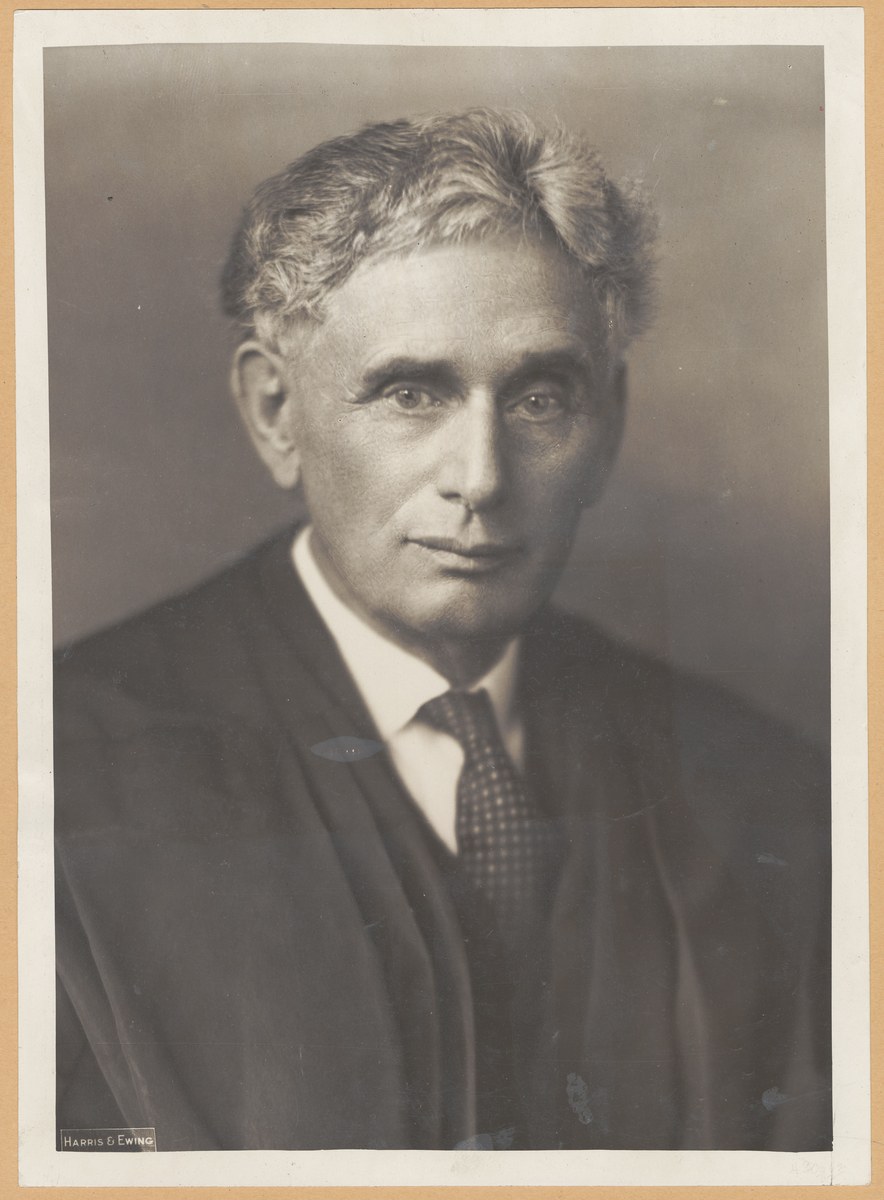
Harris & Ewing, c. 1916, Library of Congress Prints & Photographs Division, LC-DIG-ppmsca-06024 · Library of Congress Prints and Photographs Division, Harris & Ewing, '[Louis Brandeis, head-and-shoulders studio portrait, facing front]', dated [1916?], reproduction number LC-DIG-ppmsca-06024, via Wikimedia Commons file 'Louis Brandeis, head-and-shoulders studio portrait, facing front LCCN2004673443.jpg' (original digital file 4498 x 6103). Downscaled only (never upscaled) to 884 x 1200. The Library's Harris & Ewing rights page states there are no known restrictions, that the firm's gift restrictions have expired and that copyrights on acquired prints have expired. · Public domain (Library of Congress: no known restrictions; Harris & Ewing)
lawyer · 20th Century
1856–1941
Not yet included in personality matching — the documented evidence doesn't yet cover enough of the personality model. Everything else on this page is fully available.
Argued Muller v. Oregon (1908) with a brief that gave two pages to precedent and over a hundred to evidence on women's working conditions; a unanimous Court upheld the law and the 'Brandeis brief' became a model for fact-based argument.
Served on the U.S. Supreme Court from 1916 to 1939; his Olmstead v. United States dissent (1928) argued that government wiretapping violated the Fourth Amendment's protection of the 'right to be let alone', and his Whitney v. California concurrence became a milestone of free-speech law.
Co-wrote the 1890 Harvard Law Review article 'The Right to Privacy' with Samuel Warren and published 'Other People's Money and How the Bankers Use It' (1914), whose banking reforms were largely adopted only after the bank failures of the 1930s.
In 1906 Brandeis resigned from the board of the United Shoe Manufacturing Company when it tried to monopolise the industry, and later testified against it at public hearings.
This is consistent with acting on principle at a cost to a client relationship. Conflict Tolerance
In Olmstead v. United States (1928), Brandeis dissented from the majority that allowed wiretapping, arguing that the framers conferred 'the right to be let alone' against the government.
This is consistent with reasoning independently of the majority, extending older principles to new technology. Independent Thinking
From about 1892 Brandeis, who had started with railroad and manufacturing clients, increasingly took public-interest cases for little or no fee, later paying his firm so his partners would not suffer.
This is consistent with a shift in motivation from private practice toward public-interest work. Impact Motivation
People whose overall profiles resemble theirs.



Not a rival — a different profile shape worth a look.