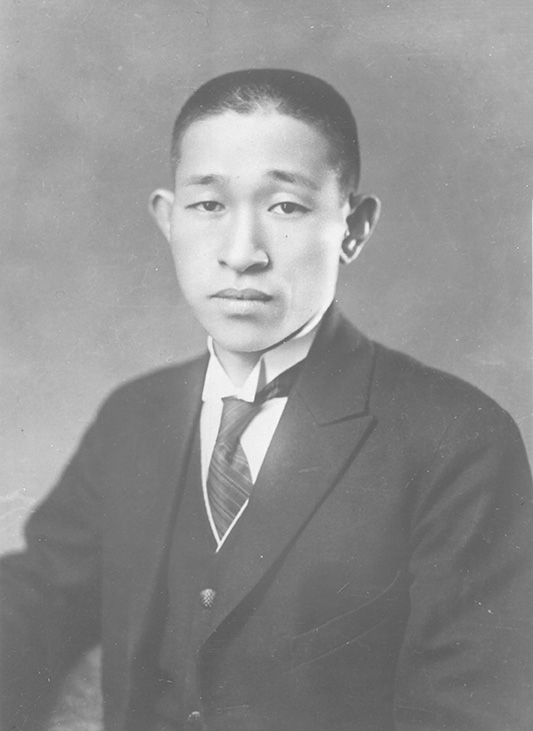
Photograph by an unknown photographer, 1929 (public domain); via Wikimedia Commons · Wikimedia Commons 'Formal Portrait of Kōnosuke Matsushita in 1929 (cropped).jpg' (crop of 'Formal Portrait of Kōnosuke Matsushita in 1929.jpg', 533 x 753), a studio photograph dated 1929 whose photographer is unknown; the file page tags it PD-Japan-oldphoto (a photograph made before 1957 in Japan, whose Japanese term had expired before the 1996 URAA date, so it was not restored in the United States) and cites the Sumitomo Mitsui Trust Realty 'town archives' Hirakata page as its source. The same pose appears as 'Matsushita Kōnosuke in middle age.jpg', taken from the 1935 book Kansai Meishi Shashinroku (Kokusei Kyokai, National Diet Library digital collection ID 1111970), which gives the photograph a concrete publication date of 1935. The Wikidata P18 lead 'Konosuke Matsushita 01.jpg' (420 x 650, from the 15 August 1961 issue of the magazine Photo) was REJECTED because its Commons page carries Not-PD-US-URAA, i.e. it is not public domain in the United States. The cited realty-company page has no copyright notice about the photograph; no Panasonic page was reachable (holdings.panasonic returns 403 to automated requests), so the absence of a conflicting Panasonic notice is not confirmed. Saved at the Commons cropped size with no resizing or upscaling. · Public domain (Japan, pre-1957 photograph, photographer unknown; not restored in the US)
entrepreneur · 20th Century
Konosuke Matsushita
1894–1989
Known For
Not yet included in personality matching — the documented evidence doesn't yet cover enough of the personality model. Everything else on this page is fully available.
Trait Constellation
Key Achievements
Founded Matsushita Electric in 1918, starting from an electric plug he designed after leaving the Osaka Electric Light Company, and reorganised it in 1935 as Matsushita Electric Industrial Co.
Built the firm into what Britannica calls the world's largest maker of consumer electric appliances, with washing machines, refrigerators and televisions for Japanese homes in the 1950s and brands such as Panasonic, Quasar and National.
Developed a management approach built on abundant, low-priced goods: a divisional system from 1933 to develop managers, an in-house training institute from 1932, and a decision in the 1929 depression to dismiss no workers.
Moments That Reveal Them
When retailers distrusted his battery bicycle lamp and sales stalled, Matsushita placed lit lamps in their shops to show they would burn for thirty hours, and orders followed.
This is consistent with a founder who found a practical, low-cost way around a sales obstacle. Resourcefulness
After the 1964 Atami meeting with about 170 distributor presidents, Matsushita said the company was at fault, then personally took over the sales headquarters and introduced new sales systems from February 1965; the account is largely company-derived.
This is consistent with a leader who took direct action to repair a conflict with his sales network. Proactive Agency
Turning Points
In December 1929, with Japanese firms laying off workers in the depression, Matsushita decided his company would dismiss no one, and EBSCO says the company revived and built two new factories in 1930.
This is consistent with a mission-driven leader willing to carry cost to protect his workforce, per an admiring biography. Impact Motivation
Similar People
People whose overall profiles resemble theirs.


Mahatma Gandhi

Martin Luther King Jr.

Wangari Maathai

Mustafa Kemal Atatürk

Yi Sun-sin
Opposite Profile
Not a rival — a different profile shape worth a look.

Wolfgang Amadeus Mozart
Sources
- Kōnosuke Matsushita (Q252785) -- verified live via the Wikidata API (2026-10-23): English label 'Kōnosuke Matsushita', description 'Founder of Panasonic (1894-1989)', born 27 November 1894, died 27 April 1989, Korean label '마쓰시타 고노스케', citizenship Japan and Empire of Japan, several P18 images. Orientation only; not used as support for any row.
- Encyclopaedia Britannica, 'Matsushita Konosuke' (britannica.com), read in full via an Internet Archive copy because the live site blocks bots: Japanese industrialist who founded Matsushita Electric Industrial Co., Ltd., then the largest manufacturer of consumer electric appliances in the world; orphaned and an errand boy at 9; joined the Osaka Electric Light Company at 16 and quit at 23 to sell his own electric plug design; inventive marketing helped growth; reorganised the firm in 1935; prevented the post-war occupation authorities from breaking the company up; chief maker of washing machines, refrigerators and televisions for Japanese homes by the 1950s; brands Panasonic, Quasar and National; president to 1961 and then chairman; his business philosophy of producing essential consumer goods in abundance at the lowest prices was widely adopted. CANONICAL SIGNIFICANCE SOURCE.
- Won Z. Yoon, 'Konosuke Matsushita' (EBSCO Research Starters, History, 2024; text derived from a reference-work biography), read in full: his apprenticeships from age ten; the 1917 plug venture on about one hundred dollars whose first experiment failed; the 1918 founding; the 1923 bicycle-lamp whose sales stalled until he lit lamps in sceptical retailers' shops to show they lasted thirty hours; the December 1929 decision, during the depression, that the company would dismiss no worker; a 1932 mission to serve society by supplying useful goods and an in-house training institute; the 1933 divisional management system to evaluate divisions and develop managers; wartime military production; occupation-era designation as a zaibatsu until October 1950, which the company and its union contested; the 1961 move to chairman. Contains marriage and family detail that was excluded. Its bibliography draws on Matsushita's own autobiography and PHP publications, so its account is partly self-sourced, and its 'first' claims were not used. Encyclopaedic, admiring.
- Kirkus Reviews, review of John P. Kotter, 'Matsushita Leadership' (Free Press, 1997; review posted 2010), read in full: calls the book 'a singularly uncritical and sketchy briefing' that verges on hagiography, notes it largely ignores the company's contribution to Japan's wartime effort and the factors behind postwar growth (decentralised management, calculated risks, protection of domestic outlets, R&D) and seldom comes to grips with the personal qualities of the 'competitive and demanding entrepreneur'. Used only as a counter-voice on how uncritically the Matsushita story is told; the Kotter book itself was NOT opened.
- Yuji Takeuchi, 'Matsushita Kōnosuke to Nakauchi Isao no shinnen' (Konosuke Matsushita and Isao Nakauchi's convictions), Japan Research Institute management column (24 July 2006, jri.co.jp), read in full in Japanese: a think-tank researcher's account that in 1964 Matsushita gathered distributors' presidents at Atami, pointed out their complacency but also admitted Matsushita Electric's own fault, apologised and gave them the calligraphy 'coexistence and mutual prosperity'; that Matsushita Electric and the discount retailer Daiei then fought a roughly 30-year dispute over discounting (shipment stoppage, an antitrust complaint, and Matsushita's 1975 invitation asking Nakauchi to give up the 'way of might'); and the author's view that the clash set Matsushita's belief in list-price sales and distributor loyalty against Nakauchi's belief in consumer price sovereignty. Independent of Panasonic; a counter-voice because it treats Matsushita's pricing stance as one side of a genuine conflict. Details of the Atami meeting rely on the company's own accounts.
- The Shashi, 'Konosuke Matsushita: Panasonic Holdings CEO 1935-1961' (the-shashi.com, a Japanese company-president data and analysis site), read in full: tenure December 1935 to January 1961, revenue rising from 18.9 to 105.4 billion yen between FY1955 and FY1960, move to Kadoma and divisional system in 1933, post-war 'restricted company' designation and his own designation under the military-production purge, a campaign by the company union (15,000 employees collecting signatures) that helped get his purge designation reduced and later lifted, the 1952 Philips technical tie-up, the 1956 five-year plan from 22 billion to 80 billion yen that was exceeded (105 billion), the 1957 National Shop Association. Secondary compilation of Japanese sources that does not name its documents; treated as moderate-reliability and not independent of corporate histories.
- Yutaka Sugiura, 'Rebuilding relations with distributors by admitting Matsushita was at fault' (Atami conference, 1964), The Shashi Japanese-language case page, read in full: 170 company presidents were invited to Atami in July 1964 without a fixed agenda after the first fall in half-year sales and profits since 1950, Matsushita on the third day said the company was in the wrong and apologised, then took over the sales headquarters himself in August 1964 and introduced the one-region-one-distributor, divisional direct-sales and new monthly-payment systems from February 1965, accepting lower profit for three years; the analyst adds that the keiretsu distribution structure later became a burden for his successors. Analyst commentary whose references are mainly Panasonic's own company histories and Matsushita's own 'Watashi no rirekisho' memoir, so it corroborates the JRI column only in part.
- Toyo Keizai Online, 'Matsushita Konosuke: excessive competition poisons the Japanese economy' (republication, 30 December 2019, of a 24 May 1958 Weekly Toyo Keizai interview), only the free introduction and the first answer were read because the rest is behind a paywall: the editors describe him as opposing discount selling at the time of a price war and the Fair Trade Commission's scrutiny, quote him wanting makers' designated prices respected, and he says in the first answer that excessive competition is a matter of industry self-restraint. Mostly self-quotation framed by the magazine; partial read, used only as context for the pricing stance in the JRI column.
- Wikimedia Commons file pages 'Formal Portrait of Kōnosuke Matsushita in 1929.jpg' and its cropped derivative, 'Konosuke Matsushita 01.jpg' (rejected), 'Matsushita Kōnosuke in middle age.jpg' and the realty-company page cited by the 1929 file, checked for the portrait's rights basis. Not used for scoring.