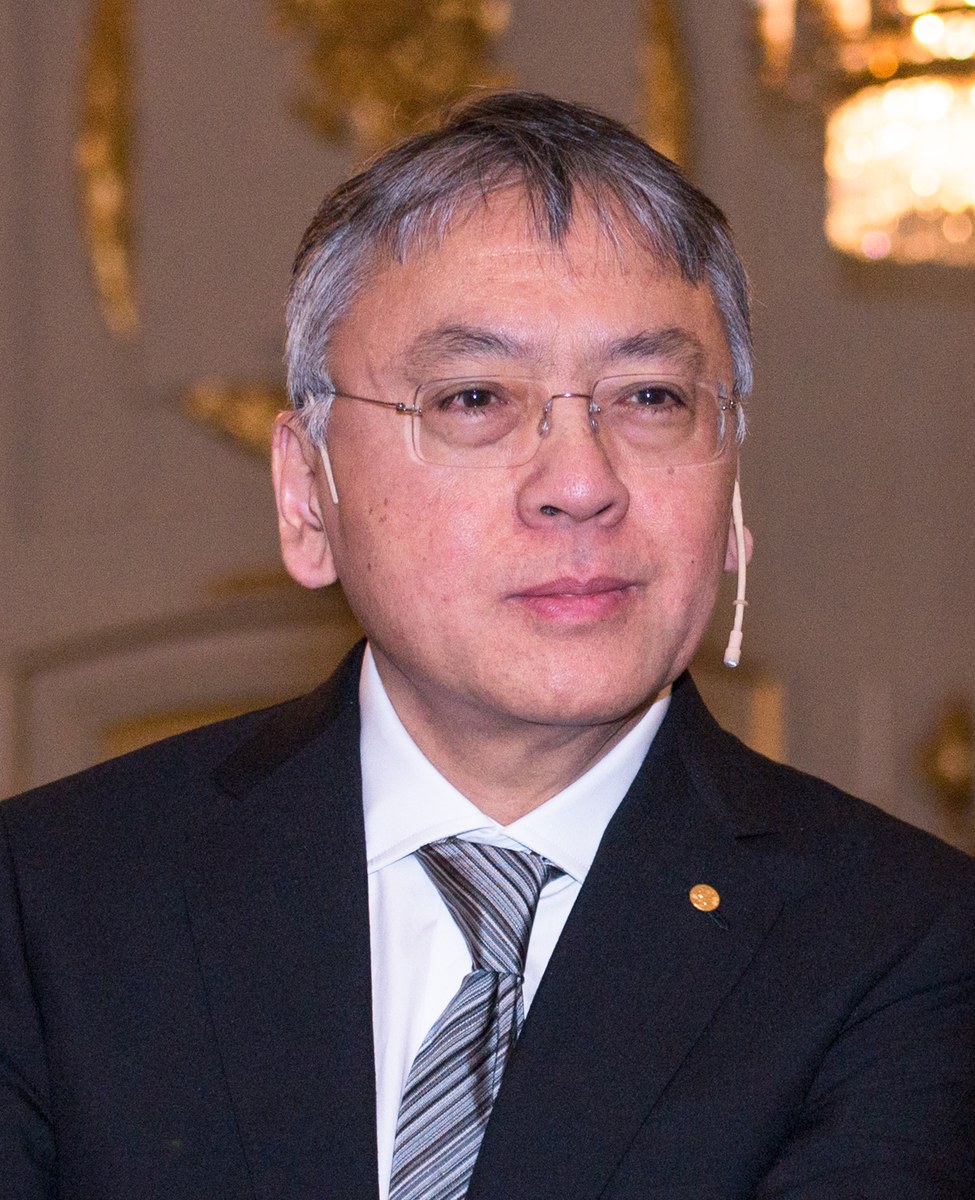
Photo: Frankie Fouganthin, 2017, CC BY-SA 4.0 (resized) · Wikimedia Commons, 'Kazuo Ishiguro in Stockholm 2017 02.jpg' -- own work by photographer Frankie Fouganthin, taken 6 December 2017 at the Swedish Academy press conference in Stockholm, released by the photographer under CC BY-SA 4.0. Original 1219 x 1500 pixels, downscaled only (never upscaled) to 975 x 1200. Chosen over the Commons P18 'Kazuo Ishiguro by Kubik.JPG' (CC BY 2.5, 360 x 450, 2005). · CC BY-SA 4.0
writer · Contemporary
Kazuo Ishiguro
b. 1954
Known For
Not yet included in personality matching — the documented evidence doesn't yet cover enough of the personality model. Everything else on this page is fully available.
Trait Constellation
Key Achievements
Wrote restrained, memory-driven novels including An Artist of the Floating World, The Remains of the Day, Never Let Me Go and The Buried Giant.
Won the 1989 Booker Prize for The Remains of the Day, a novel narrated by an English butler.
Awarded the 2017 Nobel Prize in Literature for novels 'of great emotional force' that uncovered 'the abyss beneath our illusory sense of connection with the world'.
Moments That Reveal Them
He began Never Let Me Go as a 1950s lounge-singer story, then switched to a cloning premise after a dinner conversation and a year later abandoned the original setting.
This is consistent with a willingness to change course on a project when a stronger framework appears. Adaptability
His archive at the Harry Ransom Center holds thousands of preparatory notes and drafts for each novel, kept by a writer described as working slowly.
Consistent with a slow, repeated reworking of each book before publication. Persistence
Turning Points
In Never Let Me Go he moved away from the guarded narrators of his earlier books, a shift the profile calls his most radical stylistic departure.
Consistent with a readiness to change his own established formal approach rather than repeat it. Experimentation
Similar People
People whose overall profiles resemble theirs.

Louis Pasteur

Leonardo da Vinci

Benjamin Franklin

Abraham Lincoln

Pablo Picasso
Opposite Profile
Not a rival — a different profile shape worth a look.

Otto von Bismarck
Sources
- Kazuo Ishiguro (Q272855) -- verified live via the Wikidata API (2026-10-23): English label 'Kazuo Ishiguro', description 'British novelist (born 1954)', born 1954-11-08, no date of death, place of birth Nagasaki, citizenship listed as United Kingdom and Japan, Korean label '가즈오 이시구로', P18 images including a 2017 Stockholm photograph. Orientation only; not used as support for any row.
- 'Ishiguro Wins Nobel Prize in Literature', Shelf Awareness, 5 October 2017, read in full: the Swedish Academy's citation ('in novels of great emotional force, has uncovered the abyss beneath our illusory sense of connection with the world'), permanent secretary Sara Danius's remarks (a 'writer of great integrity' who 'doesn't look to the side' and has 'developed an aesthetic universe all his own', blending Austen, Kafka and Proust with restraint), the honours listed (Whitbread 1986, Booker 1989, OBE 1995, Chevalier de l'Ordre des Arts et des Lettres 1998), the eight works named, the Guardian's note that bookmakers favoured others, and Salman Rushdie's congratulation noting that Ishiguro also plays guitar and writes songs. CANONICAL SIGNIFICANCE SOURCE (trade press reporting the award body's citation; the nobelprize.org pages returned an access error and were not opened). The praise is the Academy's and a friend's, so it is retrospective and admiring.
- Harry Ransom Center (University of Texas at Austin) press release on its 2015 acquisition of the Kazuo Ishiguro archive, read in full: Booker Prize for The Remains of the Day (1989) and Whitbread Book of the Year for An Artist of the Floating World (1986), the novels from A Pale View of Hills (1982) to The Buried Giant (2015), the archive's thousands of preparatory notes and drafts for each novel by a writer who 'works slowly', a document called 'HOW I WRITE', yellow sticky-note annotations, two early unpublished novels, songwriting, a pulp Western, and the screenplays (The Saddest Music in the World, The White Countess, and two Channel 4 originals); the director's remark on how fully the archive shows memory's ties to his art. Institutional archive record; independent of the author but descriptive and admiring, and the archive's contents themselves were not examined.
- Encyclopedia.com entry on 'The Remains of the Day' (Gale 'Novels for Students' reference material), read to the page's cut-off: author biography (born in Nagasaki, to England as a child, honours degree in philosophy and literature 1978, University of East Anglia creative-writing master's 1980, social work before writing full time, OBE 1995), the novel's 1988 publication and 1989 Booker Prize, the 1993 Merchant Ivory film, and a spread of named critical reactions from Graver, Rushdie, Rubin, Gurewich, Lee, Hassan, Kakutani, Coates and Strawson (praise) to Geoff Dyer (narrative irony 'trite', voice 'coaxed') and Gabriele Annan (didactic, read as anti-Japanese). The family details on the page were not used. Independent reference compilation including dissent; the final fifth of the page was not read.
- 'Never Let Me Go: A Profile of Kazuo Ishiguro', Poets & Writers (2005), read in full: the profile writer's observations that he began Never Let Me Go as a 1950s lounge-singer story, switched to a cloning premise after a dinner conversation and a year later abandoned the original setting, that the book is his most radical stylistic departure with a world the reader must infer, Ishiguro's own words ('I don't think in terms of genre at all'; he must be careful not to repeat his devices), critic James Wood's 'reliably unreliable' narrators, the 'voluptuously deceptive storyteller' description, starred pre-publication reviews, and his early songwriting. Independent interview-based press profile mixing the writer's observations and the subject's own words; the two are separated in the rows.
- John O'Neill, 'Neil Gaiman and Ursula K. Le Guin on Kazuo Ishiguro's The Buried Giant', Black Gate, 7 March 2015, read in full: Le Guin's blog objection to what she read as Ishiguro's disdain for fantasy while using its 'surface elements' (quoting his remark in a New York Times interview asking whether readers would be 'prejudiced against the surface elements' and say 'this is fantasy'), her description of reading the book as painful, and Neil Gaiman's largely positive New York Times review that admits an 'inability to fall in love with it'. Counter-voice source about a single book; the page reproduces Le Guin and Gaiman second-hand, contains no reply from Ishiguro, and a commenter's summary of Le Guin is not used.
- Penguin Random House page for the Everyman's Library edition of 'Never Let Me Go', including an author interview, read in full: Ishiguro's own account of writing pieces about students over about fifteen years, repeatedly setting the idea aside to write other novels, and of a radio discussion of biotechnology that made the framework fall into place; his choice of a 1970s-80s English setting rather than a future one, of a less guarded narrator, and his wish for 'unfilmable' novels; plus publisher copy and review blurbs. Mostly SELF material (an author interview on a publisher's page, promotional in purpose) and counted as the self perspective only; not the sole support for any row.
- Wikimedia Commons file page 'Kazuo Ishiguro in Stockholm 2017 02.jpg' (wikitext and API record) -- checked for the portrait's licence: own work by Frankie Fouganthin, taken 6 December 2017 at the Swedish Academy's press conference in Stockholm, licensed CC BY-SA 4.0 by the photographer; original 1219 x 1500 pixels. Not used for any scoring.