Mary Wollstonecraft
70% Profile Match
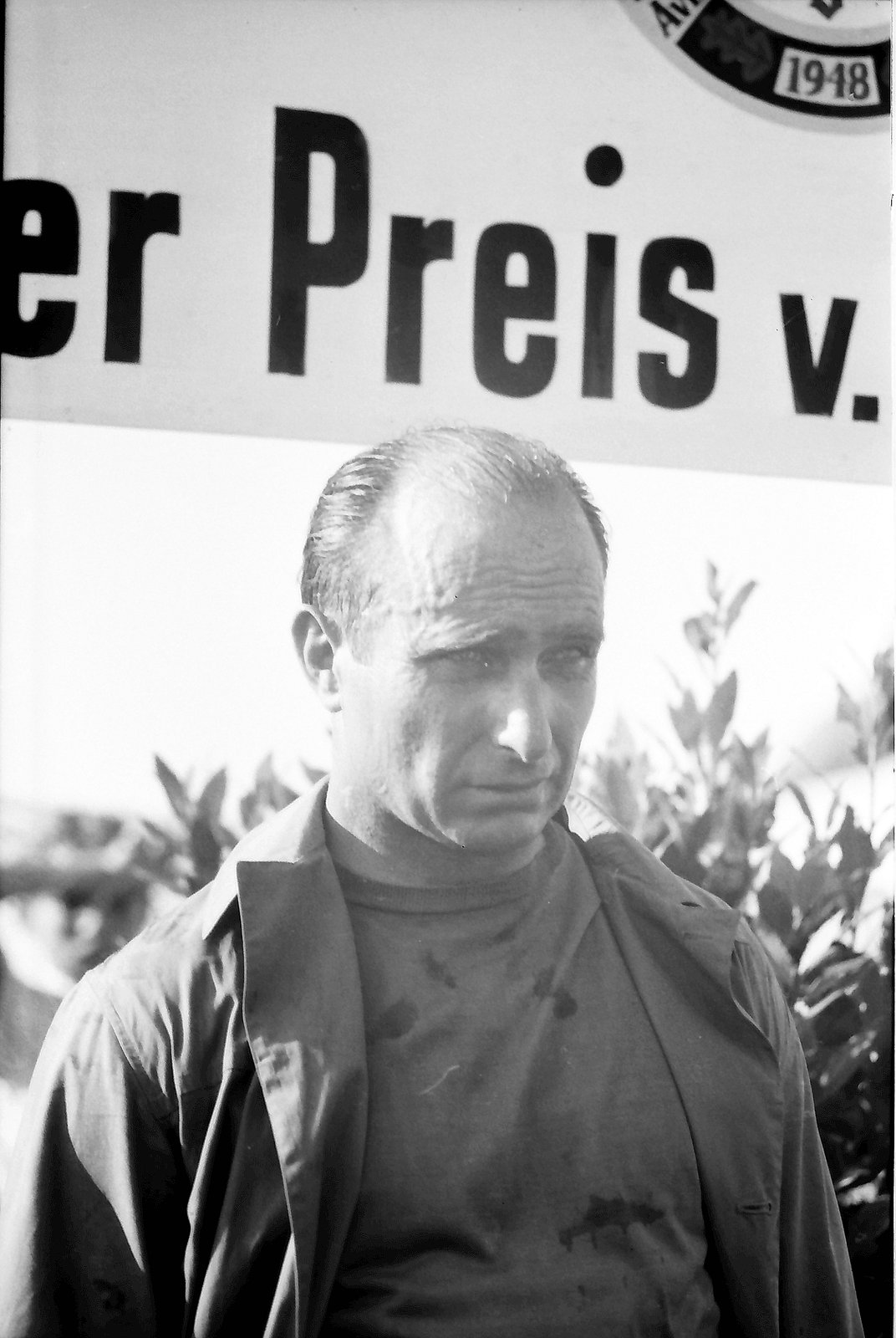
Willy Pragher / Landesarchiv Baden-Wuerttemberg, Staatsarchiv Freiburg W 134 Nr. 048170a, 4 August 1957 (German Grand Prix, Nuerburgring), CC BY 4.0 (resized from the 1124x1677 Commons file) · Landesarchiv Baden-Wuerttemberg, Staatsarchiv Freiburg, W 134 Nr. 048170a (Sammlung Willy Pragher), 'Nuerburgring: Fangio auf dem Ehrenpodium; gross; mit Kranz', via Wikimedia Commons · CC BY 4.0
Between 1951 and 1957 he won five Formula One World Drivers' Championships: in 1951 with Alfa Romeo, in 1954 and 1955 with Mercedes-Benz (he began 1954 in a Maserati), in 1956 with Ferrari and in 1957 with Maserati. The last four came in consecutive years, and his total of five stood as the record until Michael Schumacher passed it in 2003.
Racing in Formula One from 1950 to 1958, he won 24 Grands Prix, took pole position 29 times and set 23 fastest laps in 51 starts, and started all but two of those races from the front row.
At the 1957 German Grand Prix at the Nurburgring, a pit stop of about 52 seconds left him roughly 50 seconds behind the two leading Ferraris with ten laps to go. He then broke the lap record repeatedly, lapped in 9 min 17.4 s, passed both cars on the penultimate lap and won by 3.6 seconds, clinching his fifth title. It was the last of his 24 Grand Prix wins, and it is widely regarded as the best drive of his career.
In a 1979 interview Fangio said that in every team he drove for he promised the mechanics 10 per cent of whatever he won. He recalled that at the 1953 Italian Grand Prix his Maserati had a vibration that practice could not cure; he complained again the night before the race, and by Sunday it was cured. He said he had no idea how the mechanics had done it.
This account, which is his own and was told with some humour, is consistent with a driver who deliberately kept the people who prepared his cars on his side; his team-mate Stirling Moss likewise says he treated mechanics as friends and colleagues. Collaboration
At the Portuguese sports-car Grand Prix in Lisbon in June 1957 he let Menditeguy's Maserati and Gregory's Ferrari set the early pace and, in his words, passed to take the lead once their cars were showing the effects of that effort, after ten laps. At Le Mans that year he set the pace in practice but held himself in reserve, waiting to see which car was best placed before agreeing to drive; Denis Jenkinson called this a crafty move.
These episodes are consistent with timing his effort to how a race was likely to unfold rather than going flat out from the start; Moss likewise says he drove only as fast as seemed necessary. They are race tactics, not proof of long-range planning. Planning Orientation
Fangio was already 38 when the Automovil Club Argentino sent a team to Europe in 1949 with him as its leader. He won at San Remo, Pau, Perpignan, Marseilles, Monza and Albi, and the results brought an invitation to join Alfa Romeo, the dominant Grand Prix team, for the first world championship season in 1950. He later said he had gone intending to stay about a year and ended up staying ten.
The move shows him taking his racing career from South American road races to European Grand Prix circuits and different cars in his late thirties, which is consistent with an ability to change his approach when circumstances shift; it is one reading among several, since the Argentine club also made the decision to send him. Adaptability
People whose overall profiles resemble theirs.