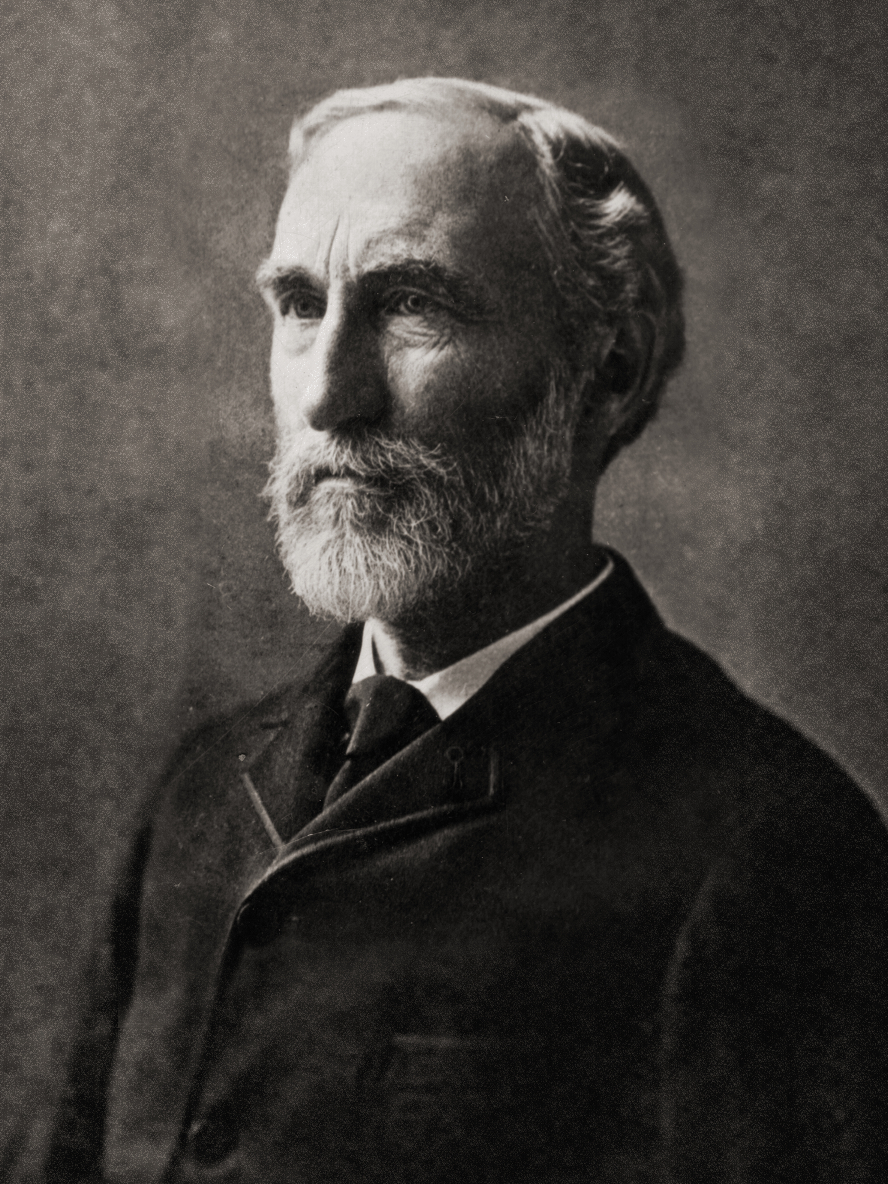
Photograph of Josiah Willard Gibbs by an unidentified photographer, frontispiece of The Scientific Papers of J. Willard Gibbs (Longmans, Green and Co., 1906), public domain, via Wikimedia Commons · Photographic portrait of Josiah Willard Gibbs made before his death in 1903 by an unidentified photographer, reproduced as the frontispiece ('with portrait') of The Scientific Papers of J. Willard Gibbs, edited by H. A. Bumstead and R. G. Van Name (Longmans, Green and Co., London and New York, 1906). The file is the 888 x 1184 pixel digitisation of that frontispiece on Wikimedia Commons, used as it is, with no cropping or enlargement. The basis is the documented 1906 publication of the book in New York and London, so the photograph is in the public domain in the United States as a work published before 1931; the photographer is not named, so no lifetime of an author is relied on. · Public domain (published 1906)
physicist · 19th Century
Josiah Willard Gibbs
1839–1903
Known For
Not yet included in personality matching — the documented evidence doesn't yet cover enough of the personality model. Everything else on this page is fully available.
Trait Constellation
Key Achievements
Founded chemical thermodynamics with 'On the Equilibrium of Heterogeneous Substances' (1876 and 1878), which introduced chemical potentials and a general condition of equilibrium; his phase rule later proved practical in steel and ammonia production.
Developed vector analysis for his students, privately printed in 1881 and 1884 and published as a textbook in 1901 by his pupil E. B. Wilson, and wrote Elementary Principles in Statistical Mechanics (1902).
Held Yale's chair of mathematical physics from 1871 until his death, without salary for his first nine years, and received the Royal Society's Copley Medal in 1901.
Moments That Reveal Them
He preferred geometrical representations of his equations to mechanical models, because the models seldom corresponded completely with the phenomena and the discrepancies destroyed their usefulness for him.
This is consistent with a preference for abstract representations that stay logically exact. Systems Thinking
He rejected suggestions that he rewrite his thermodynamic treatise for a general readership, and a later writer noted that the dense, formula-filled memoir is rarely read in full.
This is consistent with putting compact rigour ahead of winning a wider audience. Persuasiveness
Turning Points
In 1873, at 34, he published his first papers, and a note at the end of the second suggested treating mixtures of different substances like mixtures of states, the path that led to his 1876-1878 memoir on chemical equilibrium.
This is consistent with extending a method step by step into a more general theory. Systems Thinking
Similar People
People whose overall profiles resemble theirs.


Maimonides

Alan Turing

Emmy Noether

Rabindranath Tagore

Aristotle
Opposite Profile
Not a rival — a different profile shape worth a look.
Theodore Roosevelt
Sources
- Josiah Willard Gibbs (Q153243), verified live via the Wikidata API (2026-10-31): label 'Josiah Willard Gibbs', description 'American scientist (1839-1903)', born 1839-02-11, died 1903-04-28, Korean label present. Orientation only; not used as support for any row.
- Charles S. Hastings, 'Biographical Memoir of Josiah Willard Gibbs, 1839-1903', National Academy of Sciences Biographical Memoirs, volume 6 (May 1909), read in full in the PDF text (it reproduces most of Henry Bumstead's review of the scientific work and adds a section on his character and academic life). CANONICAL SIGNIFICANCE SOURCE: the National Academy's memoir; it calls 'On the Equilibrium of Heterogeneous Substances' (1876 and 1878) his most important work and says it founded a new department of chemical science, and it covers his vector analysis, work on the electromagnetic theory of light and 'Elementary Principles in Statistical Mechanics'. A colleague's tribute, so admiring; its remarks on his lack of advocacy and slow recognition are the useful counterweights.
- Henry A. Bumstead, 'Josiah Willard Gibbs' (biographical sketch of 1903, reprinted in volume 1 of The Scientific Papers of J. Willard Gibbs, 1906), read in full in the Wikisource transcription: a former student and co-editor's account of his education, Yale chair from 1871, systematic and solitary way of working, careful but closed lectures, reluctance to publish his vector analysis, the controversial notes in Nature over quaternions, and the slow reception of his thermodynamics. Warm and partisan, and it overlaps with the National Academy memoir, so the two are not independent of each other.
- Fielding H. Garrison, 'Josiah Willard Gibbs and his Relation to Modern Science, I', Popular Science Monthly 74 (May 1909), read in full in the Wikisource transcription (part one of a series): an outside writer, an Army Medical Library assistant librarian, who calls his own account frankly journalistic. It calls Gibbs a mathematician rather than an experimenter, says his contribution was new ways of thinking, notes that the 1875-78 memoir has about seven hundred formulas and is rarely read in full, that its aim was not understood at first and that some theorems were later rediscovered by others, and that the general theory rested on earlier work by James Thomson and Horstmann. The most independent and most critical of the sources, though secondhand.
- Donald M. Fiene, 'Josiah Willard Gibbs', EBSCO Research Starter (2024), read in full: a scholar's overview listing his key works, the 1871 Yale chair that carried no salary for about nine years, Yale's counter to a Johns Hopkins offer, the obscure venue and terse style that kept him little known, the way Helmholtz and Planck independently reproduced some results, Ostwald's 1892 German translation, his refusal to rewrite the treatise for a general readership, and the later industrial use of the phase rule. Reference article for general readers; the salary figures are only summarised in it.
- Connecticut History (a CTHumanities project), 'Josiah Willard Gibbs's Impact on Modern Science' (15 February 2020, unsigned), read in full: his Yale degrees, 1871 chair, the two-part monograph published by the Connecticut Academy in 1875 and 1878, the 1901 Copley Medal and later honours, and the statement that much of his work received little recognition in his time. A state-humanities popular article; one caption in it contains a date error, so it is used only for the outline.
- Encyclopaedia Britannica, eleventh edition (1911), 'Gibbs, Josiah Willard' (unsigned in the transcription), read in full on Wikisource: a contemporary reference entry listing his Yale posts, the thermodynamic papers, the 1876 and 1878 memoir credited with founding a new branch of chemical science, the vector pamphlets of 1881 and 1884 and E. B. Wilson's 1901 textbook, the 1883-1889 optics papers, the 1902 statistical mechanics book and the 1901 Copley Medal. Short and respectful.