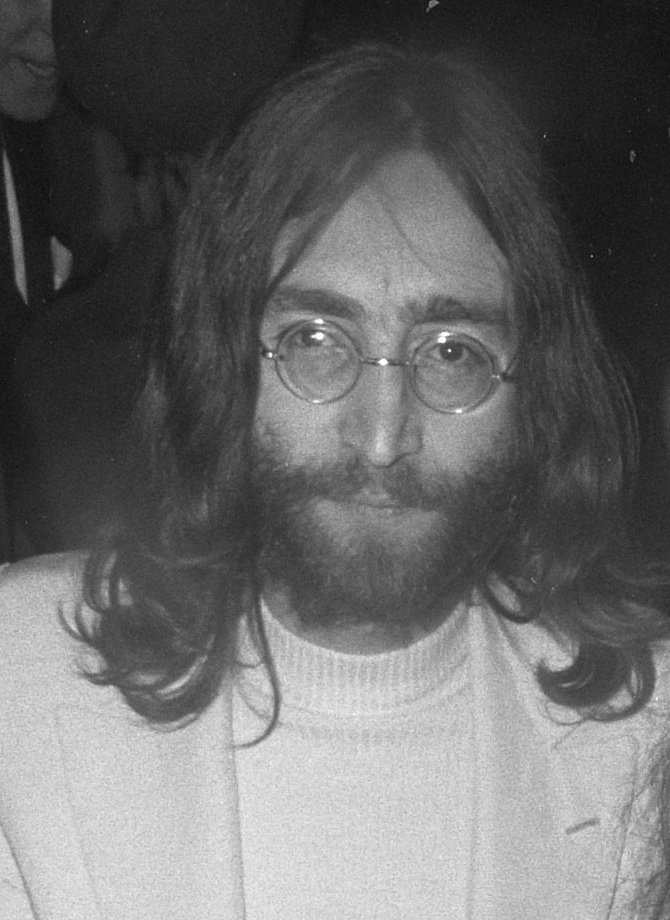

Photograph by Joost Evers / Anefo, Nationaal Archief (CC0; credit not required, given as a courtesy); cropped and converted to greyscale JPEG · Nationaal Archief, Fotocollectie Anefo, record 922-2494 (photograph taken at Schiphol airport, 31 March 1969); tightly cropped from the 2410 x 3672 original file on Wikimedia Commons, with other people and the second subject removed · CC0 1.0 Public Domain Dedication (Nationaal Archief record states rights holder 'Nationaal Archief, CC0')
musician · Contemporary
John Lennon
1940–1980
Known For
Not yet included in personality matching — the documented evidence doesn't yet cover enough of the personality model. Everything else on this page is fully available.
Trait Constellation
Key Achievements
Lennon formed the Quarrymen in Liverpool, invited Paul McCartney to join, and the two began the songwriting partnership behind the Beatles. The Songwriters Hall of Fame credits "Love Me Do", "Please Please Me" and "She Loves You" (1962-63) as early successes, calls the group "perhaps the single most influential new pop entity in a generation", and says "I Want to Hold Your Hand" became the biggest-selling British single in history.
In 1966 Lennon's songs pushed the Beatles' studio work in new directions. For 'Tomorrow Never Knows', recorded in April 1966 for Revolver, he asked for a voice like a chanting Dalai Lama; engineers ran his vocal through a rotating organ speaker, and a live mix of tape loops was added. For 'Strawberry Fields Forever' he asked George Martin and Geoff Emerick to join the start of one take to the end of a remake in a different key and tempo, which they did by varying tape speed.
After the Beatles, Lennon released John Lennon/Plastic Ono Band in 1970, which he described as 'the best thing I've ever done' and as written in the first person; his second solo album, Imagine, followed in 1971, co-produced with Yoko Ono and Phil Spector, and carries the title song that is his best-known.
Moments That Reveal Them
After three days of sessions in late November 1966 the Beatles had a take of 'Strawberry Fields Forever' they thought finished, but Lennon was not satisfied and the song was remade over four more sessions. He then told Martin and Emerick he liked the start of the first version and the end of the second, and asked them to join them. Martin objected that the takes were in different keys and tempos; Lennon replied that he was sure Martin could fix it. Emerick and Martin both recall the edit falling about a minute into the song, and that Lennon listened and could not hear it.
Sending a finished take back for a remake, and then asking for the best parts of both, is consistent with a high standard for the finished track; Douglas's 1980 account of him moving on quickly after a few takes shows the standard sat alongside impatience. Perfectionism
On 20 September 1969, just after the Beatles had signed a new EMI/Capitol contract at Apple's Savile Row office, Lennon told McCartney and Starr he was leaving the group, although manager Allen Klein had asked him to keep quiet. Lennon says the announcement came after he had answered McCartney's proposals with 'No, no, no'; McCartney recalls him saying 'I'm leaving the group!' and Starr that it was not sulky. The break was kept private for months.
Saying so directly, against the manager's advice and in front of McCartney, is consistent with decisiveness and a willingness to confront; McCartney's account shows it also hurt. Decisiveness
Turning Points
On 6 July 1957 Ivan Vaughan introduced the 15-year-old McCartney to Lennon, then 16, at the Woolton fete where the Quarry Men played. In the church hall McCartney retuned Lennon's guitar and played Eddie Cochran and Little Richard songs; Lennon later said he thought 'He's as good as me'. Lennon says he invited McCartney to join; Pete Shotton recalls a message passed on a week or so later.
Bringing in a younger player he judged as good as himself is consistent with building a group around the strongest available musician, in keeping with his leadership drive. Leadership Drive
Similar People
People whose overall profiles resemble theirs.

Joan of Arc

Catherine the Great

Akio Morita

Mustafa Kemal Atatürk

Julius Caesar
Sources
- John Lennon (Q1203) -- verified live via wbgetentities (2026-10-10): en label 'John Lennon', description 'British musician (1940-1980)', born 9 Oct 1940, died 8 Dec 1980, citizenship United Kingdom, instance of human, ko label '존 레논'. Orientation only; not used as support for any row.
- Jann S. Wenner (Rolling Stone), 'Lennon Remembers, Part One and Part Two', interview recorded in New York on 8 December 1970 and published by Rolling Stone, Wayback Machine copy on archive.org -- SELF source (Lennon's own account, given while angry with the Beatles' business affairs and promoting his first solo album; he disputes and overstates in places). Read the full Part One text and the passages on the Beatles' studio work, Hamburg, the writing partnership, Rubber Soul, Phil Spector, the Let It Be sessions and the end of the group; Part Two was only searched, not read in full. Used for his own description of his work and for the 1969 meeting, never as the only support for a row.
- The Beatles Bible, 'Tomorrow Never Knows' song page, parts 1 and 2 (beatlesbible.com) -- COMPILER of dated quotations from Barry Miles (Many Years From Now), Paul McCartney, George Harrison and Ringo Starr (Anthology), Mark Lewisohn (The Complete Beatles Recording Sessions, quoting engineer Geoff Emerick), George Martin and David Sheff, with Lennon's own remarks. The books themselves were not opened; what is relied on are the quoted words of the people present at the April 1966 sessions. Read both parts in full.
- The Paul McCartney Project, session page 'Mixing Strawberry Fields Forever' (22 December 1966) -- compiler page quoting, in separate extracts, engineer Geoff Emerick (Here, There and Everywhere, 2006) and producer George Martin (All You Need Is Ears, 1979, and With A Little Help From My Friends, 1995) on the joining of two takes of Lennon's song. Two independent insider accounts that differ in detail (semitone or whole tone, which take). Read in full; the books were not opened.
- The Beatles Bible, 'Strawberry Fields Forever' song page, part 1 (beatlesbible.com) -- compiler page with quoted Lennon (1980, to David Sheff), Paul McCartney, Mike Pinder and engineer Jerry Boys; used only for the November 1966 demo and Mellotron context. Part 1 read; part 2 was not read.
- Paul McGuinness, 'One sultry July day that changed the world: the true story of how Lennon met McCartney', BBC Music Magazine / classical-music.com feature -- secondary retelling of 6 July 1957 at Woolton that draws on Hunter Davies's authorised biography, Paul McCartney and Lennon's own recollection, and records that Pete Shotton's account of the invitation differs from Lennon's. Read in full; the underlying books were not opened.
- The Beatles Bible, '20 September 1969: John Lennon reveals he is leaving The Beatles' (beatlesbible.com) -- compiler page giving the context of the EMI/Capitol renegotiation and quoting Lennon (1970, to Wenner), Paul McCartney and Ringo Starr (Anthology) on the Savile Row meeting. Three differing first-person accounts. Read in full.
- The Paul McCartney Project, article 'John Lennon tells the other Beatles he's leaving the band' (September 1969) -- compiler page with McCartney's 1984 Playboy interview, Lennon's 1969 and 1970 remarks and Kenneth Womack's Solid State (2019) on the weeks around the Toronto concert and the Plastic Ono Band's first single offer to the group. Read in full; the sensitive song-theme detail in it is not used.
- Mix magazine, 'Classic Tracks: John Lennon and Yoko Ono's Watching the Wheels' (mixonline.com) -- trade-press interview with producer Jack Douglas on the secret 1980 Double Fantasy sessions: how Lennon chose musicians, wrote at home, sang live and worked in the studio. INDEPENDENT firsthand witness (the producer), recalling decades later. Read in full.
- Record Collector magazine, 'Lennon's last session: the making of Double Fantasy' -- oral-history feature built on Lennon's 1980 interview statements (Robert Hilburn and others) and recollections of the studio musicians and producer Jack Douglas (Ken Sharp's Starting Over and Tony Davilio's The Lennon Sessions). Read in full; used for the five-year break after 1975 and the 1980 session team.
- The Beatles Bible, '17 August 1960: Live: Indra Club, Hamburg' (beatlesbible.com) -- compiler page on the first Hamburg engagement (48 nights, contracted hours) with George Harrison's Anthology recollection. Read in full. Group-level evidence; not used for a scored row.
- Matthew Wills, 'The Beatles Got Started in Hamburg. There's a Reason for That', JSTOR Daily (17 August 2020), summarising historian Julia Sneeringer's article on Hamburg's Reeperbahn in Central European History 42 (2009) -- independent scholarly context for the 1960-62 Hamburg engagements (about 1,100 hours over four stays). Read in full; the underlying article was not opened.
- The Beatles Bible, 'Imagine (album)' page, part 1 (beatlesbible.com) -- compiler page giving recording dates, producers and personnel of the 1971 album and quoting Lennon (1980, to Sheff; 1971, Crawdaddy). Read part 1; part 2 was only downloaded.
- Songwriters Hall of Fame, John Lennon profile (institutional biography; read in full)