Nelson Mandela
93% Profile Match
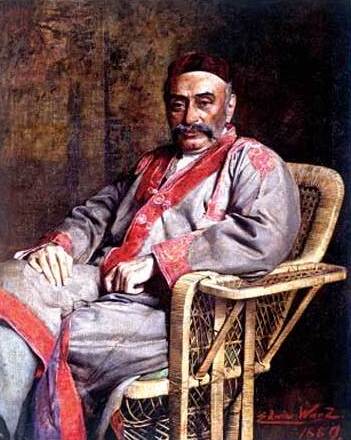
Edwin Arthur Ward, portrait of Jamsetji Tata, 1889, oil on canvas, Tata collection, Chhatrapati Shivaji Maharaj Vastu Sangrahalaya, Mumbai (public domain) · Wikimedia Commons file 'JAMSETJI N. TATA.jpg': oil-on-canvas portrait of Jamsetji Tata by the British painter Edwin Arthur Ward (1859-1933), signed and dated 1889, in the Tata collection at the Chhatrapati Shivaji Maharaj Vastu Sangrahalaya (formerly Prince of Wales Museum), Mumbai, accession 33.72; original 351 x 440 pixels, not resized or cropped · Public domain (artist died 1933)
entrepreneur · 19th Century
1839–1904
Not yet included in personality matching — the documented evidence doesn't yet cover enough of the personality model. Everything else on this page is fully available.
Founded the Tata business house: he opened the Empress cotton mill at Nagpur on 1 January 1877, later bought and renamed the Swadeshi Mill near Bombay, and also backed the Taj Mahal Hotel and a hydroelectric scheme for Bombay's factories.
From 1901 he pursued large-scale iron and steel production in India; he died in 1904 before it was built, and his sons registered the Tata Iron and Steel Company in 1907.
In 1898 he offered property worth about Rs 30 lakh to found a research university; after his death it was established in 1909 and opened in 1911 as the Indian Institute of Science in Bangalore.
After the first machinery for his Nagpur mill proved inferior and the shares fell to half their face value, he went to Europe in 1878, bought new plant at higher capital cost and scrapped the cheaper machinery.
This is consistent with finding another route when the first plan failed. Resourcefulness
In 1898 he offered fourteen Bombay buildings and four landed properties, about half his wealth, to found a research university, and in 1904 added a codicil to his will keeping the offer open to the government.
This is consistent with committing his own wealth to a public purpose over years of delay. Impact Motivation
Having worked in his father's trading firm from 1858, he began promoting a cotton-spinning and weaving company in 1874 and sited it at Nagpur rather than Bombay, moving from trade into manufacturing.
This is consistent with a readiness to back a site others doubted. Opportunity Sensing
People whose overall profiles resemble theirs.



Not a rival — a different profile shape worth a look.