Leonardo da Vinci
94% Profile Match
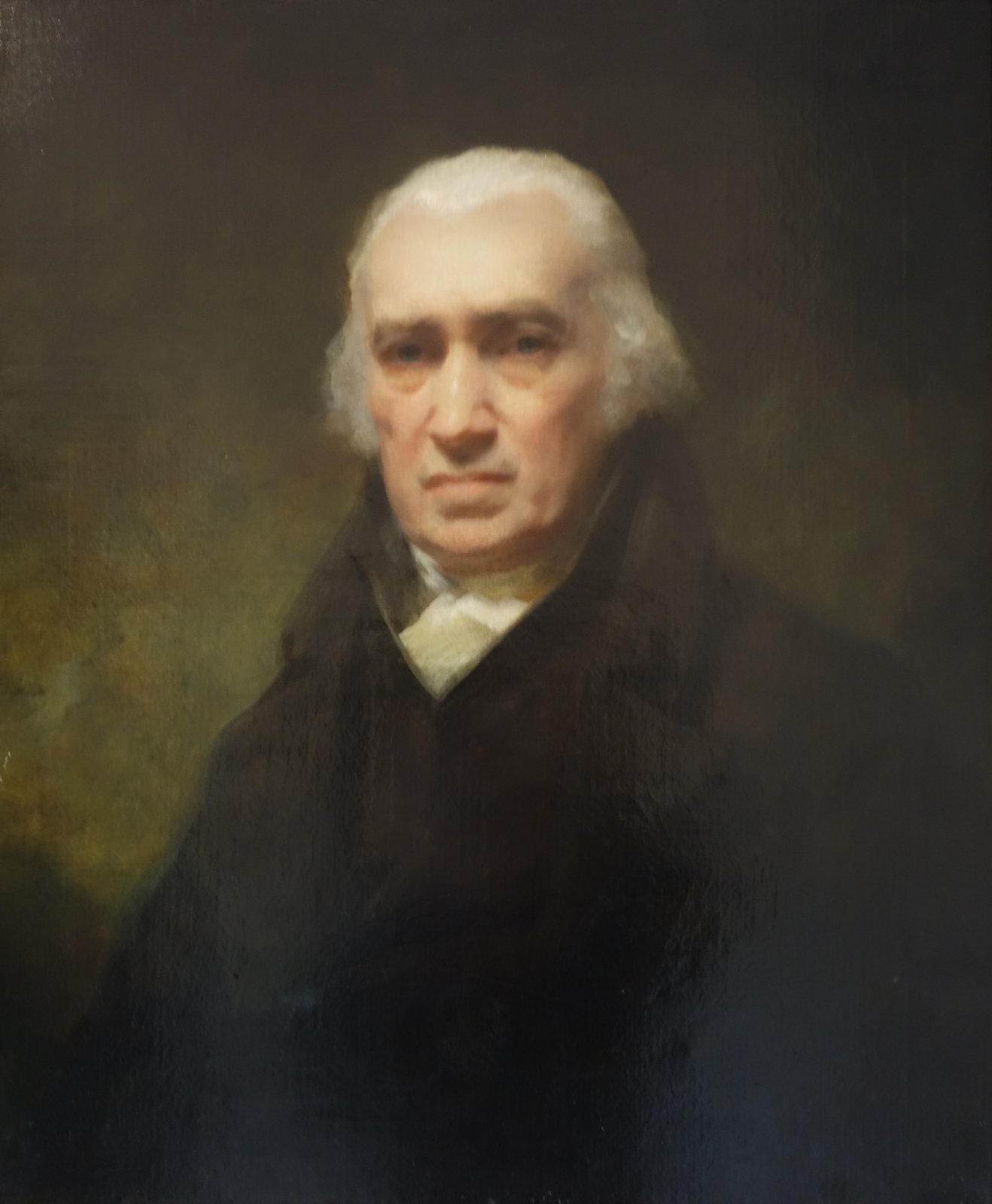
Henry Raeburn, James Watt, 1815, oil on canvas, Huntington Art Museum, San Marino, California; photograph by Daderot, CC0 (the painting is public domain: artist died 1823); cropped to the canvas and downscaled · The Huntington Library, Art Museum, and Botanical Gardens, San Marino (Henry Raeburn, oil on canvas, 1815), photographed by Daderot, via Wikimedia Commons · CC0 (photograph); painting public domain
According to Joseph Black's later account, Watt saw in early 1765 that a Newcomen engine wasted steam by cooling its cylinder at every stroke, and that condensing the steam in a separate vessel would avoid this. Engines built to his improved design were made by the firm Boulton and Watt from the mid-1770s, first for draining mines and later for driving machinery.
After James Pickard's 1780 patent covered the crank, Watt's 1781 patent set out five alternative ways of turning an engine's back-and-forth motion into rotation, and the sun-and-planet gear was the one his firm went on to use. His 1784 patent specified the parallel motion, a linkage that guides the piston rod of a beam engine along a near-straight path.
In the winter of 1763-64 Watt was asked to repair the University of Glasgow's working model of a Newcomen engine and found that its boiler could not supply enough steam to keep it running. According to John Robison, who watched and later gave an account for Watt's side in a patent suit, Watt tried larger heating surfaces, a wooden boiler and cased cylinders, and showed that more than three-quarters of the steam was being condensed and wasted.
Trying one change after another and measuring the loss, rather than only patching the model, is consistent with the profile's high experimentation score; note that Robison's account was written about thirty years later and for one side of a lawsuit. Experimentation
While setting up the first Boulton and Watt pumping engines in Cornwall in 1777-79, Watt wrote repeatedly asking Boulton to come and settle payment terms with the mine adventurers. After a contentious 1779 meeting at Wheal Union he left before it ended and wrote that he could not bear such treatment, though he also wrote that he would draw no plans for a new engine until its terms were fixed. Smiles quotes these letters, and Bramwell separately describes Watt as averse to bargaining.
The letters sit alongside a preference for leaving face-to-face negotiation to a partner while staying firm about terms in writing, which fits the profile's below-average score for conflict tolerance. Conflict Tolerance
John Roebuck, who held two-thirds of Watt's 1769 patent, became insolvent in the early 1770s, and Matthew Boulton took over Roebuck's share in place of a debt of about 1,200 pounds. Watt, who had been working as a surveyor and canal engineer in Scotland, moved to Birmingham in May 1774; in 1775 Parliament extended the patent's term and the Boulton and Watt partnership began.
Leaving Scotland and a surveying career for a new partnership when the first arrangement collapsed is consistent with the profile's adaptability, although Small's and Boulton's repeated invitations were also part of the move. Adaptability
People whose overall profiles resemble theirs.