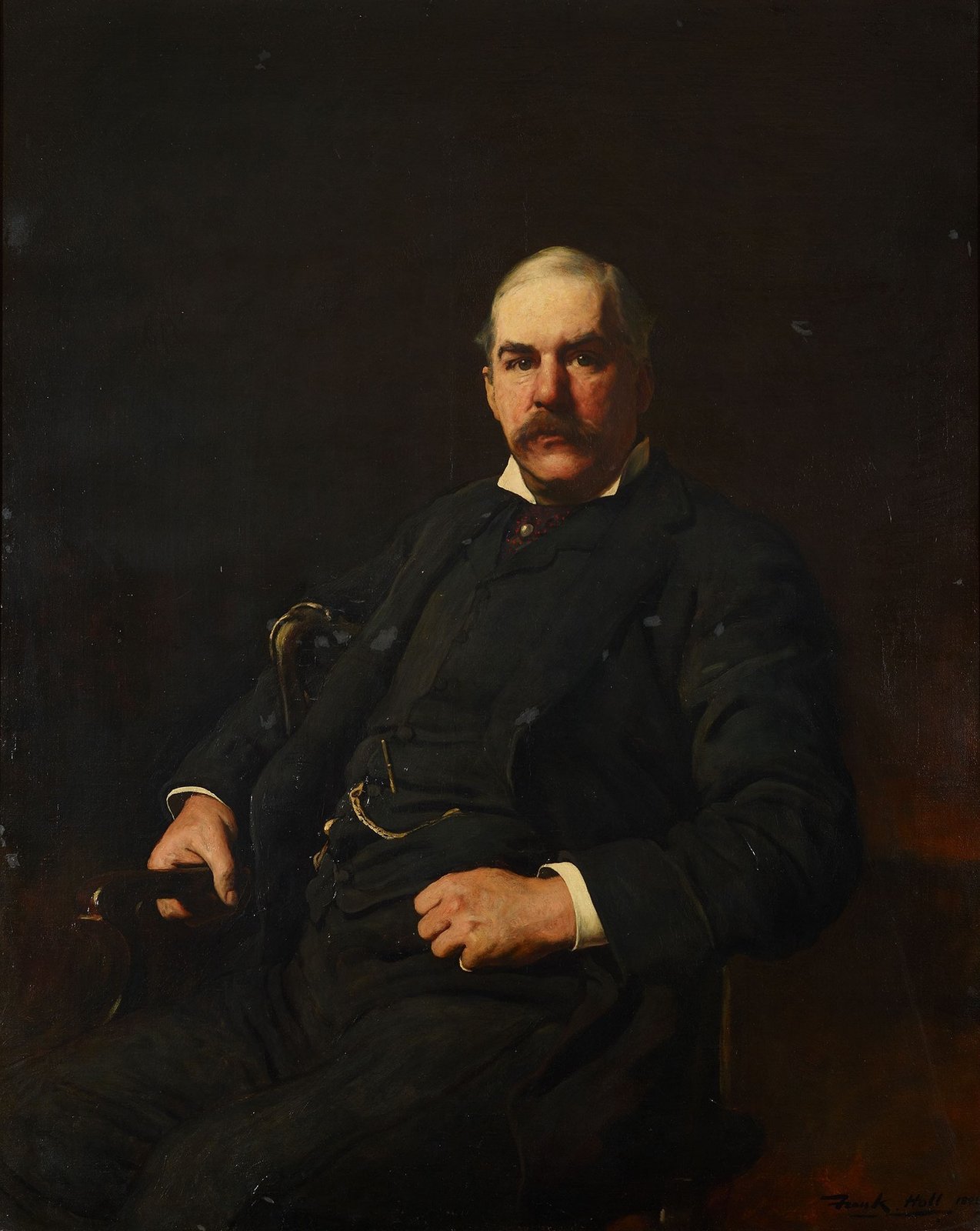

Frank Holl (1845-1888), Portrait of Pierpont Morgan, 1888, oil on canvas, The Morgan Library & Museum, via Wikimedia Commons; public domain; downscaled · The Morgan Library & Museum, New York (Frank Holl, 'Portrait of Pierpont Morgan', oil on canvas, 1888, commissioned by Morgan), via Wikimedia Commons · Public domain (author d. 1888)
Trait Constellation
Key Achievements
In February 1895 J. P. Morgan & Co. and August Belmont & Co. contracted to sell the U.S. Treasury 3,500,000 ounces of gold for four per cent bonds, with at least half of the gold to be obtained in Europe. In his 1904 account, President Grover Cleveland says the contract also bound the firms to use their financial influence against gold withdrawals, and that no gold left the Treasury for export while it ran.
On 2 March 1901 J. P. Morgan & Co. issued the circular announcing the United States Steel Corporation, which stated that the entire plan of organization and management would be determined by the firm. Ida Tarbell, drawing on Elbert Gary's recollections, writes that Morgan picked the first board of twenty-four directors and chose Gary to chair its executive committee.
During the October 1907 panic Morgan formed a $25,000,000 money pool, subscribed by leading banks and financiers, to keep the New York Stock Exchange from collapsing, and a similar pool was formed the next day, according to O. M. W. Sprague's 1910 report for the National Monetary Commission.
Moments That Reveal Them
Questioned by counsel Samuel Untermyer before the Pujo committee on 19 December 1912, Morgan denied that credit rests primarily on money or property: 'the first thing is character... Before money or anything else. Money can not buy it.' He added that 'a man I do not trust could not get money from me on all the bonds in Christendom,' and said that if a stock-exchange borrower was not satisfactory to him he called the loan 'at once, personally.'
Holding to this account of credit across two days of adversarial questioning on voting trusts, control and lending is consistent with the profile's conflict-tolerance score; the transcript records his answers, not how they were received. Conflict Tolerance
On 21 October 1907, asked to help Knickerbocker Trust, Morgan had Benjamin Strong examine its books; Strong could not establish its solvency in the time available and Morgan refused aid (Moen and Tallman). Carl Hovey's 1911 biography has him telling Knickerbocker's new president, 'I've got to stop somewhere.' After Knickerbocker suspended on 22 October and the runs spread to the Trust Company of America, Moen and Tallman say Morgan 'changed his mind' and released aid.
Changing course once the runs spread is consistent with the profile's belief-updating score, though the sources do not say what changed his mind, and the Fed essay and Hovey differ slightly on the timing of the refusal. Belief Updating
Turning Points
Ida Tarbell, drawing on Elbert Gary's recollections, writes that through 1900 Morgan rejected Gary's urging to buy Andrew Carnegie's steel company ('I would not think of it... I don't believe I could raise the money'). After a December 1900 dinner at which Charles Schwab spoke, Morgan talked with Schwab and, a few days later, asked whether an option on the Carnegie properties could be had; Carnegie refused a written option but sent a penciled price. About three weeks after the dinner Morgan sent his partner Robert Bacon to ask Gary whether buying Carnegie out was practical.
Moving from repeated refusal to a concrete inquiry within days of Schwab's talk is consistent with the profile's decisiveness score; why Morgan changed his mind is Tarbell's reading rather than a reason he is recorded as stating. Decisiveness
Similar People
People whose overall profiles resemble theirs.

Nelson Mandela

Simón Bolívar

Wu Zetian

Ernest Shackleton

Julius Caesar
Sources
- J. P. Morgan -- English Wikipedia, introduction fetched via the MediaWiki API; orientation only (identity, dates, occupation). Not used as support for any scored row.
- J. P. Morgan (Q54168) -- identity verified live via the Wikidata API (wbgetentities): label 'J. P. Morgan', description 'American financier, banker, and art collector (1837-1913)', born 1837-04-17, died 1913-03-31, citizenship United States, kowiki sitelink 'J. P. 모건'. Orientation only.
- J. P. 모건 -- Korean Wikipedia introduction fetched via the MediaWiki API; used only to confirm the conventional Korean rendering of the name (article title 'J. P. 모건'). Orientation only.
- Grover Cleveland, 'Presidential Problems' (New York: Century, 1904), chapter 'The Bond Issues' (Project Gutenberg text, archive.org copy) -- the President's own account, written nine years later and openly defending his administration, of the 7 February 1895 White House interview with Morgan and the gold-purchase contract (Section 3700 proposal, $100,000,000 urged vs. $60,000,000 fixed, 3,500,000 ounces, half from Europe, duty to protect the reserve, the ten-day window for three per cent bonds), plus the January-February 1896 public sale. FIRSTHAND non-self (Morgan's counterparty); a recollection, not a contemporaneous record. Read in full for this chapter.
- U.S. House Subcommittee on Banking and Currency, 'Money Trust Investigation' (Pujo Committee), Part 15, testimony of J. Pierpont Morgan, 19 December 1912 (GPO 1913, FRASER PDF text) -- primary transcript. Morgan's own answers are SELF testimony (one self perspective); counsel Samuel Untermyer's questions are the adversarial frame. Read: the voting-trust and fiscal-agent exchanges (pp. 1017-1020), the control and competition exchange (pp. 1050-1051) and the credit-and-character exchange (pp. 1083-1085); the remaining pages were skimmed by keyword.
- U.S. House Subcommittee on Banking and Currency, 'Money Trust Investigation', Part 14, first day of Morgan's testimony, 18 December 1912 (GPO 1913, FRASER PDF text, pp. 1003-1008) -- primary transcript, SELF testimony (same perspective as Part 15): partners, deposits of interstate corporations, his refusal to name depositors, fiscal-agent contracts. Read in full for the Morgan pages.
- Ida M. Tarbell, 'The Life of Elbert H. Gary: The Story of Steel' (New York: Appleton, 1925; archive.org scan) -- journalist's biography built on Gary's recollections, corporation records and 1913 government-suit testimony (Reed, Schwab, Bacon). Independent non-self, secondary, with second-hand recollections recorded in 1925. Read: the 1897-1901 Gary-Morgan episodes, the 1900 Carnegie discussions and the Simmons dinner, the March 1901 circular, the wire-company negotiation and the 1902 conversation (roughly pp. 80-127 and 146-149); the rest of the book was searched by keyword only.
- John Moody, 'The Masters of Capital: A Chronicle of Wall Street' (Yale University Press, 1919, Chronicles of America; archive.org scan) -- financial-analyst's narrative history. Independent non-self, secondary. Read: chapters I-II (Morgan's rise, the 1879 New York Central placing, the 1885 Vanderbilt/West Shore/South Pennsylvania settlement, the 1887 Baltimore and Ohio defeat and the voting-trust device, the Southern Railway and other reorganizations, pp. 1-34) and the opening of chapter V. Its ethnic characterisations of financiers were not used.
- Carl Hovey, 'The Life Story of J. Pierpont Morgan' (New York: Sturgis & Walton, 1911; archive.org scan) -- contemporary, admiring journalistic biography written while Morgan was alive. Independent non-self but heavily interpretive; its 1895 narrative appears to draw on Morgan's own recollection, so it is used only as corroboration there. Read: chapters VIII-IX (1895), X (U.S. Steel), XIV (the panic of 1907, pp. 293-310) and the start of XV.
- O. M. W. Sprague, 'History of Crises under the National Banking System' (National Monetary Commission, 1910; archive.org scan) -- contemporary scholarly report by a Harvard economist. Independent non-self, secondary. Read: the October 1907 account and assessment, pp. 252-256 (the trust-company runs, Morgan's influence, the stock-exchange money pool); the rest of the volume was searched for 'Morgan' only.
- Jon R. Moen and Ellis W. Tallman, 'The Panic of 1907', Federal Reserve History (federalreservehistory.org essay) -- scholarly institutional essay. Independent non-self, secondary. Downloaded and read locally (the panic narrative in full): the 21-22 October 1907 sequence in which Morgan had Benjamin Strong examine Knickerbocker Trust's books, refused aid, then 'changed his mind' for the Trust Company of America, and the cash he solicited for the stock-exchange loan post.
- H. W. Brands, 'Upside-Down Bailout' (HistoryNet, American History magazine, 2010) -- historian's popular article on the 1895 Treasury rescue with a paragraph on 1907 and the Pujo hearing. Independent non-self, secondary and popular; several scene details (timing of the meeting, the solitaire evening) differ from Cleveland's own account and are not used. Read in full; corroboration only.
- New-York Tribune, 4 November 1907, pages 1-2 (Library of Congress digitised OCR text via loc.gov) -- contemporaneous newspaper coverage of the Saturday 2 and Sunday 3 November conferences at Morgan's library on 36th Street: who attended, the trust-company directors' late-night meetings and the public statements of Morgan and Perkins. Independent non-self, primary press; the reports describe attendance and public statements, not what was decided. Pages 1-2 were read; pages 3-5 were searched for 'Morgan' with no hits.