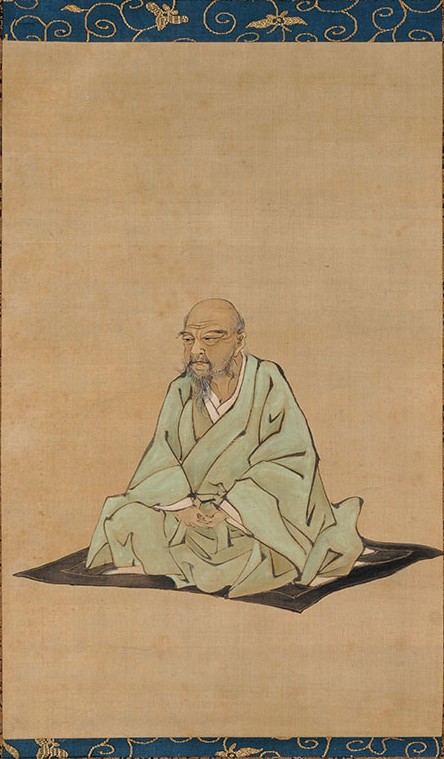
Kubota Beisen, Portrait of Ito Jakuchu, Meiji period. Shokoku-ji, Kyoto, public domain · Portrait of Ito Jakuchu by Kubota Beisen (1852-1906), one hanging scroll, colour on silk, Meiji period (Commons gives 1885, which the holder's exhibition listings do not confirm), in the collection of Shokoku-ji, Kyoto, exhibited at its Jotenkaku Museum. A posthumous portrait made about eighty-five years after his death, so shown as a later depiction and not as a likeness from life. The file is a promotional photograph of the scroll, used at its native 444 x 759 size with no resizing or upscaling; the temple site offers no item record or rights statement for it. · Public domain (a Meiji-period painting by an artist who died in 1906)
painter · Early Modern
Itō Jakuchū
1716–1800
Known For
Not yet included in personality matching — the documented evidence doesn't yet cover enough of the personality model. Everything else on this page is fully available.
Trait Constellation
Key Achievements
Painted the thirty hanging scrolls of the Colorful Realm of Living Beings between 1757 and 1766, a National Treasure of densely detailed birds, plants, fish and insects, which he gave to Shokoku-ji.
Developed a rich-colour bird-and-flower style, famed for his chickens, that Japanese reference works describe as recomposing observed forms and fine detail into a strongly imaginative picture.
Born the eldest son of a Kyoto greengrocer, he handed the family business to his brother at forty to paint full time, and after the 1788 fire destroyed his studio and shop he continued working near Sekiho-ji.
Moments That Reveal Them
Dissatisfied with the Kano school's copybook method, he turned to copying Song, Yuan and Ming paintings and to sketching the animals and plants around him, keeping fowl at home and sometimes importing exotic birds to observe them.
This is consistent with preferring direct study to an inherited school method. Independent Thinking
Lippit notes that he worked on the Colorful Realm continuously from 1757 to 1766 at about three large paintings a year, using costly materials and verso coloration painted on the back of the silk.
This is consistent with sustained, painstaking effort over a decade. Persistence
Turning Points
At forty he retired from the family greengrocer business, passing it to his younger brother, and moved to Shokoku-ji to start the Colorful Realm of Living Beings.
This is consistent with giving up a secure family trade to work as a full-time painter. Need for Autonomy
Similar People
People whose overall profiles resemble theirs.

Frida Kahlo

Maya Angelou

Sigmund Freud

James Joyce

Miles Davis
Opposite Profile
Not a rival — a different profile shape worth a look.
Alexander Hamilton
Sources
- Itō Jakuchū (Q1240575), verified live via the Wikidata API (2026-11-05): English label 'Itō Jakuchū', description 'Japanese artist (1716-1800)', Korean label 이토 자쿠추, birth 1716-03 and death 1800-10-27. Orientation only; not used as support for any row.
- Kotobank (Japanese reference aggregator) entry for Ito Jakuchu, reproducing Shogakukan's Digital Daijisen and Nipponica (entry by Kobayashi Tadashi), Heibonsha's World Encyclopedia (entry by Suzuki Hiroyuki), Britannica Japan, Heibonsha's Mypedia and Kodansha's Japanese biographical dictionary, read in the original Japanese. CANONICAL SIGNIFICANCE SOURCE: a Kyoto painter, eldest son of a Nishikikoji greengrocer, who studied the Kano school but was dissatisfied with its copybook practice and turned to copying Song, Yuan and Ming paintings and sketching the animals and plants around him; handed the family business over at 40 and devoted himself to painting; made an unusual style of rich-colour bird-and-flower painting and ink painting; best known for the thirty-scroll Colourful Realm of Living Beings (1757-66) given to Shokoku-ji, and for his chickens; unusual stone-rubbing prints; lost his house in the 1788 Tenmei fire and lived out his last years near Sekiho-ji; contrasted by Suzuki with Maruyama Okyo's plain realism (his paintings recompose observed forms into a strongly subjective, imaginative picture); Nipponica records the tale that he painted chickens for anyone for a measure of rice. Japanese scholarly reference; independent of the English press sources.
- Sarah Fleming, 'Ito Jakuchu: The Greatest Fullness', Tricycle: The Buddhist Review (read as the visible part of the page, which covers the whole profile before the subscription notice). A popular profile: eldest son of a Kyoto greengrocer, trained under Ooka Shunboku of the Kano school but found it too strict and learned from vegetables, fish and the fowl he raised, sometimes importing exotic birds to observe; took over the shop after his father's death in 1739 but had little interest in it, quoting his friend the Rinzai monk Daiten; retired at 40 to his younger brother and moved to Shokoku-ji to paint the Colorful Realm of Living Beings; the series' donation to the temple in 1765 with his dedication; the studio and family shop burned in the 1788 Tenmei fire, after which he funded the Five Hundred Arhats stone garden at Sekiho-ji by selling ink paintings for rice. Admiring; relies in part on Daiten and Baisao, who were friends, and tells at least one tale it calls perhaps apocryphal.
- Harvard Magazine, 'A Blossoming Centennial' (2012), an article built on interviews with Professor Yukio Lippit, guest curator of the National Gallery of Art exhibition 'Colorful Realm: Japanese Bird-and-Flower Paintings by Ito Jakuchu', read in full. A modern scholar's account: he began the Colorful Realm in 1757 and worked on it continuously until 1766 at about three paintings a year; initially perhaps individual works or a smaller set, later conceived under Daiten as a backdrop to a Shokoku-ji ritual, with a Shakyamuni triptych making 33; the paintings are highly crafted polychrome works on silk using expensive materials and laborious techniques, including verso coloration; the later works are more experimental; he retired at 40 from a prospering family business; Shokoku-ji gave the paintings to the Imperial Household in 1889 for funds. The article is an exhibition-promotion piece that also describes the curator; admiring.
- Canon Tsuzuri Project, 'Colorful Realm of Living Beings (Doshoku sai-e)' work page (Japanese), read in full. A cultural-heritage reproduction project's catalogue note on the Imperial Collections Museum's thirty hanging scrolls (National Treasure, 2021): painted by the former Nishikikoji greengrocer over about ten years, centred on chickens, with an overwhelming density of detail and bold compositions not seen in other painters; given by Jakuchu himself to Shokoku-ji, where it was used in ceremonies with his Shakyamuni triptych; presented to the Imperial family by the temple in 1889. Short institutional text; consistent with, but not independent of, the museum descriptions on which it draws.