Warren Buffett
93% Profile Match
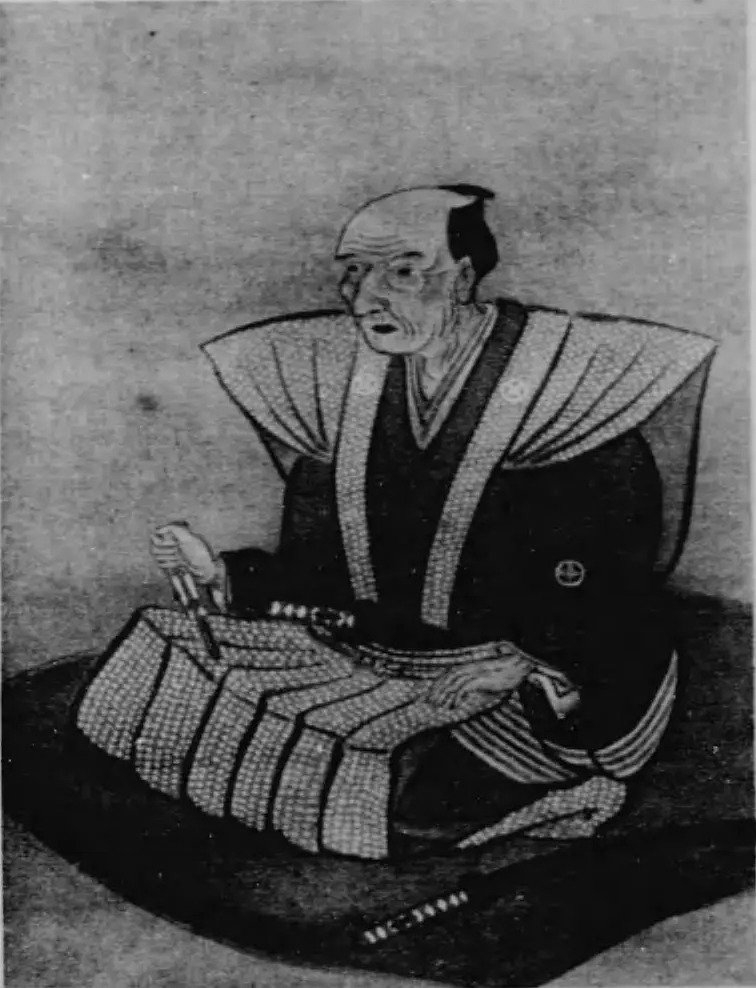
Painting probably by Aoki Katsujiro (c. 1821, attributed by the Ino Tadataka Memorial Museum, Katori); plate in Otani Ryokichi (ed.), Ino Tadataka, Iwanami Shoten, 1917; digitised by the National Diet Library, Japan (https://dl.ndl.go.jp/pid/956854) · Printed plate captioned 'Portrait of Ino Tadataka' in Otani Ryokichi (ed.), Ino Tadataka (Tokyo: Iwanami Shoten, 1917), as digitised by the National Diet Library (NDL Digital Collections item 956854, page image R0000004). It reproduces the painted portrait of about 1821 kept by the Ino Tadataka Memorial Museum in Katori, which the museum says is his only portrait and was probably painted by his disciple Aoki Katsujiro after his death. The file is the plate cropped from the library's 4064 x 2848 pixel scan of the book spread (756 x 988 pixels), black-and-white halftone, with no upscaling. · Public domain (National Diet Library item-level Public Domain Mark; a 1917 Japanese publication reproducing a painting of about 1821)
Japanese surveyor who, from 1800 at the age of 55, led ten surveys to 1816 that charted the coast from Hokkaido to Kyushu on foot with astronomical observations; after his death his disciples completed the Dai Nihon Enkai Yochi Zenzu in 1821, the Ino maps that Japan Search describes as the first maps of Japan made with actual surveying techniques.
The shogunate kept the maps secret and the official copy burned in 1873, but copies served as the base for the Japanese government's maps of the 1870s and 1880s, and a copy taken out by Siebold was published in Europe in 1840; scholars note he used the traverse method and that his longitudes were less accurate than his latitudes.
Before surveying he ran his adoptive family's sake-brewing and trading business, retired at 49 to study astronomy under Takahashi Yoshitoki, and measured a degree of meridian arc at 28.2 ri (about 110.75 km), close to the figure in Lalande's astronomy text; 2,345 materials related to him were designated National Treasures in 2010.
In 1800 the shogunate sanctioned the survey of Ezo for its value to northern defence, while Ino and his teacher were most interested in the length of a degree of latitude; the stipend was modest and he supplemented it with his own funds.
This is consistent with a man who found a way to get a scientific aim funded and sanctioned by pairing it with the state's practical concern and adding his own money. Resourcefulness
In later surveys he suffered asthma and contracted malaria and had to put down his instruments during bouts of illness, yet the survey went on for 17 years; he took little part in the last two surveys, and his students finished the maps after his death.
This is consistent with sustained effort over many years that was limited by age and illness rather than by loss of purpose. Persistence
In 1803 he spread his maps of eastern Japan before the shogun Tokugawa Ienari in Edo Castle; the shogun made him a retainer and ordered a survey of western Japan paid for by the government, and the team grew to include experts from the calendar office.
This is consistent with a private project turning into an official one once he had shown concrete results. Leadership Drive
People whose overall profiles resemble theirs.