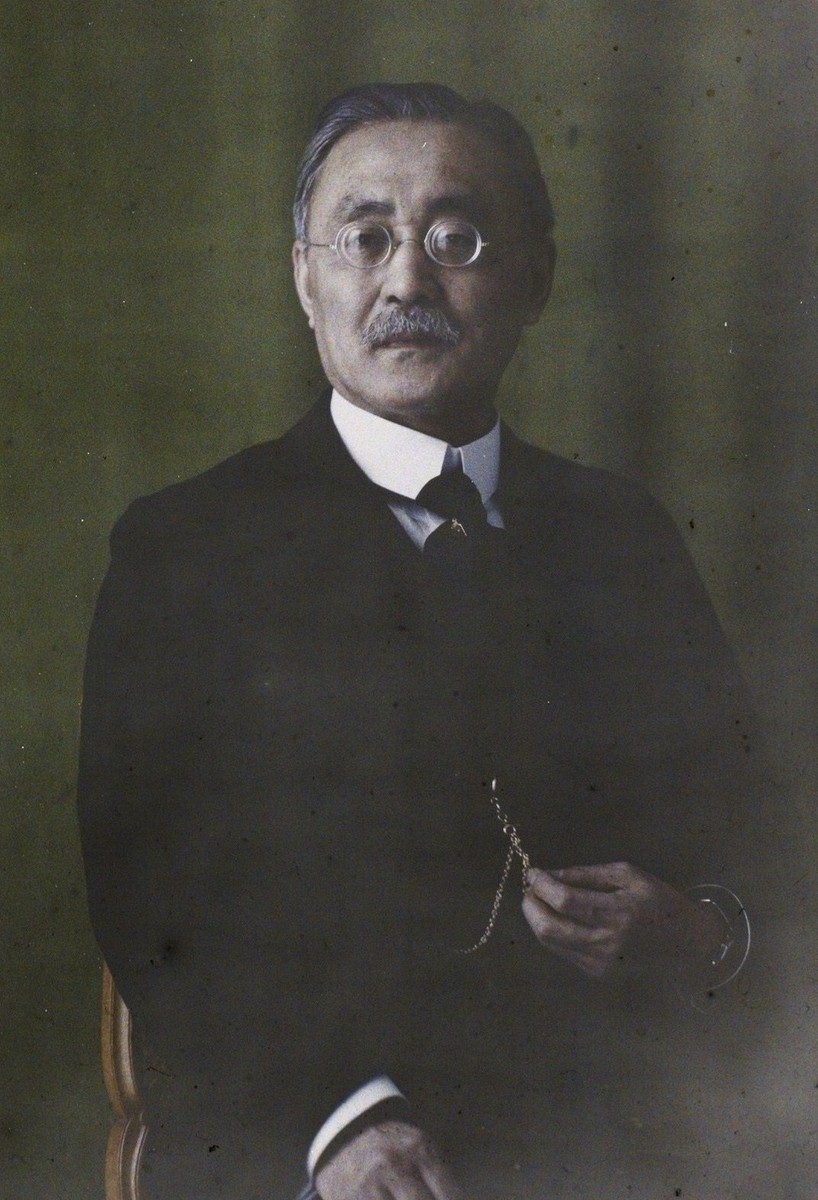
Auguste Leon, Inazo Nitobe, autochrome, 21 December 1922, Musee departemental Albert-Kahn, A35816 · Portrait of Inazo Nitobe, autochrome by Auguste Leon, taken 21 December 1922 at Boulogne, Musee departemental Albert-Kahn, inventory A35816. The museum's collection record for this item states public domain and freely reusable (CC-00); the photographer died in 1942 and Commons tags the file as public domain on the same basis. Commons original 1073 x 1575 pixels, downscaled to 818 x 1200 with no cropping and no upscaling. · Public domain, freely reusable (CC-00) per the museum record
teacher · 19th Century
Inazo Nitobe
1862–1933
Known For
Not yet included in personality matching — the documented evidence doesn't yet cover enough of the personality model. Everything else on this page is fully available.
Trait Constellation
Key Achievements
He wrote Bushido: The Soul of Japan in English (1900), explaining samurai-derived values to foreign readers; it was widely read after its 1905 American edition and has been translated into many languages.
As headmaster of the First Higher School he put education based on personalism into practice, and in 1918 he became the first president of Tokyo Woman's Christian University.
A doctor of agricultural economics who taught at Sapporo, Kyoto and Tokyo, he later served as an Under-Secretary-General of the League of Nations in Geneva (1919-1926 per the National Diet Library).
Moments That Reveal Them
He wrote Bushido in English to answer questions from his American wife and a Belgian legal scholar, illustrating each value with parallels from European history and literature for foreign readers.
This is consistent with deliberate adaptation of his message to a foreign audience, although scholars dispute how accurately the book describes samurai ethics. Persuasiveness
At the first graduation ceremony of Tokyo Woman's Christian University he described its aims as valuing insight over knowledge and character over academic ability, and cultivating persons rather than human resources.
This is consistent with an education-centred motivation, as stated by the university's own account. Impact Motivation
Turning Points
In 1884 he left the University of Tokyo before graduating and went to study in the United States, where he became a Quaker, before returning to Japan in 1891 to begin his academic career.
This is consistent with a willingness to change direction in pursuit of education abroad. Adaptability
Similar People
People whose overall profiles resemble theirs.


Malala Yousafzai

Abraham Lincoln

Maya Angelou

Nelson Mandela

Mahatma Gandhi
Sources
- Nitobe Inazo (Q12696), verified live via the Wikidata API (2026-10-26): label 'Nitobe Inazo', description 'Japanese educator, agricultural economist and diplomat (1862-1933)', born 1862-09-01, died 1933-10-15, Korean label present, P18 image 'Monsieur Inazo Nitobe.jpg'. Orientation only; not used as support for any row.
- National Diet Library of Japan, 'NITOBE Inazo' (Portraits of Modern Japanese Historical Figures; short entry read in full). CANONICAL SIGNIFICANCE SOURCE: educator and social-science scholar; Sapporo Agricultural College, Tokyo Imperial University professor, first president of Tokyo Women's Christian University, education based on personalism at the First Higher School (1906-1913), League of Nations Under-Secretary-General (1919-1926), and author of Bushido: The Soul of Japan (1900). Brief national-library biography; the First Higher School end date differs from the Suzuki chapter.
- Tadanobu Suzuki, 'Two Bridges in Nitobe's Bushido and Their Symbolism Today' (University of Victoria repository; about 16,000 characters of text extracted from the PDF and read, so some pages may be missing): his move from agricultural studies to English literature and economics, study at Johns Hopkins and in Germany, his career at Sapporo, Kyoto and Tokyo, headmaster of the First Higher School (1906-1911), founding president of Tokyo Women's Christian University (1918-1923), why and for whom he wrote Bushido in English, its 1900 and 1905 editions, and a Taiwan colonial advisory post. Scholarly commemorative essay, admiring in tone; Nitobe's own statements are quoted from his collected works.
- Christian Etzrodt, 'Nitobe Inazo's Bushido: Science or Fiction?', Electronic Journal of Contemporary Japanese Studies 18(3), 2018 (introduction and abstract read; the full text and appendix were not read): reports that Benesch and other researchers argue Bushido is an invented tradition, tests it against 29 samurai texts, and concludes that Nitobe gave a reasonably accurate description of most of the values. Independent scholarly counter-voice on the reliability of his best-known book.
- Tokyo Woman's Christian University, 'The Aims of the Founders of TWCU' (2018 centennial essay by Prof. Sano Masako, hosted by the United Church of Christ in Japan; read in full): the university's 1918 founding by six mission boards, Nitobe as first president with Yasui Tetsu as dean and A. K. Reischauer as managing director, and his first-graduation-ceremony speech on educational aims. Founder-institution account, admiring.
- UBC Botanical Garden, 'Inazo Nitobe and Bushido' (Nitobe Memorial Garden; read in full): memorial-garden biography stating his wish to be 'a bridge across the Pacific', his education in agriculture and languages in Tokyo, Sapporo, the United States and Germany, and the reception of Bushido in the West. Commemorative and admiring.
- Musee departemental Albert-Kahn collection record 'Inazo Nitobe', inventory A35816, autochrome by Auguste Leon taken 21 December 1922 (checked for the portrait only; not used for any scoring).
- Wikimedia Commons file page 'Monsieur Inazo Nitobe.jpg' (checked for the portrait only; not used for any scoring).