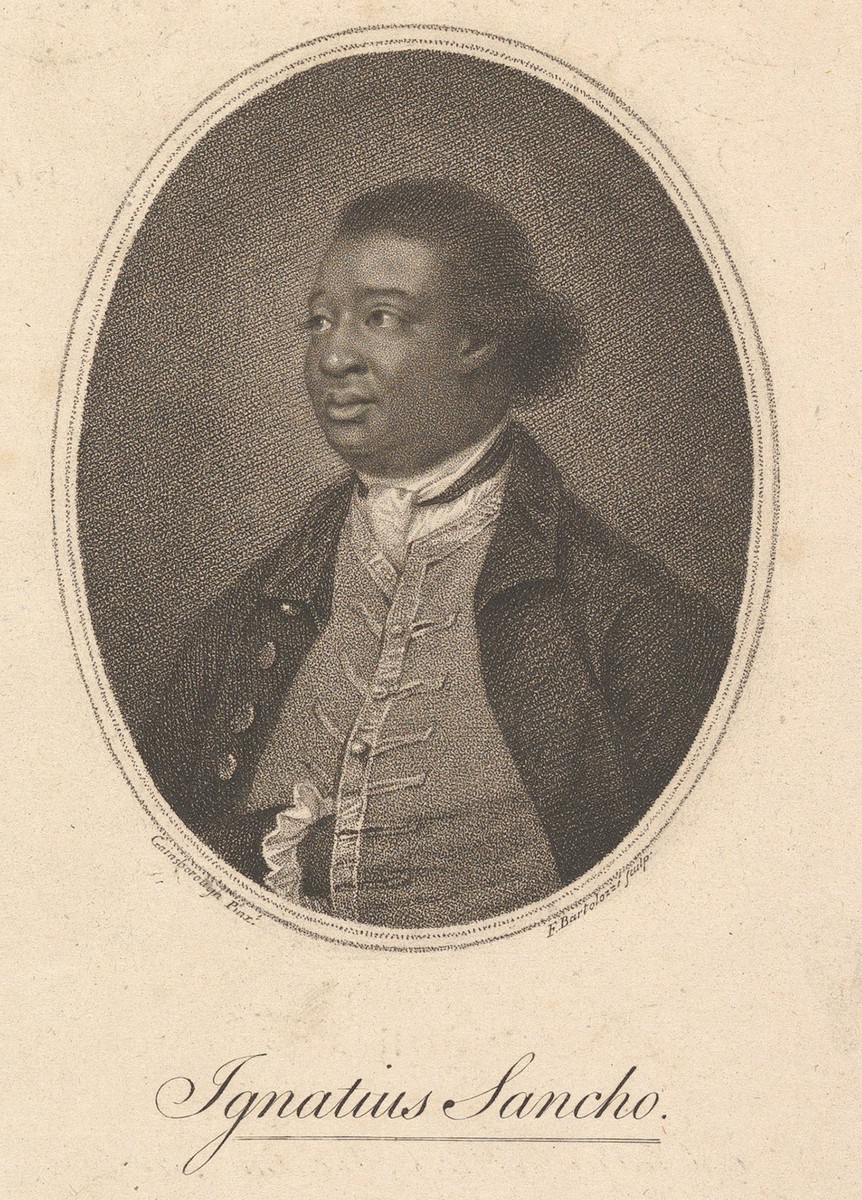
Francesco Bartolozzi after Thomas Gainsborough, 1802, The Metropolitan Museum of Art, Harris Brisbane Dick Fund, 1917, Open Access · Stipple engraving 'Ignatius Sancho' by Francesco Bartolozzi after Thomas Gainsborough's oil portrait, lettered 'Gainsborough Pinxt.' and 'F. Bartolozzi sculp.' and published in London on 20 December 1802 by William Sancho, Charles Street, Westminster; The Metropolitan Museum of Art, Harris Brisbane Dick Fund, 1917 (17.3.756-2151, object 376537). The museum's image (2158 x 3482) was cropped to the oval plate with its title line and downscaled to 862 x 1200 with no upscaling. · Public domain: The Metropolitan Museum of Art Open Access (isPublicDomain true); a 1802 print after a painter who died in 1788 and an engraver who died in 1815
composer · Early Modern
Ignatius Sancho
1729–1780
Known For
Not yet included in personality matching — the documented evidence doesn't yet cover enough of the personality model. Everything else on this page is fully available.
Trait Constellation
Key Achievements
His Letters, published two years after his death in 1782 and reprinted in five editions to 1803, made him a symbol of African humanity for eighteenth-century opponents of the slave trade.
He published dance music, 'Minuets, Cotillons & Country Dances' (about 1767), 'Composed by an African' and printed for the author in London.
Born on a slave ship and raised in service, he opened a grocery near Parliament in 1774, voted as a householder, and was painted by Thomas Gainsborough in 1768.
Moments That Reveal Them
In a letter to the famous author Laurence Sterne, he introduced himself as an African who loved his books and asked him to give half an hour's attention to slavery as practised in the West Indies.
This is consistent with taking the initiative to approach a prominent figure on a cause he cared about. Proactive Agency
While keeping the Westminster shop he published dance music, wrote letters, essays and plays for print, and kept up friendships with Garrick, Sterne and other artists and writers.
This is consistent with sustaining several creative pursuits alongside a trade. Cross-Domain Range
Turning Points
After the sisters refused to teach him, he taught himself to read, and the Duke of Montagu, who met him in Blackheath, lent him books and encouraged his education, which opened the way to service in the Montagu household.
This is consistent with a strong appetite to learn that shaped the course of his life. Curiosity
Similar People
People whose overall profiles resemble theirs.

Wu Zetian

Ada Lovelace

Leonardo da Vinci

Gertrude Bell

Aristotle
Opposite Profile
Not a rival — a different profile shape worth a look.

Nicolaus Copernicus
Sources
- Ignatius Sancho (Q1657368), verified live via the Wikidata API (2026-11-05): description 'British composer, writer and grocer', born 1729, died 14 December 1780, no Korean label (the Korean name below is a recorded transliteration). Orientation only; not used as support for any row.
- Brycchan Carey, 'Ignatius Sancho: African Composer and Man of Letters' (brycchancarey.com; a scholar's study page, read). CANONICAL SIGNIFICANCE SOURCE (with the London Museum story below): said to be born into slavery on a ship crossing to the West Indies; as a child in Greenwich forced to work for three sisters; employed by the Montagu family as butler; ran a grocery at 19 Charles Street, Westminster; composed music, appeared on stage and entertained London's literary and artistic circles; painted by Gainsborough in Bath in 1768; his letters published in 1782 and reissued in five editions to 1803; to eighteenth-century opponents of the slave trade he symbolised the humanity of Africans. The page links to the scholarly debate on the reliability of Joseph Jekyll's memoir but does not describe it. Single-author scholar's website; short.
- London Museum, 'Ignatius Sancho: Writer and early Black voter' (London Stories page, read). Records that he taught himself to read after the sisters refused to teach him, that the Duke of Montagu lent him books, that he became butler to the Duchess Mary and later valet to the next Duke, married Ann Osbourne in 1758, opened a grocery near Parliament in 1774 with the Duke's help and voted as a householder; that he wrote letters and essays (some printed under the name Africanus) and plays, composed music, was friends with Garrick and Sterne and was painted by Gainsborough in 1768; that his 1766 letter urged Sterne to support abolition; that his Letters (1782) sold out and were reprinted; and that he was less hopeful than his publisher about English attitudes and still faced discrimination. Museum text: balanced, institutional.
- Royal Museums Greenwich, collection record for the stipple-engraving frontispiece 'Ignatius Sancho, 1729-80' (read). Says the print is after an oil portrait by Thomas Gainsborough now in the National Gallery of Canada; that after Montagu's death in 1749 Sancho persuaded the widow to remove him from the sisters' household and she hired him as butler; that with Montagu family support he opened a Westminster grocery that sold slave-produced goods; that his property gave him the vote and the record calls him the second-earliest known Black person to vote in a British election, after John London in 1749; and that he was the first African in Britain to receive an obituary. Museum record; its 'second-earliest' voter claim differs from the 'first' claim in some other pages.
- Caroline Copeland, 'Ignatius Sancho and the Minuet', The Life and World of Ignatius Sancho (Rutgers-New Brunswick interdisciplinary research group; read). Says he published minuets for friends, family and patrons to dance, shows the title page 'Minuets, Cotillons & Country Dances... Composed by an African', dated [1767], printed for the author in London and dedicated to Henry, Duke of Buccleuch, with six minuets and eighteen cotillions and country dances (the page's own counts of minuets differ). It does not assess his musical training, reception or quality; the only evaluative comment concerns his letters.
- Letters of the Late Ignatius Sancho, an African, to which are prefixed Memoirs of his Life (third edition, London: J. Nichols, 1784; Project Gutenberg text of an Internet Archive scan; the Memoirs by Joseph Jekyll, the letter to Mr. Sterne and the letters of May-June 1780 on the state of the country and the Gordon Riots read, the rest searched only). SELF-REPORT and a prejudiced contemporary memoir: the Letters are his own words (the letter to Sterne is printed here with a date of 1776, whereas the London Museum dates it 1766 and Sterne died in 1768); Jekyll's Memoirs carry demeaning racial assumptions and anecdotes that scholars treat as unreliable, so only facts also given by another source are used and its anecdotes about his private life are excluded.
- The Metropolitan Museum of Art, Open Access record for 'Ignatius Sancho' (object 376537, Francesco Bartolozzi, stipple engraving and etching, 1802, Harris Brisbane Dick Fund 1917; read via the Met Open Access API). Portrait source record for the image used.