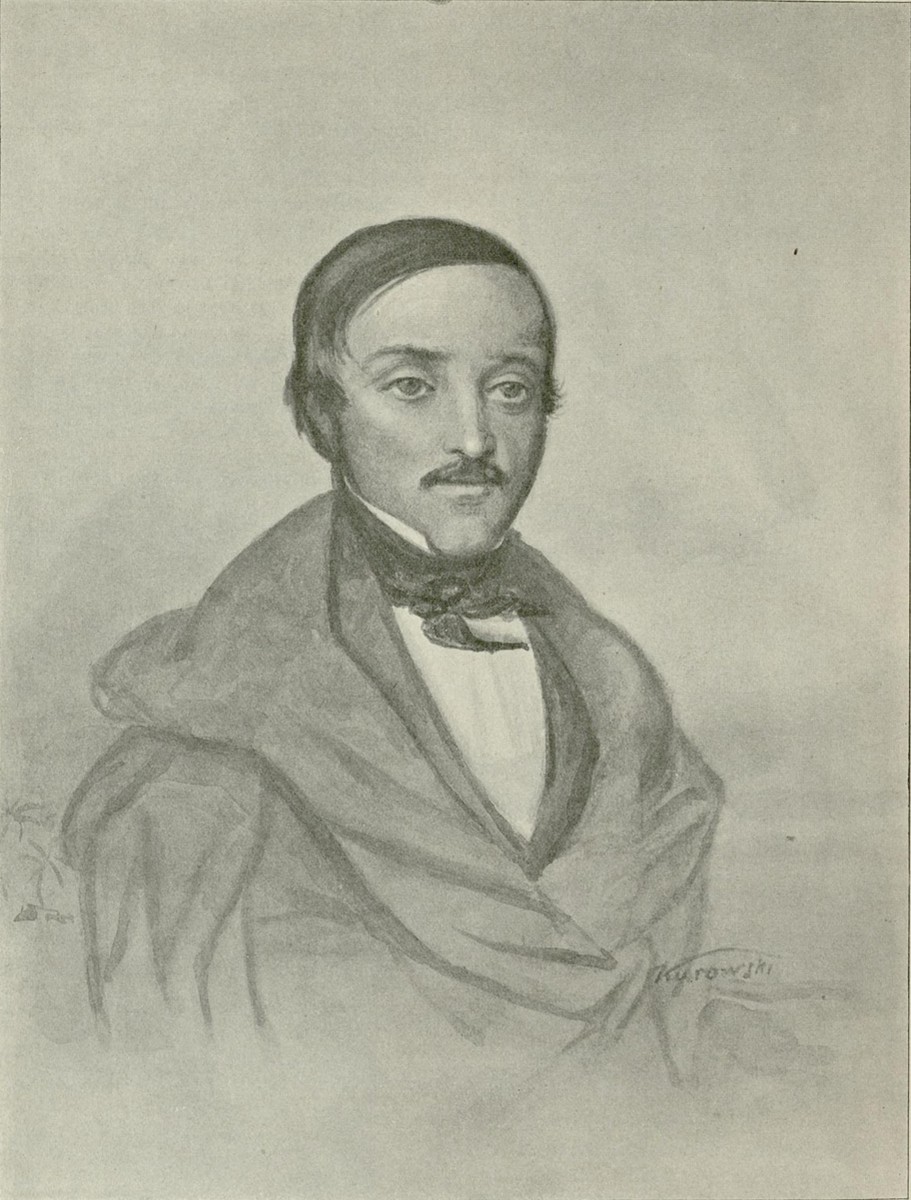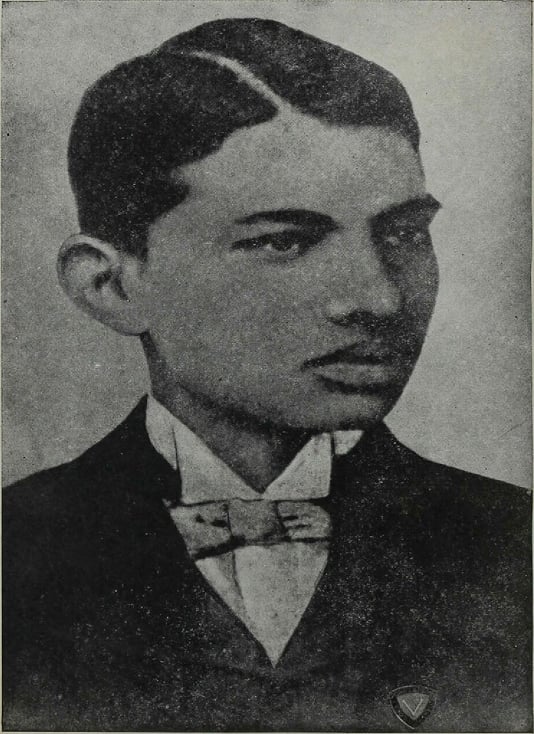

Watercolour portrait by I. Kurowski (Paris, 1832, per the plate caption); plate in August Sokolowski, Dzieje porozbiorowe narodu polskiego ilustrowane, vol. 3, Warsaw: Wiek, 1904, p. 94; digitised by the Radom Digital Library (Kazimierz Pulaski Museum in Warka copy) and the Internet Archive · Printed plate captioned 'Ignacy Domeyko' in August Sokolowski, Dzieje porozbiorowe narodu polskiego ilustrowane, volume 3 (Warsaw: Wiek, 1904), page 94, reproducing a watercolour portrait signed 'Kurowski' that the caption says was made in Paris in 1832 by I. Kurowski and kept in the Domeyko family collection at Zyburtowszczyzna. Digitised by the Radom Digital Library (edition 44083, source Kazimierz Pulaski Museum in Warka) and mirrored on the Internet Archive (page image n107, 2628 x 3699 pixels); the file is the framed portrait cropped from that page and downscaled to 911 x 1200 pixels (no upscaling), black-and-white halftone. · Public domain (Radom Digital Library edition record 'Domena Publiczna (public domain)'; a Warsaw publication of 1904 reproducing a watercolour of 1832, so public domain in the US as published before 1931)
scientist · 19th Century
Ignacy Domeyko
1802–1889
Known For
Not yet included in personality matching — the documented evidence doesn't yet cover enough of the personality model. Everything else on this page is fully available.
Trait Constellation
Key Achievements
Polish-born geologist and mineralogist who, hired in 1838 to teach chemistry and mineralogy at the Colegio de Coquimbo in La Serena, set up a chemical laboratory, introduced geological mapping of underground mines and spent years on Andean and Atacama field trips that built early scientific knowledge of Chile's mineral wealth, including his 1842 recognition of the copper deposit at El Teniente.
Served as university delegate from 1852 and rector of the University of Chile from 1867 to 1883, arguing that the university should itself teach at the higher level and turning its physical and mathematical faculty into an engineering school for the mining industry.
Wrote the Tratado de ensayes (1844), Elementos de Mineralogia (1845) and Araucania y sus habitantes (1846) and published 64 papers in the Anales de la Universidad de Chile; the mineral domeykite, a mountain range in northern Chile and asteroid 2784 Domeyko are named for him.
Moments That Reveal Them
On reaching La Serena in 1838 he had a complete chemical laboratory shipped from France in 32 crates and built a building to house it, and began systematic teaching late that year; from the fourth year he sent graduates to the Paris School of Mines.
This is consistent with someone who builds the infrastructure for a field himself instead of waiting for it to be provided. Proactive Agency
Between 1840 and 1845 he used every summer, when students were on holiday, for long geological transects of the Andes and the Atacama, and he kept making field trips even as rector.
This is consistent with sustained, repeated fieldwork pursued alongside heavy teaching and administrative duties. Persistence
Turning Points
In 1842 he wrote a memoir proposing reform of public instruction on the German model; his teaching-university plan was accepted by the University Council in 1847, when he moved to Santiago, and he was named university delegate in 1852.
This is consistent with a shift from teaching at a provincial school to shaping a national university. Leadership Drive
Similar People
People whose overall profiles resemble theirs.

Mustafa Kemal Atatürk

Jane Goodall

Nelson Mandela

Martin Luther King Jr.

Harriet Tubman
Sources
- Ignacy Domeyko (Q458245), verified live via the Wikidata API (2026-11-05): English label 'Ignacy Domeyko', description 'Polish-Chilean geologist and educator (1802-1889)', Korean label 이그나시 도메이코, born 1802 (31 July and 3 July both recorded), died 23 January 1889, citizenship Poland and Chile. Orientation only; not used as support for any row.
- Memoria Chilena (National Library of Chile), 'Ignacio Domeyko Ancuta (1802-1889)', read in full (Spanish). CANONICAL SIGNIFICANCE SOURCE: summarises his life (Vilnius studies, exile, Paris School of Mines graduation in 1837, hired in 1838 as professor of chemistry and mineralogy at the Colegio de Coquimbo), his laboratory, his expeditions (Coquimbo, Atacama, the Cachapoal in 1841-42 where he recognised the copper wealth of El Teniente, Araucania in 1845), the three lines of his contribution to Chilean mining, his role at the Instituto Nacional and the University of Chile (university delegate from 1852, rector 1867-1883, transformation of the physical and mathematical faculty into an engineering school), his works and honours. A celebratory institutional page with no criticism and some internally inconsistent dates (for example 1841 or 1842 for the Cachapoal trip).
- Memoria Chilena, 'Conocimiento geologico y mineralogico' (Domeyko minisite), read in full (Spanish): his arrival in La Serena in 1838, the laboratory equipped from college funds, government-commissioned trips to Huasco, Copiapo, Chanarcillo and the Atacama cordillera, his 1843 article on the Copiapo cordillera (in which he left Chanarcillo for a later paper), the Tratado de ensayes (1844), Elementos de Mineralogia (1845), the Ensaye sobre los depositos metaliferos de Chile, articles in the Annales des Mines from 1840, and collections sent to French naturalists. It gives no meteorite or new-mineral detail.
- Memoria Chilena, 'Labor docente de Ignacio Domeyko' (Domeyko minisite), read in full (Spanish): six years at the Colegio de Coquimbo (laboratory, library, student collection, graduates sent to Europe), his 1842 memoir proposing the reform of public instruction on the German model, his move to Santiago on the invitation of Manuel Montt, his teaching-university position set against the view of Andres Bello and Antonio Varas, his role as university delegate (about 1852-1867), the university library he built through European contacts, and the rectorship with technical schools and the 1872 report. It cites Herve and Charrier (2016) for some points, so it is not independent of that article on those points.
- Universidad de Chile, 'Ignacio Domeyko Ancuta (1867-1883)' in its page on the university's rectors, read (Spanish): his election as rector in 1867, re-election in 1882, resignation accepted on 30 May 1883, a lifetime pension, the 1879 reform and its practical, professional orientation, and a list of fields he worked in. A page by the university about its own rector, consistently positive.
- Francisco Herve and Reynaldo Charrier, 'Legado de Ignacio Domeyko (1802-1889) a la geologia y a la institucionalidad cientifica de Chile', Revista del Museo de La Plata, 2016, volume 1 special number, pages 138-148 (Spanish), downloaded as a PDF and read in full: a history-of-geology paper by two Chilean geologists (part-based on the family biography by Domeyko Lea Plaza and on the 64 papers Domeyko published in the Anales de la Universidad de Chile) covering his laboratory (32 crates shipped from France), summer transects of 1840-1845, geological mapping of underground mines, graduates sent to the Paris School of Mines, the El Teniente observation of 1842, his public dispute with Antonio Varas over the role of the university, his work as rector, his thermal-water studies, his impatience with slow European analysis of samples, his view that the Mapuche could be integrated under Catholic influence, and the honours named after him. The authors are geologists writing in tribute.
- Patryk Zakrzewski, 'Ignacy Domeyko: The Philomath of Chile', Culture.pl (Adam Mickiewicz Institute, Poland's cultural institute), read in full (English): a popular narrative of his Vilnius years, imprisonment, exile, study in Paris, the journey to Chile, the La Serena school, expeditions and the minerals named for him. Popular and admiring, with rounded claims ('essentially creates the whole Chilean higher education system', 'more than 7,000 kilometres' travelled, saltpetre claim) that no other source read confirms, so those claims are not used.
- Rafael Sagredo Baeza, historian, 'Un viaje a la libertad en la Araucania', CIPER Academico (22 August 2020), read in full (Spanish): an interpretive column on Domeyko's January 1845 journey through Araucania to Osorno and his books on it, reading the empathy toward the Mapuche as shaped by his exile and homesickness for Poland, and noting that he found Mapuche oratory an 'artificial melopea'. It is selective in its focus on empathy; a reader comment mentions that his work also guided policy on occupying the region, which the column itself does not discuss.
- August Sokolowski, Dzieje porozbiorowe narodu polskiego ilustrowane, volume 3 (Warsaw: Wiek, 1904), Radom Digital Library edition 44083 (record 'Domena Publiczna (public domain)', source: Kazimierz Pulaski Museum in Warka), Internet Archive copy: printed plate captioned 'Ignacy Domeyko'. Opened for the portrait only; the book text was not read.