Abraham Lincoln
93% Profile Match
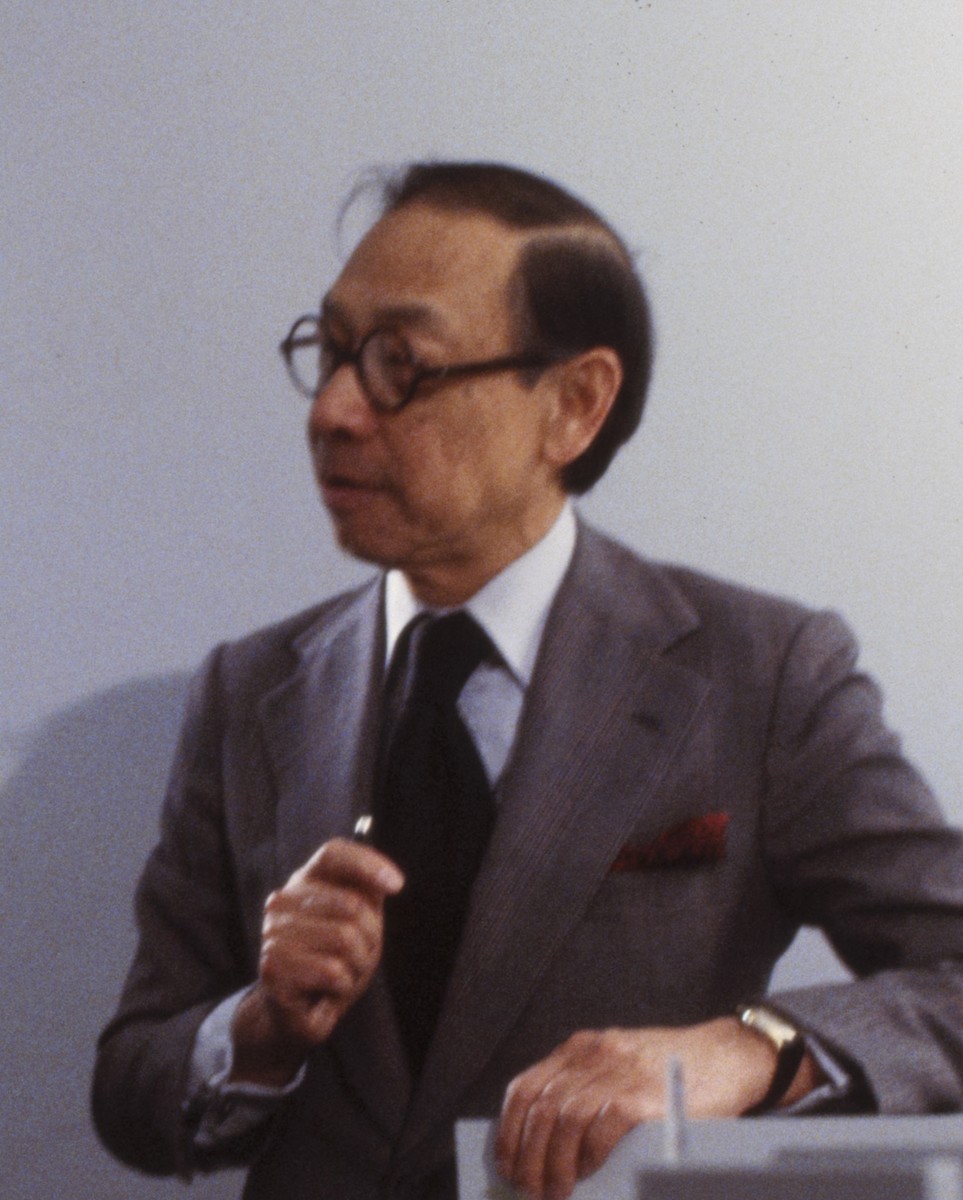
Photo: Bernard Gotfryd, 1980, Library of Congress, Prints and Photographs Division (LC-DIG-gtfy-03125), cropped and downscaled from the original · Library of Congress, Prints and Photographs Division, Bernard Gotfryd photograph collection (item 2020732666, reproduction number LC-DIG-gtfy-03125; slide caption 'Itzhak Perlman with I.M. Pei, architect, looking at model of NYC Convention Center', photographer Bernard Gotfryd, [1980]), via Wikimedia Commons file '(03125v).jpg' (original JPEG 4910 x 3340 pixels). The Library's rights advisory for the item is 'No known restrictions on publication'; the item notes read 'Photo agency: Newsweek' and 'Gift; Bernard Gotfryd; 2004', and the collection statement adds that the photographs were restricted during Gotfryd's lifetime (he died in 2016) and that privacy and publicity rights may apply. A 4:5 region (1553 x 1935 pixels) around Pei was cropped from the right of the frame, excluding the violinist Itzhak Perlman at the left, and downscaled once to 963 x 1200 (never upscaled). · No known restrictions on publication
architect · 20th Century
1917–2019
Not yet included in personality matching — the documented evidence doesn't yet cover enough of the personality model. Everything else on this page is fully available.
He designed the glass pyramid and the underground lobby of the Grand Louvre, which gave the Louvre a central entrance linking its three wings. Inaugurated on 29 March 1989 after fierce criticism, the pyramid has become the museum's symbol.
He designed the East Building of the National Gallery of Art in Washington, opened in 1978, solving an irregular site by dividing it into two triangles. According to Paul Goldberger, the New York Times critic Ada Louise Huxtable hailed it as the most important building of the era, and Pei called it one of his most important works.
He founded I. M. Pei & Associates in 1955 (later Pei Cobb Freed & Partners) and designed more than fifty projects, including the Kennedy Library (1979), the Bank of China Tower in Hong Kong (1989) and the Museum of Islamic Art in Doha (2008). Britannica describes his style as an extension of the International Style, with bold geometric arrangements and richly contrasted materials, and he won the 1983 Pritzker Architecture Prize.
While designing the Louvre pyramid, Pei first looked at a lightly reflective glass, then decided to make the glass as transparent as possible so that it would not change how the colours of the old buildings were seen. According to architect Michael Flynn, he also wanted the metal frame matched to the roofs around it, which led to a series of conversations about which of the 11 shades of grey on those buildings to use. The Louvre says it took two years of research to develop the extra-clear glass.
This is consistent with close attention to fine visual detail such as the clarity and colour of materials. Detail Orientation
Asked to design the Rock and Roll Hall of Fame in Cleveland, Pei, who was not a rock fan, first turned the job down. After changing his mind he prepared by travelling to rock concerts with the publisher of Rolling Stone, according to the New York Times, and AP says he admitted he was just catching up with the Beatles and researched the roots of rock and roll.
This is consistent with a habit of learning about an unfamiliar subject before designing for it. Curiosity
In 1964 Jacqueline Kennedy, impressed when she visited his office, chose Pei for the Kennedy Library over candidates including Louis Kahn; Goldberger says the commission thrust him into the forefront of American architects. Political objections to the Cambridge site then delayed the project for years, and after the 1976 move to Columbia Point Pei and an associate started the design 'all over again'. The library was dedicated on 20 October 1979.
This is consistent with seeing a long, entangled commission through a change of site and a redesign. Persistence
People whose overall profiles resemble theirs.

Not a rival — a different profile shape worth a look.