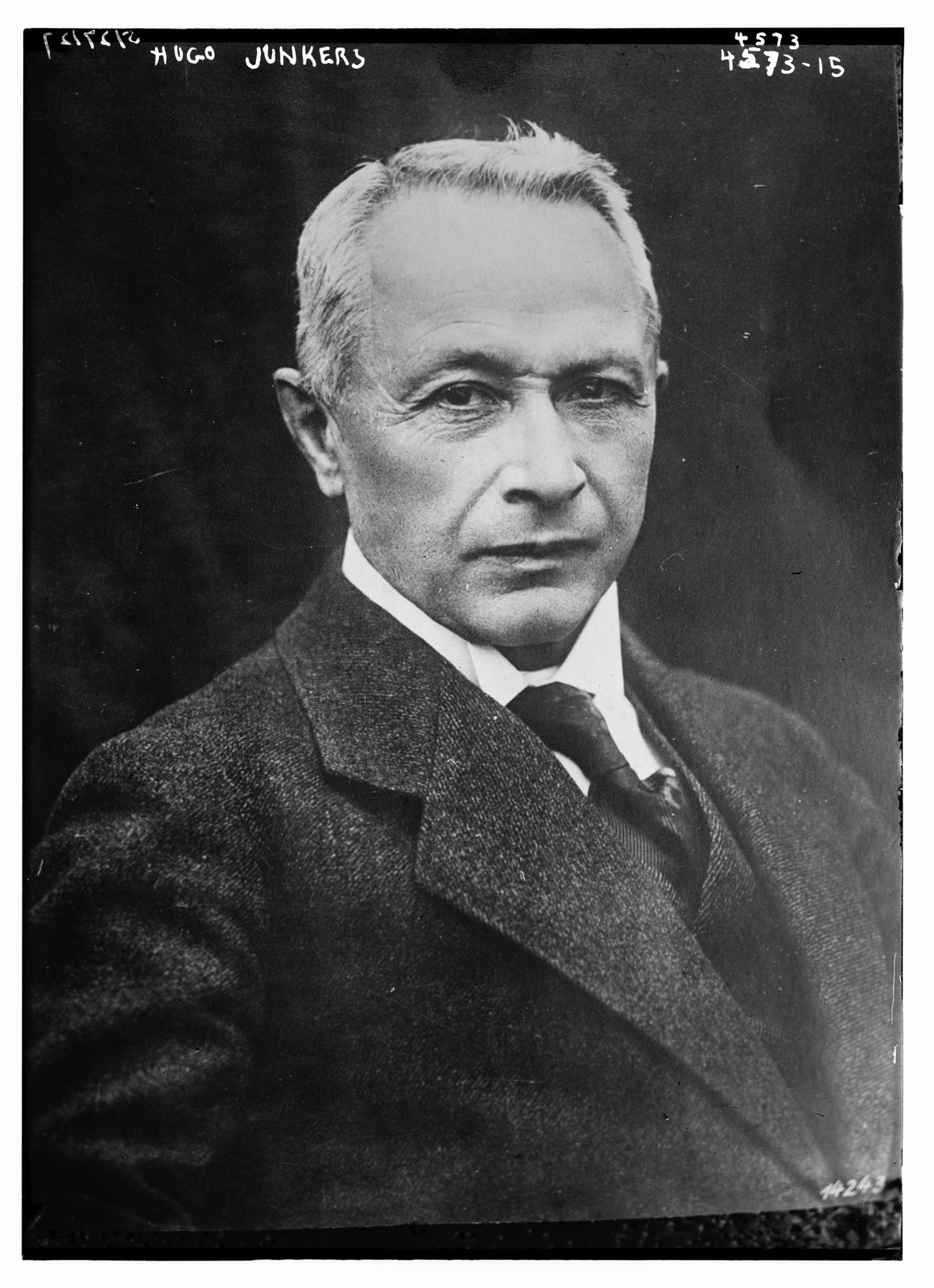

Bain News Service, 'Hugo Junkers', glass negative, between about 1915 and about 1920; Library of Congress Prints and Photographs Division, no known restrictions on publication · Library of Congress, Prints and Photographs Division, George Grantham Bain Collection (call number LC-B2- 4573-15; digital file LC-DIG-ggbain-26735), also on Wikimedia Commons as 'Hugo Junkers LCCN2014706903.tif' · Public domain
Trait Constellation
Key Achievements
In 1910 Junkers patented an all-wing aircraft with unbraced, thick-profile cantilever wings, after working from 1909 with his Aachen colleague Hans Reissner on a metal-winged aircraft. His company's J 1 first flew in December 1915; the Neue Deutsche Biographie lists it as his first all-metal aircraft, with a speed of 170 km/h at just over 1,000 kg, and a regional history portal calls it the first all-metal aircraft in the world. Wartime shortages of duralumin meant it was built of sheet iron, and it was nicknamed the Blechesel, the 'sheet-metal donkey'.
In 1919 his Dessau company built the F 13, a four-seat all-metal airliner with an enclosed cabin. The Neue Deutsche Biographie says it showed all the essential features of the modern airliner and that about 300 were built; it helped start German commercial aviation. In 1921 Junkers set up an air-traffic department that became Junkers Luftverkehr, which merged in 1926 with a competitor to form Deutsche Luft Hansa.
The Ju 52, first flown in 1930 as a single-engine aircraft and from 1932 as the three-engine Ju 52/3m, became known worldwide as 'Tante Ju' (Aunt Ju). The Neue Deutsche Biographie describes it as a 17-passenger airliner, the last aircraft to arise from Junkers's personal initiative, the standard airliner of Deutsche Lufthansa before 1939, and until the early 1940s the most-built airliner in the world; a newspaper feature counts almost 5,000 built after 1932.
Before aircraft, Junkers worked on gas engines at Dessau and in 1892 patented, with Wilhelm von Oechelhaeuser, a horizontal two-stroke opposed-piston gas engine. In the same year he patented the calorimeter, which measures the heating value of gas, and from it developed the gas bath heater and the water heater; his firm Junkers & Co. was founded in Dessau in 1895. He built an opposed-piston oil engine in 1908, founded Junkers Motorenbau in 1923, and in 1929 produced the first diesel aircraft engine. The heater business paid for his later research.
Moments That Reveal Them
On 11 January 1916 Junkers asked the army aviation inspectorate for money to develop the J 1 further; the war ministry ordered six more aircraft at 25,000 marks each. Between August and October he sent it a series of long letters, and he asked again for an advance on 6 October and 19 December. The ministry replied that orders would follow once his aircraft were ready for the front. Byers records that by early 1917 he had put over 1.5 million marks of his own money into aircraft research. An order for fifty J 4 aircraft came on 20 March 1917.
Repeating the requests over a year, and continuing development with his own money while they went unanswered, is consistent with persistence; the account rests on one scholarly study drawing on his own letters. Persistence
After army officials forced a joint company on him and Anthony Fokker in October 1917, Junkers refused Fokker's demand to run its operations and insisted that the patented wing could be used only by the new company. In April 1918 he drafted a letter to the inspector of flying troops complaining that the board was setting research priorities and allocating money for his research institute, and noted that he intended to take the institute back into his own firm. The joint company was formally dissolved on 24 April 1919.
Resisting outside control over his research and its funding is consistent with a strong need for autonomy; Byers also reports that army officials saw the same stance as a lack of deference. Need for Autonomy
Turning Points
The 1932 world economic crisis pulled Junkers's group of companies into financial trouble. To save the aircraft and engine works he sold his original water-heater firm, Junkers & Co., to Robert Bosch. In October 1933 the National Socialist government forced him to transfer the majority of the shares in his aircraft and engine companies to the Reich and to leave their management. He spent his remaining years on private research into metal building, and died in 1935.
Selling the firm that had financed his research in order to keep the aircraft and engine works going is consistent with resourcefulness; the 1933 transfer is recorded as an event and is not a basis for any trait. Resourcefulness
Similar People
People whose overall profiles resemble theirs.


Aung San Suu Kyi
Coco Chanel

Che Guevara

Joan of Arc
Fela Kuti
Sources
- Hugo Junkers (Q60363) -- verified live via Wikidata Special:EntityData (2026-10-08): en label 'Hugo Junkers', description 'German aviation pioneer (1859-1935)', born 3 Feb 1859, died 3 Feb 1935, citizenship Germany, GND 118776525, image 'Bundesarchiv Bild 146-2005-0007, Hugo Junkers.jpg'; no Korean label. Orientation only; not used as support for any row.
- Hugo Junkers -- English and German Wikipedia articles (raw wikitext), read as orientation only and to flag contested points (Reissner's share in the first all-metal aircraft; the circumstances of his last years); not used as support for any scored row.
- Gert Behrsing, 'Junkers, Hugo', Neue Deutsche Biographie 10 (1974), pp. 695-697, deutsche-biographie.de -- scholarly encyclopedia biography, read in full (career from the Aachen and Dessau gas-engine work, the 1892 calorimeter and opposed-piston engine, the 1895 firm, the Aachen chair, the 1910 thick-wing patent, J 1, F 13, the airline, Ju 52, the 1925-27 finance committee and the 1932 crisis). Written from archive material in the Deutsches Museum and standard older biographies; admiring of his technical record but dated and factual in tone.
- Richard Byers, 'An Unhappy Marriage: The Junkers-Fokker Merger', Journal of Historical Biography 3 (Spring 2008), pp. 1-30 (open access, University of the Fraser Valley) -- peer-reviewed scholarly article by a historian whose doctoral work was on Junkers, based on Junkers company correspondence, his diary notes and army-inspectorate files. Read in full: the J 1 years 1915-16, the financing letters, the December 1916 meeting with Fokker, the 1917 merger, the 1918 dispute over the research institute and the 1919 break-up. Independent of the company and of the family; also reports the army's unflattering view of him.
- Christoph Kaltscheuer, 'Hugo Junkers', Portal Rheinische Geschichte (Landschaftsverband Rheinland), published 2 September 2016, last changed 21 December 2021 -- regional-history biography, read in full: schooling and training, the engine station with Oechelhaeuser, the 1912 resignation from the Aachen chair after internal disputes over his research intensity, the post-1919 civil turn, the contacts with the Bauhaus, the 1932 sale of the heater firm.
- Archiv des Deutschen Museums, Munich, Findbuch FA 043 Junkers-Werke, Teilbestand Metall- und Hausbau (Juhaus), status 12 Oct 2023 -- archive finding aid whose introduction (read in full) summarises the company history, the products made during the 1921-22 aircraft-building ban, the systematic house-building research from 1926, and states that contacts with the Bauhaus did not lead to close cooperation in house building. The 1,300-plus file list was skimmed, not read.
- Ulrike Triebs, 'Hugo Junkers 1859-1935', LeMO (Lebendiges Museum Online), Deutsches Historisches Museum, Berlin, status 14 September 2014 -- dated institutional chronology, read in full: the 1910 patent, J 1, the Junkers-Fokker works, the air-traffic department of 1921, the attempts to work around the aircraft-building ban, the Bauhaus contacts, the tensions with senior staff before 1933.
- Sebastian Beck, 'Ein freier Geist' (150th birthday of Hugo Junkers), Sueddeutsche Zeitung, 2 Feb 2009 / online 17 May 2010 -- newspaper feature, read in full, built partly on interviews with his grandson Bernd Junkers, who manages the family papers; used only for the working-pattern details and the F 13 and company figures it states, with that family connection noted.
- 'Fokkers and Junkers', WarHistory.org, 16 September 2018 -- long web article read in full; a Fokker-centred account of the Berlin and Dessau negotiations of December 1916 to October 1917 and of the J 1 and J 4 aircraft. The page does not name its author or sources, so it is used only as a second, Fokker-side view of events that Byers also documents.
- Dr. Gasterstaedt (Junkers engineer), 'Development of the Junkers-Diesel Aircraft Engine', NACA Technical Memorandum No. 565 (Washington, May 1930), translated from Automobiltechnische Zeitschrift, 10 and 20 January 1930 -- company-insider technical paper, first pages read (the two-stroke principle chosen for the aircraft diesel); used only for what the engine was, not for any behaviour.
- Heidi Debschuetz, 'Hugo Junkers and the Aunt Ju', Technik Museum Sinsheim Speyer, museum story of 23 September 2025 -- short museum summary, read in full: the J 1 first flight of 12 December 1915, the F 13 altitude record of 13 September 1919, the Ju 52. Used for dates only.
- Wilhelm Exner Medal (Austrian Trade Association), 'Hugo Junkers', medallist of 1927 -- foundation biography page, read in full; honour recorded only, not used for any scored row.
- U.S. Centennial of Flight Commission, 'Hugo Junkers and His Company' (centennialofflight.net) -- short English-language overview, read in full; a US popular summary used only to cross-check the F 13, Luftverkehr and Ju 52 outline. Not used for any scored row.