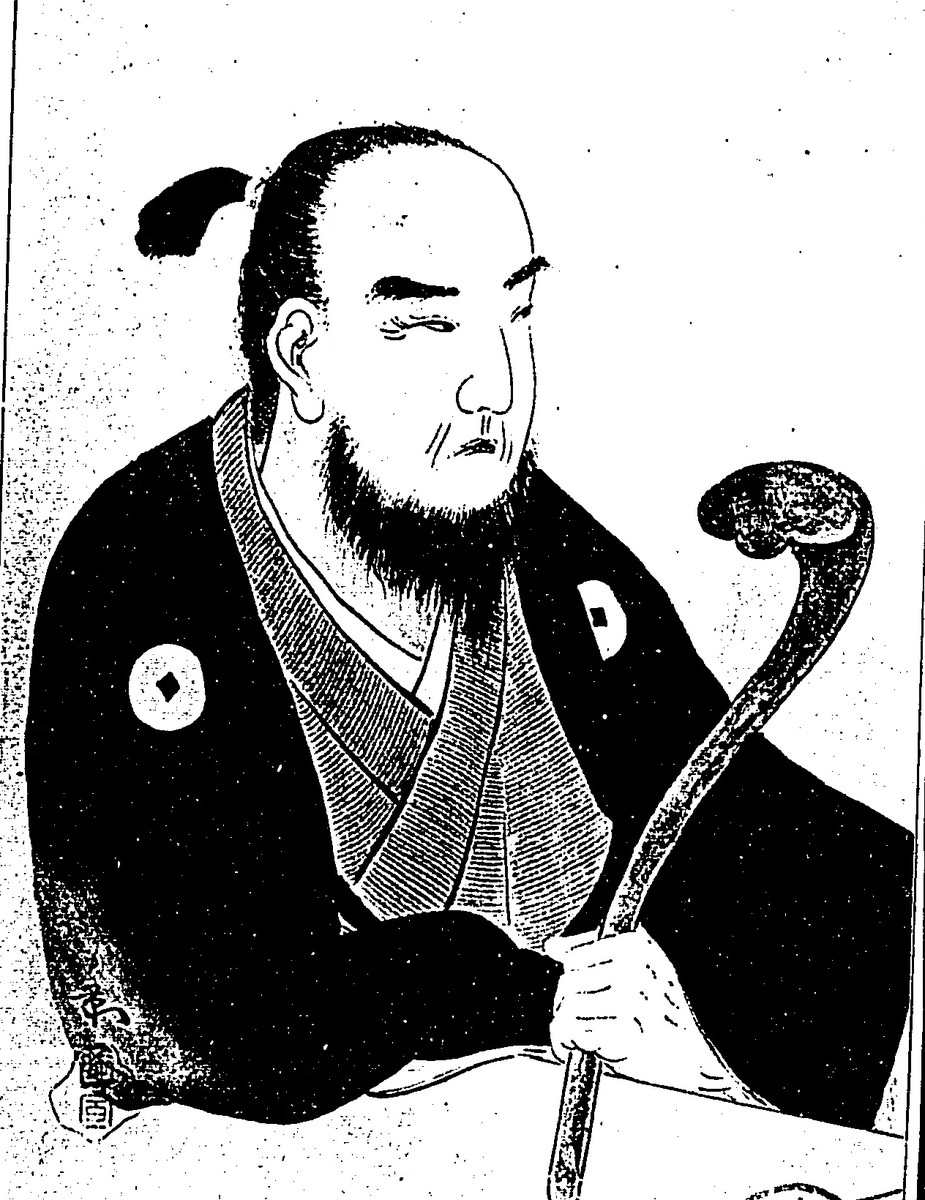
Anonymous illustration in Kakurin Yashi, Hiraga Gennai (Kobunkan, Tokyo, 1899); digitised by the National Diet Library, Japan (https://dl.ndl.go.jp/pid/888008) · Printed plate captioned 'Portrait of Hiraga Gennai' (Hiraga Gennai shozo) in Kakurin Yashi, Hiraga Gennai (Tokyo: Kobunkan, 1899), as digitised by the National Diet Library (NDL Digital Collections item 888008, IIIF canvas R0000003). It is a line-and-halftone print of a seated man in a dark robe holding a long curved fungus-shaped staff, with a small artist's seal at the lower left that cannot be read; the draughtsman is not named in the metadata. The scan of the book spread (3802 x 2929 pixels) carries library ownership stamps, which were left out by cropping to the picture only (1264 x 1640 pixels), then reduced to 925 x 1200 pixels; no upscaling, no retouching. · Public domain (National Diet Library item-level Public Domain Mark; a Japanese book published in 1899, before 1931)
inventor · Early Modern
Hiraga Gennai
1728–1780
Known For
Not yet included in personality matching — the documented evidence doesn't yet cover enough of the personality model. Everything else on this page is fully available.
Trait Constellation
Key Achievements
Edo-period herbalist from Sanuki who, with his teacher Tamura Ransui, held product fairs from 1757 (the 1762 fair drew over 1,300 items from more than 30 provinces) and compiled the six-volume Butsurui Hinshitsu in 1763.
He made fire-resistant cloth from asbestos, completed the repair of an imported electrostatic machine (the erekiteru) in 1776, which the IEEE honoured as a Milestone in 2025, and reportedly taught Western painting methods to Odano Naotake, whose circle became the Akita school.
He also wrote satirical fiction and a puppet play, but his Chichibu, Tada and Akita mining ventures failed and the authorities never recognised him; his friend Sugita Genpaku called him 'an extraordinary person'.
Moments That Reveal Them
With his teacher Tamura Ransui he held the first product fair in 1757 and five fairs in about six years; the 1762 fair drew over 1,300 items from more than 30 provinces, and he compiled 360 selected items into the Butsurui Hinshitsu (1763).
This is consistent with a person who organised and published collective work rather than only collecting for himself. Proactive Agency
He obtained a damaged imported electrostatic machine in Nagasaki about 1770 and finished repairing it in November 1776 after what he called seven years, with only fragmentary knowledge of static electricity, according to the IEEE proposers; copies were then shown as a healing device to the wealthy but found no patron.
This is consistent with long hands-on trial and repair of an imported device that went ahead of his theoretical understanding. Experimentation
Turning Points
In 1754 he left his post in the Takamatsu domain and in 1756 moved to Edo to study under Tamura Ransui, giving up a secure hereditary position for the life of a masterless retainer.
This is consistent with a willingness to trade a secure position for freedom to pursue his own studies, at a later cost in recognition and patronage. Risk Tolerance
Similar People
People whose overall profiles resemble theirs.

Wu Zetian

Leonardo da Vinci

Louis Pasteur

Gertrude Bell

Aung San Suu Kyi
Sources
- Hiraga Gennai (Q968242), verified live via the Wikidata API (2026-11-05): English label 'Hiraga Gennai', description 'Japanese pharmacologist and writer (1728-1780)', Korean label 히라가 겐나이, Japanese label 平賀源内, born 1728-01-01 (year precision), died 1780-01-24, citizenship Japan, several occupations. Orientation only; not used as support for any row.
- Kotobank (dictionary aggregator), entries 'Hiraga Gennai' from Shogakukan Daijisen, Nihon Kokugo Daijiten, Nipponica, Heibonsha's World Encyclopedia and Mypedia, Britannica Concise, Yamakawa's history dictionary, Nihon Jinmei Daijiten and Obunsha's history dictionary (Japanese), read in full. CANONICAL SIGNIFICANCE SOURCE: the reference works agree that he was an Edo-period herbalist (honzo scholar), inventor and comic writer from Sanuki who studied under Tamura Ransui, held product fairs from 1757 (the 1762 fair drew over 1,300 items from more than 30 provinces) and compiled the Butsurui Hinshitsu (1763), made fire-resistant asbestos cloth, a thermometer and a copy of the imported electrostatic machine (erekiteru, 1776), painted in Western style and taught it to Odano Naotake (the Akita school), and wrote satirical fiction and a puppet play; they also record that his Chichibu, Tada and Akita mining ventures failed (Heibonsha, Yamakawa: a 'mountebank' reputation), that the erekiteru found no patrons (Nipponica), that he sought but did not obtain an official post, that he was imprisoned in 1779 after a fatal incident and died there, and that the authorities never recognised him (Nipponica, Mypedia).
- National Diet Library, 'Nichiran' exhibition column on Hiraga Gennai (Japanese), read in full: the Library presents him as one aspect of how Dutch learning was absorbed, an entrepreneur and popular-fiction writer who tried to use Western knowledge for society at large; it records his product exhibitions with Tamura Ransui, the Butsurui Hinshitsu (1763, six volumes, 360 selected items with some Dutch names), the asbestos-cloth treatise (1765) and the restoration of the erekiteru, that he hardly understood Dutch but collected European natural-history illustrations and met the head of the Dutch trading post, that his insect pictures were copied by Shiba Kokan, that his enterprises were not understood by the public and his life deteriorated, and that his friend Sugita Genpaku called him 'an extraordinary person'.
- Agency for Cultural Affairs (Japan), Cultural Heritage Online, record 'Portrait of a Western Woman' (Seiyo Fujinzu, attributed to Hiraga Gennai; Kobe City Museum), read: calls him a theoretical leader of Western-style painting, records that in 1773 at the Ani copper mine in Akita he reportedly taught Western painting methods to Odano Naotake and Satake Shozan, calls this his only known oil painting while stating that the attribution is traditional and needs careful examination because no other works are confirmed as his, and summarises his career (domain medicine attendant, herbal medicine in Edo, product fairs, erekiteru and asbestos cloth, popular fiction).
- IEEE Milestones record 'Elekiteru: First Electrostatic Generator in Japan, 1776' (dedicated 22 March 2025 at the Hiraga Gennai Memorial Museum, Kagawa; ETHW wiki page, first 100,000 characters read, the last 37,000 not read): the citation and proposers' history say he obtained a damaged imported device in Nagasaki about 1770, probably from a Dutch interpreter, and completed the repair in November 1776 (he wrote 'seven years', the proposers adopt six), that his knowledge of static electricity was only fragmentary, that demonstrations inspired Japan's first generation of electricity researchers, and that the surviving devices are attributed to him through family lore; it flags its own limits (the proposers' own translations, calendar conversion, the 'first in Japan' claim resting on the literature consulted, internal inconsistencies). An engineering-society award body, so an admiring commemorative voice with candid caveats.
- Lapham's Quarterly, contributor profile 'Hiraga Gennai' (no author named), read: a short English magazine note that he gave up his samurai inheritance to become a masterless retainer, moved to Edo in 1756 for botanical research, engineering and satirical writing, was called the 'Japanese Da Vinci', felt his inventions went unrecognised, and killed a disciple and died in prison of tetanus a month later. Brief, popular and uncited; used only as a cross-check of the outline.
- National Diet Library Digital Collections, Kakurin Yashi, Hiraga Gennai (Tokyo: Kobunkan, 1899; item 888008), item-level Public Domain Mark in its IIIF manifest; the plate printed near the front of the book is captioned 'Portrait of Hiraga Gennai'. Opened for the portrait only; the book text was not read.