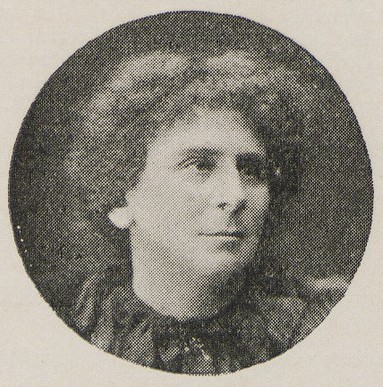
Photographer unknown, Mrs Ayrton, printed in the Who's Who of the International Congress of Women, London, 1899, Schlesinger Library, Harvard, public domain, via Wikimedia Commons · Studio photograph of Hertha Ayrton, reproduced as a small printed halftone in the 'Who's Who' album of the International Congress of Women, London, June 1899 (caption 'Mrs Ayrton'); photographer not named. The scan is from the Charlotte Perkins Gilman Papers, Schlesinger Library, Radcliffe Institute, Harvard University (Collection 177, folder 6), page about 2682 x 1828 pixels, and the Wikimedia Commons copy is a circular-portrait crop of that page, 383 x 387 pixels. The same pose, hair and brooch appear in a Library of Congress Bain News Service photograph of Hertha Ayrton, which is how the identification was checked. A printed publication of 1899 is in the public domain in the United States by age (published before 1931) and, with no named photographer, in the United Kingdom. The file is used at its original 383 x 387 size, with no resizing or upscaling. · Public domain (published in 1899)
Trait Constellation
Key Achievements
She worked out why electric arc lamps hissed and flickered, tracing the hissing to oxygen reaching the positive carbon, and related current, arc length and voltage in her 1899 paper and her book The Electric Arc (1902).
Her studies of sand ripples and water vortices led her to design a hand-held fan to clear poison gas from trenches in the First World War; after initial dismissal the War Office issued about 104,000.
She became the first woman member of the Institution of Electrical Engineers in 1899 and won the Royal Society's Hughes Medal in 1906, although the Society had declined to elect her a fellow as a married woman.
Moments That Reveal Them
Sharp describes her lecture experiments in which puffs of oxygen against the arc's crater produced the hissing while nitrogen did not.
This is consistent with an experimenter who isolated a cause by testing one gas at a time. Experimentation
Hirsch says the War Office dismissed her fan and acrimonious press exchanges followed until it issued 104,000, and Sharp describes a year's delay before the fans were used at the front.
This is consistent with an inventor who kept pressing a rejected idea through official resistance. Persistence
Turning Points
In 1893, while her husband was away in Chicago, she took over the electric-arc experiments, which became the research that established her reputation after earlier work on a line divider and other inventions.
This is consistent with a move from inventing instruments to sustained experimental research. Cross-Domain Range
Similar People
People whose overall profiles resemble theirs.


Emmy Noether

Abraham Lincoln

Pablo Picasso

Benjamin Franklin

Sequoyah
Opposite Profile
Not a rival — a different profile shape worth a look.
Theodore Roosevelt
Sources
- Hertha Ayrton (Q17522), verified live via the Wikidata API (2026-10-31): label 'Hertha Ayrton', description 'English electrical engineer (1854-1923)', born 28 April 1854, died 23 August 1923 (other sources give 26 August), citizenship United Kingdom, Korean label present. Orientation only; not used as support for any row.
- Marjorie Malley, 'Ayrton, Hertha', Complete Dictionary of Scientific Biography (Scribner, 2008), via Encyclopedia.com, read in full. CANONICAL SIGNIFICANCE SOURCE: engineer; education at Girton and Finsbury; her patented line divider; taking over the electric-arc research and relating power, potential, current and arc length; her analysis of the hissing arc as oxidation of the positive carbon; the 1899 reading of her paper at the Institution of Electrical Engineers and her election as its first woman member; The Electric Arc (1902); the sand-ripple vortex work and its application in the anti-gas fan, whose wide use was hindered; the 1906 Hughes Medal and the Royal Society's refusal to elect a married woman. Reference article by a historian of science.
- Pam Hirsch, 'Hertha Ayrton', Jewish Women: A Comprehensive Historical Encyclopedia (Jewish Women's Archive, 2009), read in full: family and schooling, Cambridge, the line divider and its patents, work on the arc, the first paper read by a woman at the Institution of Electrical Engineers, her 26 patents (five on dividers, 13 on arc lamps and electrodes, the rest on propelling air), the anti-gas fan that the War Office first dismissed before issuing 104,000, and the Royal Society's refusal of her fellowship in 1902. Scholarly encyclopedia entry by a Cambridge historian; it also describes suffrage campaigns, which are not scored.
- Evelyn Sharp, 'Hertha Ayrton, 1854-1923: A Memoir' (Edward Arnold, 1926), read through the Internet Archive text (about 625,000 characters searched, chapters on the arc, the 1902 Royal Society episode, the Hughes Medal and the Ayrton fan read closely): the gas experiments showing that oxygen reaching the crater causes the hissing, the Royal Society's 1902 letter on a married woman's certificate, the fan's rejection by the War Office advisers, the favourable Chatham report and the year of delay before use at the front. Biography by a friend and fellow campaigner, so admiring and partisan; letters quoted in it are the nearest thing to her own voice here.
- 'Hertha Ayrton', Grace's Guide to British Industrial History, read in full, including the two 1923 obituaries reproduced from the engineering press: timeline from 1884 to 1923, her demonstrated linear relation among arc length, pressure and potential difference, the 12 papers in The Electrician in 1895-6, the 1899 Institution of Electrical Engineers paper, the 1906 medal, and the over 100,000 anti-gas fans used on the western front. Volunteer-run industrial-history site reproducing contemporary obituaries; the obituaries are professional-press tributes.
- 'Hertha Ayrton', Wikipedia, read for orientation only (it cites the Oxford Dictionary of National Biography entry by Joan Mason, which was not opened); never counted as a research source.