Benjamin Franklin
93% Profile Match
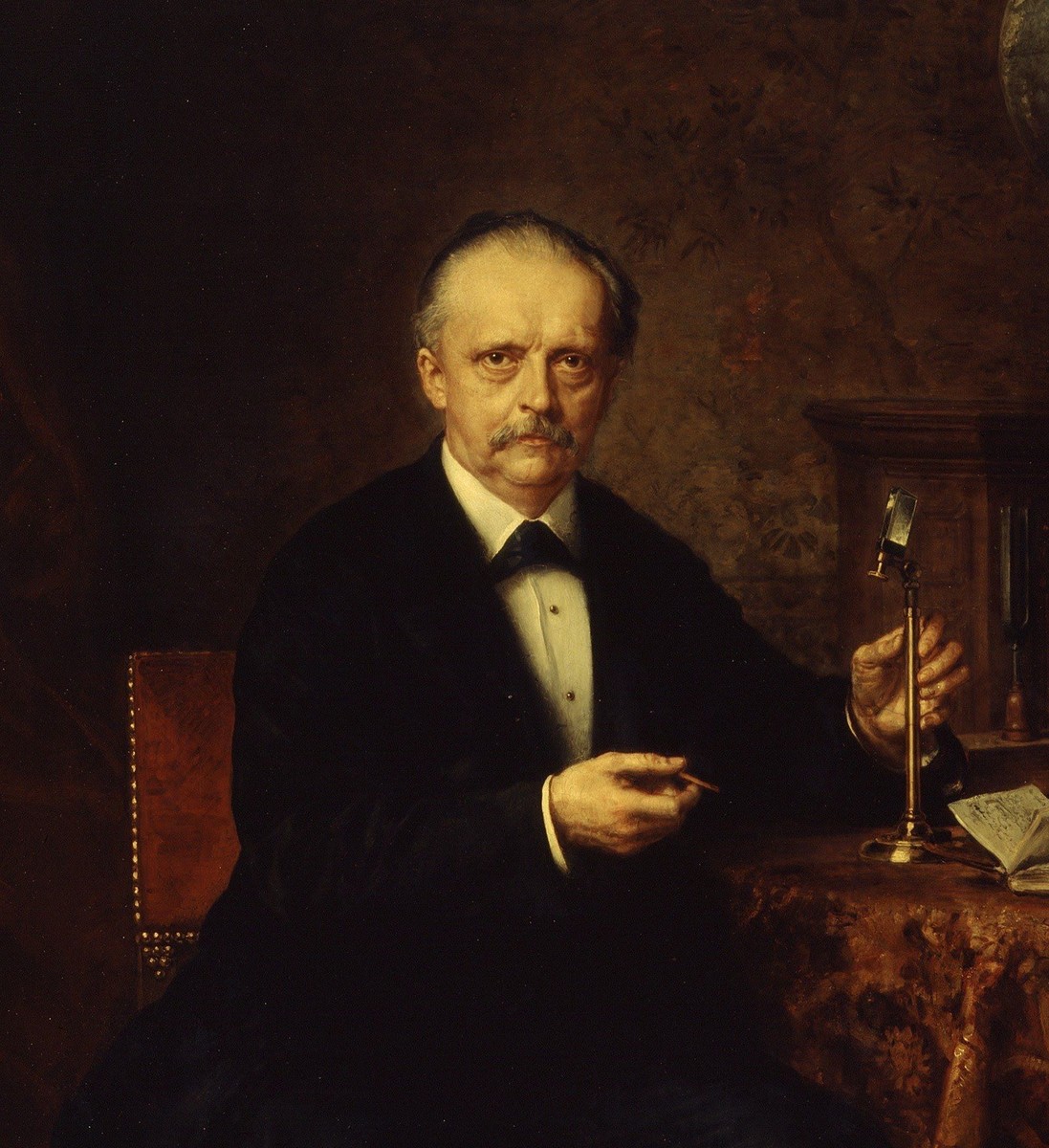
Ludwig Knaus, 'Der Physiker Hermann von Helmholtz', 1881, Alte Nationalgalerie, Staatliche Museen zu Berlin (A I 314); photograph credit Staatliche Museen zu Berlin / Andres Kilger, Public Domain Mark 1.0; the file is cropped and downscaled from the Google Art Project reproduction · Staatliche Museen zu Berlin, Alte Nationalgalerie, inventory A I 314 (ObjID obj:958941; https://id.smb.museum/object/958941): Ludwig Knaus (1829-1910), 'Der Physiker Hermann von Helmholtz', 1881, oil on panel, 120 x 85 cm, acquired 1881 by purchase after a commission for the National Gallery's portrait collection; the museum's photograph credit reads 'Staatliche Museen zu Berlin, Alte Nationalgalerie / Andres Kilger' with the Public Domain Mark 1.0. The file used is the Google Art Project reproduction on Wikimedia Commons ('Ludwig Knaus - Der Physiker Hermann von Helmholtz (1881).jpg', 2311 x 3303 pixels), cropped to the upper body (1600 x 1750 pixels at original scale) and then downscaled once to 1097 x 1200; never upscaled. Rights: the painter died in 1910, the painting is a commissioned portrait of the living sitter, and the museum's own record states the Public Domain Mark; no conflicting copyright notice was found on its page. It shows him seated in evening dress with an optical instrument in his hand (the museum says he is explaining the ophthalmoscope) and optical and acoustic apparatus on the table beside him. · Public Domain Mark 1.0 (Staatliche Museen zu Berlin; painter Ludwig Knaus died 1910)
physicist · 19th Century
1821–1894
Not yet included in personality matching — the documented evidence doesn't yet cover enough of the personality model. Everything else on this page is fully available.
In July 1847, while still a Prussian army surgeon, Helmholtz read his memoir 'Über die Erhaltung der Kraft' to the Berlin Physical Society, setting out the mathematical principles of the conservation of energy. Poggendorff declined to print it in his Annalen der Physik und Chemie as not experimental enough, so it appeared as a separate pamphlet; Helmholtz later credited Robert Mayer with having stated the principle earlier.
In 1850-51 Helmholtz built the ophthalmoscope, which let doctors see the living retina, and in the following years he laid the experimental foundations of the physiology of vision and hearing in his three-volume Handbuch der physiologischen Optik (1856-67) and Die Lehre von den Tonempfindungen (1862-63). They contain his doctrine of unconscious inference in perception, his theory of pitch perception and his account of vowel quality, and a social-sciences encyclopedia says that posterity sees sensory physiology and psychology as his most significant contributions.
Alongside the physiology, Helmholtz did major work in physics: a 1858 paper on the hydrodynamics of vortex motion, a critical survey of competing electrodynamic theories after he took the Berlin chair of physics in 1871, which the Dictionary of Scientific Biography says first brought Maxwell's field theory to Continental physicists and inspired his pupil Heinrich Hertz, and an 1882 memoir distinguishing free from bound energy in chemical reactions. In the late 1880s he became president of the newly founded Physikalisch-Technische Reichsanstalt.
In late 1850, preparing a lecture on Brücke's finding that animal eyes shine with reflected light, Helmholtz asked what image the reflected rays form, and built an instrument from spectacle lenses and microscope cover-glasses to find out. It was very hard to use, and he said later that he might not have persevered without his conviction that it must succeed; after about eight days he saw a living human retina. On 17 December 1850 he wrote to his father that the idea was so obvious that it seemed almost ludicrous that he and others had been so slow to see it.
This is consistent with persistence in getting a new instrument to work, though the account is largely Helmholtz's own words and his biographer notes that the invention was less simple than he made it sound. Persistence
In 1852 Helmholtz's colour experiments led him to reject Newton's account of complementary colours, and he revived Thomas Young's three-receptor theory only to refute it. Grassmann attacked the first conclusion at once; in 1855 Helmholtz acknowledged the experimental error and announced new experiments giving the complementary colours that Newton's theory requires, and by 1858 he had become the foremost advocate of Young's theory, amended to meet his own earlier objections.
This is consistent with a researcher who corrected his own published conclusions, though the account comes from one dictionary entry and a later reviewer says other leading scientists' opinions rarely altered his own. Belief Updating
By 1866 Helmholtz had finished his great treatises on sensory physiology and was thinking of leaving physiology for physics; in 1868 he wrote that physiology had grown too great for any individual to encompass, while German physics lacked well-trained young recruits. When the Berlin chair of physics fell vacant in 1870 he accepted it in early 1871, once the building of a new physics institute was promised, and in Berlin he turned to electrodynamics, thermochemistry and, later, the principle of least action.
This is consistent with a researcher who changed fields when he judged the old one too large for one mind and the new one short of recruits, though the sources know his reasons mainly from his own 1868 statement. Cross-Domain Range
People whose overall profiles resemble theirs.



Not a rival — a different profile shape worth a look.