Marie Curie
88% Profile Match
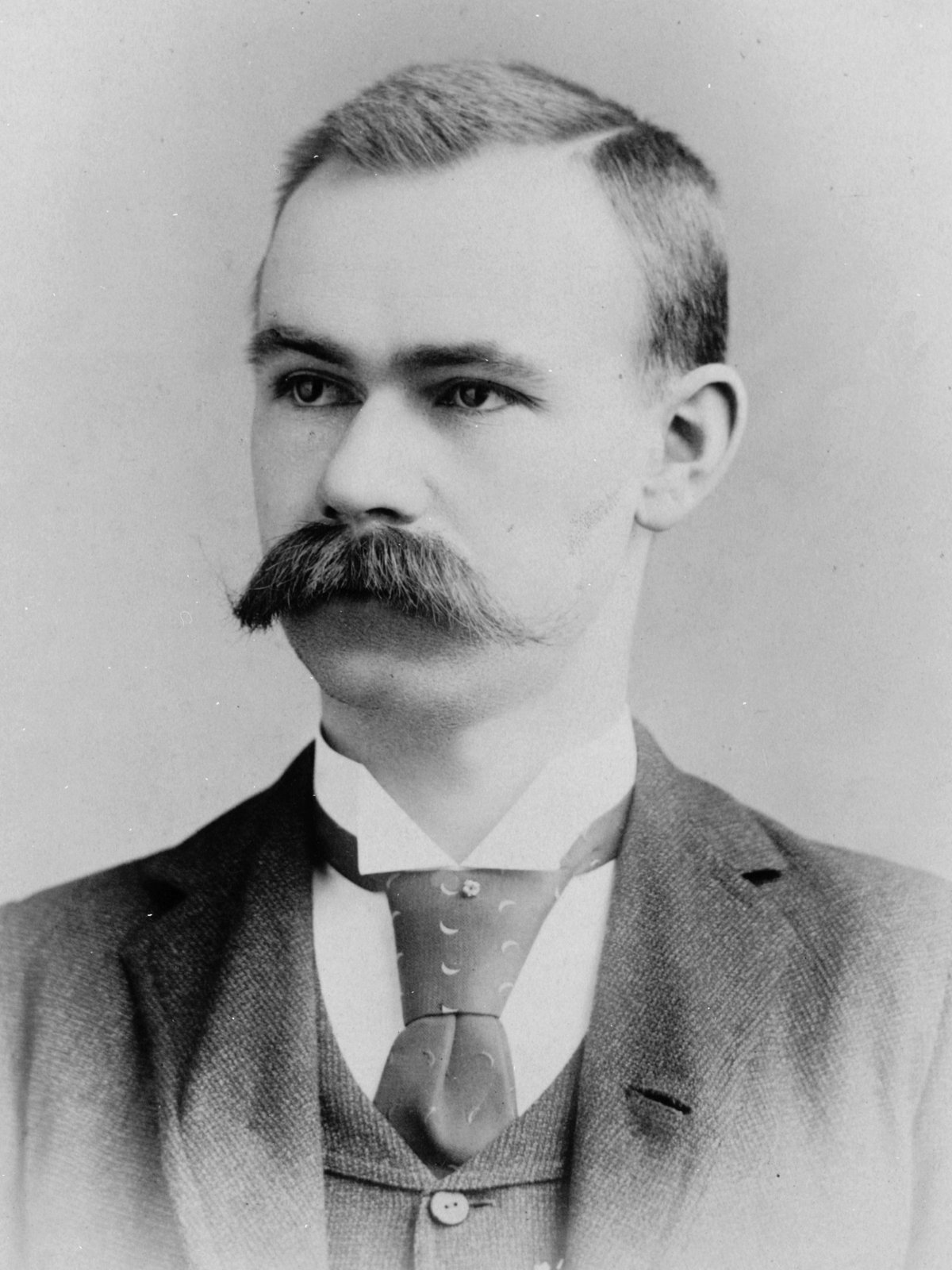
C. M. Bell (Charles Milton Bell, approximately 1849-1893), '[Herman Hollerith, head-and-shoulders portrait, facing left]', cabinet card photograph, ca. 1888, Washington, D.C.; Library of Congress Prints and Photographs Division (LC-USZ62-115982), no restriction recorded · Library of Congress Prints and Photographs Division, LOT 12259 (LC-USZ62-115982; hdl.loc.gov/loc.pnp/cph.3c15982), via Wikimedia Commons 'Hollerith.jpg' (cropped to the photograph) · Public domain
Hollerith devised an electric tabulating system in which each person's census details were recorded as holes in a card and counted by an electrically operated machine; his first patent application was filed in September 1884 and the patents issued in January 1889. In the 1889 test on St. Louis census districts his method needed 5 hours 28 minutes to tabulate, against 55 hours 22 minutes for the Hunt method and 44 hours 41 minutes for the Pidgin method, and the Census Office adopted it. In 1890 the first count of the whole US population took a little over six weeks, and a preliminary total was announced on 28 October 1890.
In 1896 Hollerith incorporated the Tabulating Machine Company and won an order to supply machines for Russia's first national census (1897). An Austrian workshop had been licensed to build his system for the 1890 Austrian census, Norway and France also used it, the New York Central railroad became a commercial customer from 1897, and the US Census rented his machines again in 1900. In 1911 he and his directors sold the company to the merger that formed the Computing-Tabulating-Recording Company, renamed International Business Machines (IBM) in 1924; he stayed on as a consulting engineer.
From 1902 Hollerith redesigned his equipment for business customers. By 1907 his second system combined a keyboard punch, a sorter and an adding tabulator, with plugboard programming and an automatic card reader, around a 45-column card; a later 80-column card became the standard IBM card. His engineering collaborator Eugene Ford of the Taft-Peirce company played a key part in the keyboard punch design.
In 1895 the New York Central railroad dropped its trial of Hollerith's adding tabulator because the machine was unreliable. Within a few months he devised a new adding tabulator for the same job; it was accepted after a second trial, and the railroad became a customer from 1897.
Returning with a redesigned machine after a failed trial, rather than leaving the customer, is consistent with persistence; the account rests on one scholar's reading of archival letters. Persistence
In 1894 Hollerith offered the Norwegian statistical office a tabulator free for testing and travelled to Norway to assemble it himself. After a positive test the office bought it the following year for $1,100, and it was used for Norway's 1900 census.
Taking a free machine abroad and installing it himself, before any order existed, is consistent with proactive agency. Proactive Agency
For the 1904-05 year the Census Bureau obtained a lower rental rate; Hollerith opposed the concession but his directors overruled him. In 1905 the Bureau obtained funds to develop its own tabulating machinery, based on his early patents that would expire in 1906. When it refused his condition that the government do no experimental work on tabulating machines, it sent back the rented machines, and his company did not supply the Census Bureau again until the late 1920s.
Making the contract conditional on the customer not experimenting on its own is consistent with a strong need to keep control of his design; Truesdell's Census Bureau history itself calls the Bureau's rates 'excessive and exorbitant', so the dispute had two sides. Need for Autonomy
People whose overall profiles resemble theirs.




Not a rival — a different profile shape worth a look.